Ultimate Guide to Payment Compliance in iGaming
Ultimate Guide to Payment Compliance in iGaming
Payment compliance in the iGaming industry is a complex but necessary aspect of running a successful operation. Here's what you need to know:
- High Stakes: In 2024, gambling fines reached €135.6 million, with many operators facing penalties over $1 million due to weak compliance frameworks.
- Chargeback Risks: iGaming chargeback rates are 2–4%, significantly higher than standard e-commerce. Visa’s new 2026 rules lowered the "Excessive" dispute threshold to 1.5%, with steep penalties for violations.
- Cost Implications: Non-compliance leads to high fees, chargeback costs ($25–$100 per case), and rolling reserves (5–10% of transaction volume held for 90–180 days).
- Jurisdictional Complexity: Operators must navigate over 100 different regulatory frameworks, including credit card bans in regions like the UK, Australia, and Brazil (as of April 2026).
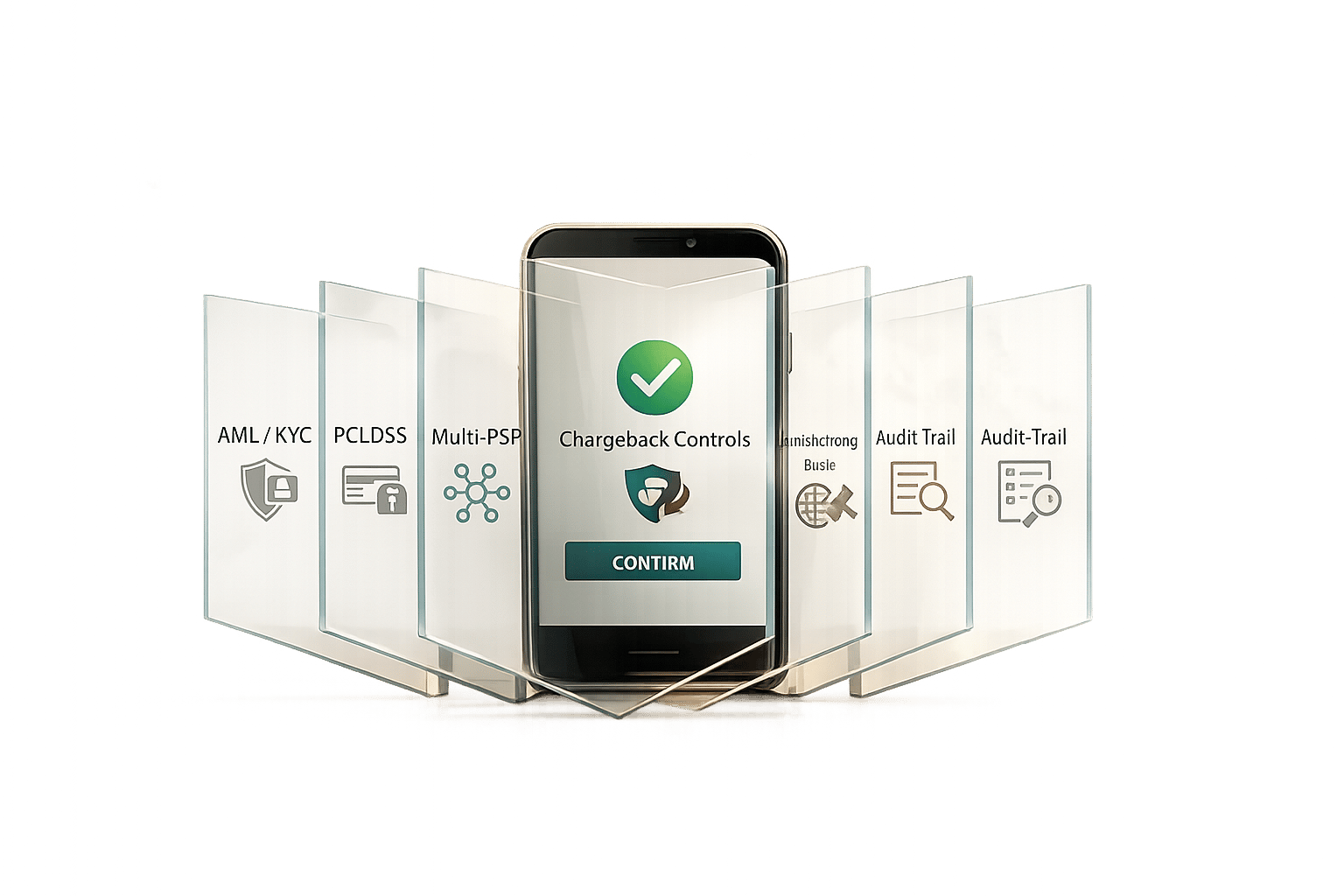
- Key Frameworks: Compliance relies on AML/CFT protocols, KYC standards, and PCI-DSS requirements, which are mandatory for fraud prevention and maintaining licenses.
- Operational Challenges: High card decline rates (20–40%) and evolving regulations, such as mandatory KYC verification before deposits, make compliance an ongoing challenge.
Quick Overview of Key Points:
| Aspect | Details |
|---|---|
| Fines | €135.6M in 2024; $1M+ penalties for many operators in 2023 |
| Chargeback Threshold | Visa’s 2026 limit: 1.5% dispute rate, $50 fine per breach |
| KYC Timing | Verification now required before deposits in many regions |
| Jurisdictions | 100+ frameworks; credit card bans in UK, Australia, Brazil (2026) |
| Costs | High-risk fees: 2.5–7%; chargebacks: $25–$100; reserves: 5–10% |
Payment compliance is not optional - it’s a critical requirement to avoid fines, protect revenue, and maintain operational stability. The article delves into the challenges, regulatory frameworks, and strategies to set up a compliant payment system in iGaming.
::: @figure 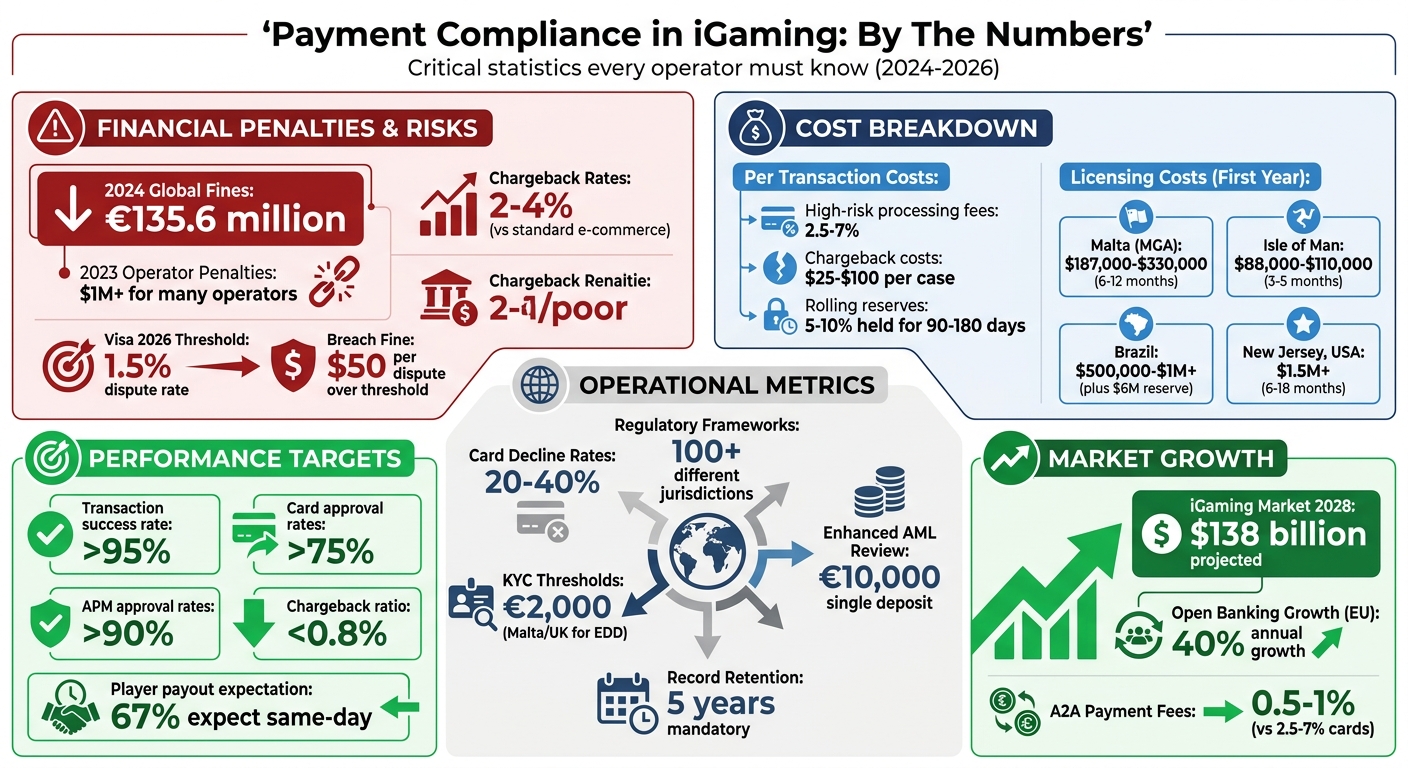 {iGaming Payment Compliance: Key Statistics and Cost Breakdown 2024-2026}
Banking in iGaming Best Practices for iGaming Operators 1080P
sbb-itb-ba142f6
Core Regulatory Frameworks for Payment Compliance
Three key frameworks form the backbone of payment compliance in iGaming: AML/CFT protocols, KYC standards, and PCI-DSS requirements. Together, they establish a comprehensive system for ensuring compliance.
AML and CFT Requirements
Anti-Money Laundering (AML) and Countering the Financing of Terrorism (CFT) regulations rely on a multi-layered approach to prevent illegal activities. Operators are required to verify players using documents like passports and biometrics, monitor transactions for unusual patterns, and employ AI tools to assess potential risks.
Enhanced Due Diligence (EDD) is triggered when deposit thresholds are surpassed. For instance, the Malta Gaming Authority enforces EDD when deposits exceed €2,000, while the UK Gambling Commission applies the same threshold at £2,000 [1]. At this stage, operators must verify the origin of funds, often by reviewing bank statements or payslips. Additionally, any single deposit exceeding €10,000 automatically prompts an enhanced AML review and may require filing a Suspicious Activity Report (SAR) [1].
Transaction monitoring is crucial for identifying red flags like minimal play schemes, chip dumping, or structured deposits designed to avoid detection [8]. If a customer's behavior deviates significantly from their usual gambling patterns, operators are obligated to file SARs with Financial Intelligence Units (FIUs). Records of customer identification, transaction logs, and SARs must be retained for five years [1].
Even when using a Payment Service Provider (PSP), operators remain fully accountable for maintaining KYC records, monitoring AML compliance, and filing SARs.
AML protocols seamlessly integrate with KYC standards, creating a stronger compliance framework.
KYC and Identity Verification Standards
KYC (Know Your Customer) standards are an essential part of compliance, especially before deposits are made. These protocols follow a tiered system:
- Basic verification: Email and IP address checks.
- Intermediate verification: Identity document checks.
- High-level verification: Assessment of income and bank statements [3].
The trend in the industry has shifted to require KYC verification before the first deposit, rather than at the withdrawal stage [1].
A Risk-Based Approach (RBA) is recommended to classify players by their risk levels [8]. This approach allows operators to allocate resources effectively, focusing on high-risk players, such as high-rollers and Politically Exposed Persons (PEPs), who require more scrutiny and senior management approval [1][8]. For example, in the UK, a net loss of £125 per month now triggers a mandatory financial vulnerability check [1].
Automating the KYC process using API integration can reduce friction for players while ensuring compliance with pre-deposit verification requirements.
PCI-DSS and Data Security Standards
Building on identity verification, PCI-DSS ensures the security of card data through strict security measures. This framework is critical for safeguarding sensitive card information during storage, processing, and transmission.
The Payment Card Industry Data Security Standard (PCI-DSS) became mandatory under its updated version, PCI DSS 4.0, on March 31, 2024. This version introduces over 500 security controls, emphasizing a customized, risk-based approach [9].
Compliance requirements depend on annual transaction volume:
| PCI DSS Level | Annual Transactions | Requirements |
|---|---|---|
| Level 1 | > 6 million | On-site QSA audit, annual ROC |
| Level 2 | 1–6 million | Annual SAQ, quarterly scan |
| Level 3 | 20,000–1 million | Annual SAQ, quarterly scan |
| Level 4 | < 20,000 | Annual SAQ (self-assessment) |
Using a hosted payment page from your PSP can significantly reduce the PCI-DSS compliance burden. For example, this setup qualifies operators for SAQ-A, which involves answering only 22 questions, compared to the 329 required for SAQ-D (applicable when operators store or process card data themselves) [1].
Additionally, PCI DSS Requirement 6.4.3 mandates that critical vulnerabilities must be patched within one month [9]. To further enhance security, many operators are now adopting tokenization, replacing card numbers with non-sensitive tokens that cannot be exploited [9].
Setting Up a Compliant Payment Processing System
Once regulatory protocols are in place, the next step for iGaming operators is setting up a payment system that meets compliance standards. A well-structured payment infrastructure is essential for smooth operations and to avoid disruptions caused by regulatory or provider issues.
The process begins with selecting the right payment partners. Popular processors like Stripe and PayPal don’t allow gambling-related transactions (MCC 7995), so operators need to work with specialized high-risk Payment Service Providers (PSPs) [10][2]. Relying on just one provider is risky - account termination could bring your payment operations to a standstill.
"If your single processor terminates your account - which will happen at some point - your casino stops taking payments. This is an existential risk."
- iGamingHub Editorial [4]
To mitigate this, a dual acquirer setup is the minimum recommendation. Having at least two active processor relationships ensures that payments can continue if one provider terminates the account [2]. For operators expanding into multiple markets, a payment orchestrator is an even better solution. This technology integrates multiple acquirers through a single API, offering benefits like smart routing to boost approval rates, automatic failover, and support for local payment methods [10][11].
Your system should also be modular. Separate components for fraud detection, currency conversion, and transaction tracking allow for easier updates when regulations change [11]. Key elements include automated KYC/AML tools, PCI-DSS compliant data handling through tokenization, and responsible gambling features like deposit limits and self-exclusion tools [1][10]. For operators under the Malta Gaming Authority (MGA), funds must be routed into segregated accounts to separate player funds from operational funds [12].
Infrastructure and Multi-PSP Integration
Beyond choosing the right partners, compliance controls must be embedded into the payment infrastructure. For example, BIN-level blocking is essential to enforce credit card bans in jurisdictions like the UK, Australia, and Brazil (which banned credit card gambling in April 2026) [1]. Additionally, implementing 3D Secure (3DS) meets EU PSD2/SCA requirements while shifting liability [2][12]. Neutral billing descriptors with customer service numbers can also help reduce disputes based on buyer’s remorse [2].
Chargeback management is another critical area. Tools like Verifi CDRN or Ethoca can intercept disputes before they escalate into formal chargebacks, potentially preventing 20–40% of these events [2]. This is especially important given Visa’s updated Acquirer Monitoring Program (VAMP), which as of April 1, 2026, lowered the "Excessive" threshold to 1.5% and introduced fines of $50 per dispute for merchants exceeding this limit [2]. Additionally, your system must log every payment decision with timestamps and reasons, retaining records for at least five years to meet audit requirements [1][12].
Card fees are generally higher than those for e-wallets, which can affect revenue [4]. Open banking and account-to-account (A2A) payments are gaining traction in the EU, with a 40% annual growth rate, thanks to lower fees (0.5–1%) and zero chargeback risk [10]. High-risk acquirers often require a rolling reserve, typically 5–10% of transactions held for 90–180 days [10][2].
"A 3% rate with 85% approval beats 2% with 60% approval. Do the math on actual revenue."
- iGaming Payment Solutions [10]
These measures lay the groundwork for compliance and operational stability.
Testing and Validation Before Launch
Before going live, test all payment options in a sandbox environment across the regions and currencies you plan to target. Simulate both common and edge-case scenarios, and document the results for future audits [12]. Aim for a transaction success rate above 95% [13], with card approval rates over 75% and alternative payment method (APM) approval rates exceeding 90% [10]. Keep chargeback ratios below 0.8%, as rates approaching 1% can trigger compliance issues [10].
A phased rollout is a smart way to launch. Start with a limited user group to monitor approval rates, processing times, and system performance under real-world conditions. This step is critical because one-third of bettors abandon platforms with slow deposit processing, making latency testing essential [14]. Additionally, ensure withdrawal times meet expectations - 67% of players now expect same-day payouts, with a maximum wait time of 24 hours [10]. This phase helps identify integration issues that might not appear in sandbox testing and allows for routing logic adjustments before scaling up.
Jurisdictional Variations in Compliance
Layered compliance involves juggling multiple standards, but regional differences make it even more challenging. Payment compliance shifts based on where players are located and where operators are licensed. For example, the EU leans toward a unified framework with directives like PSD2 and AMLD6, while the US regulatory landscape is fragmented, with each state deciding its own rules [16]. This means operators must manage four layers of compliance: global standards (like PCI DSS), license-specific rules from regulators like the MGA or UKGC, jurisdiction-specific requirements, and restrictions set by payment service providers (PSPs) [1].
"Europe represents a mature, highly regulated, and fragmented environment, whereas North America is scaling up fast, driven by fresh legislation and investment."
- Tatiana Martins, Journalist, G&M News [16]
In the US, geofencing is critical. Payment systems must confirm in real time that players are within state borders before processing transactions [1]. Meanwhile, EU compliance emphasizes Strong Customer Authentication (SCA) and 3D Secure (3DS) under PSD2 [1]. KYC (Know Your Customer) requirements also vary significantly. US states typically require verification before deposits, whereas some EU jurisdictions historically triggered verification only after deposits reached €2,000 - a practice now evolving [1]. Additional restrictions include credit card bans in certain regions, such as Pennsylvania in the US, while similar bans are more widespread in Europe [3]. These differences demand market-specific compliance strategies.
Compliance in Malta and the EU
Malta serves as a prime example of tailored compliance in Europe. The iGaming sector contributes 12% to the nation’s GDP, making it a critical industry [13]. The Malta Gaming Authority (MGA) enforces compliance through several directives. Directive 3 focuses on AML/CFT (Anti-Money Laundering/Counter Financing of Terrorism), Directive 6 ensures player fund segregation, and Directive 8 emphasizes social responsibility [17][12]. Operators must physically segregate player funds into EU bank accounts with specific naming conventions, not just separate them on paper [17]. Enhanced Due Diligence (EDD) is triggered when deposits exceed €2,000, and operators are required to display reality check pop-ups every 30 minutes [1][17].
EU-wide rules add more layers. PSD2 mandates SCA for transactions over €30, though operators can reduce friction for low-risk payments using Transaction Risk Analysis (TRA) [12]. The upcoming PSD3 will extend open banking rules and tighten fraud prevention [7]. Operators must also integrate with national self-exclusion systems like GAMSTOP in the UK, OASIS in Germany, CRUKS in the Netherlands, and Spelpaus in Sweden [1]. Germany imposes a strict €1,000 monthly deposit cap, while the UK requires affordability checks for players losing more than £125 per month [1].
| Feature | Malta (MGA) | Germany | United Kingdom (UKGC) |
|---|---|---|---|
| KYC Timing | Before withdrawal (tightening) | Before first deposit | Before first deposit |
| Credit Card Use | Generally allowed | Restricted via deposit caps | Strictly banned |
| Deposit Limits | Player self-imposed | Mandatory €1,000/month cap | Self-imposed + affordability checks |
| Special Systems | Segregated player accounts | OASIS register integration | GAMSTOP integration |
The MGA charges an annual license fee of approximately $27,000 (€25,000), with non-tax compliance costs for mid-size operators ranging between $130,000 and $187,000 annually [17]. Financial reporting must align with IFRS standards, which can be a hurdle for US-based operators accustomed to US GAAP [17].
United States-Specific Compliance Requirements
Unlike Europe’s harmonized approach, the US follows a patchwork model. Currently, 39 states allow sports betting, but only 7 permit full iGaming (online casinos) [16]. Each state has its own licensing framework, regulatory body, and compliance requirements. For instance, operators in New Jersey face entirely different rules than those in Pennsylvania or Michigan. Tax rates also vary widely - New York imposes a 51% tax on online sports betting revenue, while New Jersey’s rates are between 13% and 15% [16].
Geofencing is non-negotiable in the US. Payment systems must verify player location in real time, ensuring transactions are processed only within licensed states [1]. Many states also require servers to be located within their borders and mandate identity verification before the first deposit, unlike Malta’s threshold-based KYC [7][1]. Credit card use is generally permitted, though some states, like Pennsylvania, have adopted bans similar to those in parts of Europe [3].
"The gambling industry faces unique challenges standard e-commerce solutions can't handle. Restrictive merchant category codes trigger automatic declines."
- Pranav Khanna, Payment Processing Specialist [7]
Payment preferences also differ. While European players favor e-wallets and SEPA transfers, US players tend to use ACH (pay-by-bank) systems and debit cards [7]. Operators must maintain audit trails for at least five years and report suspicious activities to state-specific agencies rather than centralized Financial Intelligence Units [15]. The fragmented US system requires operators to craft state-specific compliance strategies, adding significant complexity.
The Role of Licensing in Payment Compliance
A strong licensing framework is at the heart of maintaining payment compliance within the iGaming industry.
Licensing as a Foundation for Compliance
A gaming license is more than just a formality - it’s a gateway to the financial tools operators need to run their businesses. Without a valid license, companies can’t set up corporate bank accounts, onboard payment providers, or process transactions [26,27]. Valeriy Stalirov, CEO of Stalirov&Co, highlights this critical point:
"Without a proper gaming license, you can't open a bank account, onboard a payment processor, sign with affiliates, or even run ads on most platforms"
- Valeriy Stalirov, CEO of Stalirov&Co [18]
Jurisdictions like Malta, the UK, and the Isle of Man are considered top-tier by financial institutions. Their licensing processes require rigorous audits and reporting, which help reassure banks and acquirers of an operator’s credibility [18]. Before granting licenses, regulators often demand independent technical audits by labs like GLI or BMM. These audits ensure fairness in wallet logic, transaction reporting, and system reliability [18]. Additionally, regulators scrutinize the "source of funds" for shareholders and require proof of sufficient capital to cover player balances and liabilities [27,4].
The financial and time commitments for licensing vary widely depending on the jurisdiction. For instance:
- Malta: Licensing through the Malta Gaming Authority (MGA) costs between $187,000 and $330,000 in the first year and takes 6–12 months to complete [18].
- Isle of Man: Costs range from $88,000 to $110,000, with a timeline of 3–5 months [18].
- Brazil: Operators face fees between $500,000 and over $1 million, plus a statutory reserve of approximately $6 million [18].
- United States (New Jersey): Licensing can exceed $1.5 million and may take anywhere from 6 to 18 months [18].
These expenses reflect not only the cost of obtaining the license but also the ongoing commitment to maintaining compliance. As Valeriy Stalirov points out:
"Getting the license is only the starting point. Once you're approved, regulators expect you to maintain the same standards you showed during the application"
- Valeriy Stalirov, CEO of Stalirov&Co [18]
Given the complexity and cost, acquiring an existing license can often be a more efficient option.
License Transfer Support with MyReadyMade

Purchasing a licensed operator can significantly speed up entry into markets where obtaining a new license might take up to a year [26,32]. However, transferring a license isn’t a simple process - it requires regulatory approval of the new ownership and thorough due diligence to ensure the buyer meets compliance standards [19]. As the Rapidpace team explains:
"Most reputable payment gateways will only work with licensed casinos. Without a valid license, it's difficult - if not impossible - to offer credit card payments, crypto wallets, or bank transfers"
- Rapidpace team [19]
This is where MyReadyMade (https://myreadymade.com) comes in. Specializing in license transitions across more than 50 jurisdictions, the platform provides expert M&A advisory and license transfer services. Key features include:
- Verified business listings with NDA-protected communications
- 24/7 deal support
- An average transaction close time of 30–45 days
For buyers, this means immediate access to compliant payment systems without the lengthy wait for new applications in regions like Malta or Greece [26,32]. For sellers, transferring an existing licensed operation ensures smoother transitions, avoiding disruptions like frozen accounts or terminated payment processor relationships during regulatory reviews [33,34]. By simplifying the license transfer process, MyReadyMade helps operators maintain seamless payment compliance.
Conclusion
Staying compliant with payment regulations in the iGaming industry demands constant vigilance. Regulatory updates can quickly render previous compliance efforts outdated, leaving operators vulnerable to hefty fines. In 2024 alone, global gambling penalties reached a staggering €135.6 million [1].
The focus of regulatory scrutiny has shifted heavily toward payment systems. Card networks, for instance, have tightened their thresholds - VAMP reduced its "Excessive" merchant threshold to 1.5%, imposing $50 fines for each breach [2]. Meanwhile, key markets like the UK and Germany now enforce strict Know Your Customer (KYC) protocols, requiring full identity verification before players can deposit funds [20]. As the Financial Action Task Force highlighted in its 2024 report:
"iGaming is global; regulation is stubbornly local." - Financial Action Task Force, 2024 report [6]
In this challenging regulatory environment, operators must take proactive steps to safeguard their operations. Strategies include partnering with at least three active payment processors, leveraging pre-dispute alert services, diversifying 20–30% of deposit methods (such as open banking or cryptocurrency), and ensuring access to banking through valid licensing [4][2].
As the iGaming market is projected to surpass $138 billion by 2028 [6], operators who can quickly adapt to these evolving regulations will be best positioned to seize growth opportunities. Or, as PayRam Insights aptly puts it:
"In this regulatory thunderdome, survival isn't about being the biggest - it's about being the most adaptable." - PayRam Insights [5]
Building a robust payment compliance framework is not just a regulatory necessity - it’s the foundation for long-term operational resilience in a rapidly shifting landscape.
FAQs
What should my payment compliance roadmap include for a new iGaming launch?
A solid payment compliance plan for launching a new iGaming platform needs to address several critical areas. Start by focusing on jurisdiction-specific requirements, such as the product's scope and reporting obligations. Next, implement internal controls like audit trails and timestamps to ensure transparency and accountability. Finally, adhere to regulatory standards, including Know Your Customer (KYC), Anti-Money Laundering (AML) measures, and responsible gambling protocols.
It's essential to comply with regional payment regulations and align your operations with licensing authorities like the Malta Gaming Authority (MGA) or the UK Gambling Commission (UKGC). Additionally, adopt adaptable policies to remain responsive to any legal changes. Make sure to follow PCI DSS standards for secure payment processing and select payment gateways that can keep up with shifting regulatory landscapes.
How can I lower card declines without increasing AML/KYC risk?
To cut down on card declines in iGaming while staying compliant with AML/KYC regulations, it's essential to refine payment strategies. Techniques like smart routing and retry mechanisms can significantly improve approval rates. Partnering with local acquiring banks that understand specific regional rules can also make a big difference in boosting approvals.
Another key area to address is 3DS authentication. Simplifying this process can help reduce declines linked to security checks, all while keeping compliance strong and minimizing risks tied to verification procedures.
What’s the quickest way to secure a license so I can onboard PSPs and banking?
To get a license quickly for onboarding PSPs and banking, it’s smart to target jurisdictions known for their efficient processes, such as Curaçao or Malta. Make sure your application is thorough, complies with all regulations, and includes every required document. Working with licensing consultants or legal experts who understand the specific jurisdiction can streamline the process, help avoid delays, and ensure everything is handled correctly.
Related Articles

KYC vs. AML for Payment Processors: What to Know
KYC confirms identity at onboarding, but only continuous AML monitoring stops payment processors from becoming conduits for financial crime.

Checklist for Secure Player Database Transfers
Step-by-step checklist for secure player database transfers: compliance, encryption, vendor vetting, zero-trust, integrity checks, and audits.

How Forex Firms Adapt to Regional Preferences
Localize platform features, payments, compliance, and marketing to boost trust and conversions in each Forex market.
Looking to Buy or Sell?
Get in touch with our team for personalized assistance