Checklist for Secure Player Database Transfers

Checklist for Secure Player Database Transfers
Transferring player databases is risky and requires strict security and compliance measures. Mishandling can lead to fines (up to 4% of global turnover under GDPR), data breaches, and reputational damage. This guide outlines key steps to ensure safe and lawful transfers:
- Understand Regulations: Know if you're a data controller or processor. Use frameworks like GDPR's SCCs or the EU-U.S. Data Privacy Framework for cross-border transfers.
- Classify Data: Inventory and categorize data (e.g., PII, financial, health) to apply the right safeguards.
- Ensure Encryption: Use AES-256 for storage and TLS 1.3 for transfers. Manage encryption keys securely.
- Vet Vendors: Select vendors with certifications like SOC 2 or ISO 27001. Review contracts for compliance terms.
- Secure Transfer Protocols: Use SFTP, FTPS, or HTTPS with strong encryption standards.
- Post-Transfer Validation: Verify data integrity, maintain audit trails, and conduct compliance audits.
Following these steps reduces risks and ensures compliance with privacy laws like GDPR, HIPAA, and CCPA.
::: @figure 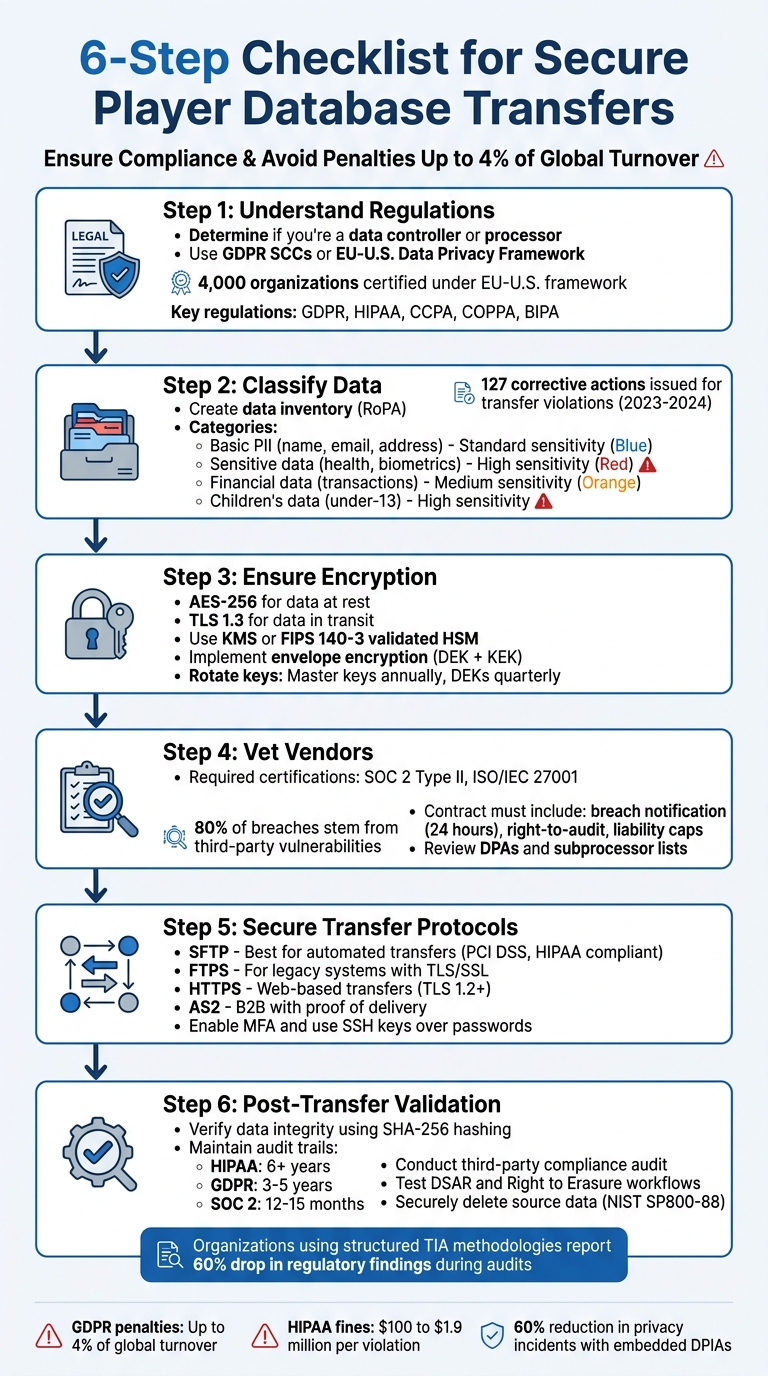 {6-Step Checklist for Secure Player Database Transfers with Compliance Requirements}
MFT Compliance & Risk Mitigation: Secure Your Data Transfers
sbb-itb-ba142f6
Pre-Transfer Preparation and Risk Assessment
When planning a data transfer, it’s crucial to define the data involved, the destination, and the legal requirements that apply. Skipping this step can lead to compliance issues, such as invalid privacy notices or contracts.
Review Regulatory Requirements
Start by determining whether your organization is a data controller or a data processor. This distinction shapes your compliance obligations.
"Controller and processor misclassification is the foundational error in data privacy diligence. If a target has categorized itself as a processor when it functions as a controller, its privacy notice, consent records, and contractual flow-downs are structurally defective."
– Alex Lubyansky, M&A Attorney, Acquisition Stars [3]
For cross-border transfers, you need a legal framework in place. For example, transferring player data from the EU to the US requires the 2021 Standard Contractual Clauses (SCCs) along with a Transfer Impact Assessment (TIA) to evaluate surveillance laws in the receiving country. Alternatively, the EU-U.S. Data Privacy Framework, introduced in July 2023, allows self-certified US companies to facilitate transfers. Major firms like Microsoft, Google, Amazon, and Meta are among the roughly 4,000 organizations certified under this framework [6].
In the US, state-specific laws add complexity. Beyond California's CCPA/CPRA, states like Colorado, Virginia, and Texas have their own definitions of "sensitive data." If your data includes health information, you’ll need a Business Associate Agreement (BAA) under HIPAA, with penalties ranging from $100 to $1.9 million per violation [1]. For data involving children under 13, COPPA applies, while Illinois’ BIPA mandates written consent for biometric data like fingerprints or facial geometry.
A Record of Processing Activities (RoPA) is essential. This document catalogs data types, purposes, legal bases, and retention periods, serving as the foundation for GDPR compliance under Article 30. Additionally, ensure all vendor contracts include appropriate "service provider" clauses (for CCPA) or Data Processing Agreements (for GDPR Article 28).
Once your regulatory framework is clear, the next step is to inventory and classify your data.
Create a Data Inventory and Classification System
Map every data flow, including direct transfers, automated backups, remote access, and subprocessors you may not have documented.
Classify data by sensitivity. For instance:
- Basic PII (e.g., name, email, address) involves standard compliance.
- Sensitive data (e.g., health records, biometrics) demands stricter safeguards under GDPR Article 9 and may trigger assessments under China’s PIPL if processing exceeds 100 million records [6].
- Financial data like transaction records falls under industry rules such as the GLBA Safeguards Rule.
| Data Category | Examples | Sensitivity Level | Key Regulatory Impact |
|---|---|---|---|
| Basic Personal Data | Name, email, address | Standard | GDPR Art. 44–49; PIPL Art. 38 |
| Sensitive Personal Data | Health records, biometrics | High | GDPR Art. 9; PIPL security assessment |
| Financial Data | Transactions, credit scores | Medium | GLBA Safeguards Rule |
| Children's Data | Under-13 user information | High | COPPA compliance required |
Document the purpose and legal basis for each data category. Determine whether transfers are systematic or occasional, and evaluate their volume. Large-scale transfers may require additional regulatory assessments. Between 2023 and 2024, EU regulators issued 127 corrective actions for international transfer violations [4].
Before transferring, conduct a retention review. Moving data beyond its retention period violates GDPR’s data minimization principle (Article 5) and is a common compliance pitfall. Organizations using structured TIA methodologies report a 60% drop in regulatory findings during audits [4].
Perform a Security Gap Analysis
Assess vulnerabilities in confidentiality, integrity, and availability. This step ensures your systems are ready for secure transfers.
- Confidentiality: Address risks like unauthorized access and insider threats.
- Integrity: Prevent data corruption or profiling errors.
- Availability: Safeguard against service interruptions or data loss [7].
Review your technical protocols. Avoid outdated systems that transmit data in cleartext. Implement Multi-Factor Authentication (MFA) for sensitive data and automated checksum verification to confirm data integrity - relying solely on "successful copy" statuses is risky [1].
Use a risk scoring matrix (Likelihood × Severity) based on ISO 29134 to prioritize fixes. Critical risks (scores 17–25) should halt processing until resolved. Embedding Data Protection Impact Assessments (DPIAs) into your workflows can reduce privacy incidents by 65% compared to treating them as one-off tasks [7].
"DPIAs are mandatory under GDPR Article 35 whenever processing is likely to result in a high risk to individuals - penalties for non-compliance reach up to 10 million euros or 2 percent of global annual revenue."
– Chimaka Ikemba, Privacy & Compliance Writer, DapriPro [7]
For transfers to jurisdictions with weaker data protections, implement supplementary measures like end-to-end encryption (with the importer unable to access keys) or pseudonymization before transfer [5]. GDPR Article 35(8) also requires consulting your Data Protection Officer, as failure to do so can escalate enforcement penalties [7].
Address these gaps thoroughly before moving to secure transfer methods.
Data Encryption and Anonymization Methods
Once you've completed your risk assessment, the next step is to implement technical measures to protect data during transfer and storage. These safeguards are essential for securing player databases, whether the data is at rest or in transit.
Use Encryption Standards for Data at Rest and in Transit
To secure stored data, use AES-256 encryption. For data transfers, rely on TLS 1.3, while disabling outdated versions like TLS 1.0 and 1.1. Keep TLS 1.2 available only as a fallback option [8]. Additionally, apply Transparent Data Encryption (TDE) at the database engine level to automatically safeguard files and backups.
Keep in mind that TDE introduces a slight performance impact, typically around 3–5% overhead, while application-level encryption can slow systems by 15–30% [8]. It's also vital to encrypt backups and logs, as unencrypted backups are a common weak spot during audits.
These encryption steps create a strong security baseline, allowing for further data protection techniques.
Apply Pseudonymization and Tokenization
Pseudonymization replaces personal identifiers with reversible substitutes, improving privacy without sacrificing data functionality. For example, use deterministic masking, such as consistent hashing with a secret salt, to ensure identical inputs produce identical outputs - this is particularly important for maintaining database JOIN operations. For authentication credentials or session tokens, implement tokenization with short-lived tokens like JWTs with expiration dates to reduce risk during data transfers [8].
Another technique, data shuffling, rearranges column values to maintain foreign key relationships while separating sensitive details. This is especially critical given that up to 99.98% of Americans can be re-identified using as few as 15 demographic attributes - and over 60% using just gender, date of birth, and ZIP code [9]. Ensure mapping keys or related data are stored securely and separately under strict protections.
Manage Encryption Keys Properly
Encryption is only as strong as its key management. Use a dedicated Key Management System (KMS) or a FIPS 140-3 validated Hardware Security Module (HSM) to store keys securely. Never hard-code keys into source code or configuration files. Instead, rely on secret management tools like HashiCorp Vault or AWS Secrets Manager.
Adopt envelope encryption, where a Data Encryption Key (DEK) secures the data, and a Key Encryption Key (KEK) protects the DEK. For example, in 2023, a fintech company used FIPS 140-2 validated AWS KMS for master keys, implemented quarterly key rotation, and automated re-encryption using Lambda functions. This approach helped them achieve zero SOC 2 audit findings [8].
"Encryption without proper key management is like having a vault with the combination written on the door."
– Naina Patel, Cybersecurity Expert [8]
Key management best practices include:
- Automating key rotation on a fixed schedule (e.g., master keys annually, data encryption keys quarterly).
- Restricting key access through Role-Based Access Control (RBAC) and the principle of least privilege.
- Requiring dual control for critical operations like key generation or recovery.
- Maintaining immutable logs for all key-related activities to ensure accountability.
Secure Transfer Methods and Vendor Vetting
When it comes to migrating player data, ensuring security isn’t just an option - it’s a necessity. The protocols you choose and the vendors you work with play a direct role in safeguarding sensitive information during the transfer process.
Choose Secure File Transfer Protocols
Not all transfer protocols are created equal. Some offer higher levels of security, making them better suited for handling sensitive data. Here’s a breakdown of the most commonly used secure transfer methods:
- SFTP (SSH File Transfer Protocol): A top choice for secure, automated system-to-system transfers. It uses a single channel for both commands and data, making it highly secure and compliant with standards like PCI DSS and HIPAA [12].
- FTPS (FTP over SSL/TLS): Adds encryption to traditional FTP but requires careful configuration due to its use of multiple ports. It’s a good option for legacy systems that still rely on FTP [10][13].
- HTTPS: Ideal for ad-hoc sharing and web-based transfers. When configured with TLS 1.2 or higher, it meets PCI DSS 4.1 requirements and offers broad compatibility with browsers [10].
- AS2 (Applicability Statement 2): Tailored for B2B transactions, this protocol provides proof of delivery through Message Disposition Notifications (MDNs), acting like a digital "certified mail" receipt [11][13].
| Protocol | Encryption | Best Use Case | Compliance Support |
|---|---|---|---|
| SFTP | SSH | Automated system-to-system transfers | High (PCI DSS, HIPAA) |
| FTPS | TLS/SSL | Legacy systems requiring FTP | High (with proper TLS config) |
| HTTPS | TLS | Ad-hoc sharing, web portals | Moderate to High |
| AS2 | TLS + Message Encrypt | B2B/EDI with proof of delivery | High (Non-repudiation) |
To further enhance security, configure these protocols with encryption standards like AES-256 and TLS 1.2+ [15]. Additionally, move away from password-based authentication. Instead, use SSH keys, digital certificates, or multi-factor authentication (MFA) [10][13]. To ensure data integrity, employ cryptographic hash functions like SHA-256 to verify files haven’t been altered during transit [11][15].
While secure protocols are vital, they’re only one piece of the puzzle. The next step is ensuring your vendors meet stringent security criteria.
Vendor Due Diligence Criteria
Data breaches often stem from third-party vulnerabilities - accounting for 80% of breaches and 62% of network intrusions [17][16]. This makes vendor vetting a critical component in protecting player data.
Before partnering with a vendor for database transfers, confirm they hold certifications such as:
- SOC 2 Type II: Covers security, availability, and confidentiality [16][14].
- ISO/IEC 27001: Focuses on information security management [16][14].
Ensure vendors comply with industry-specific regulations like HIPAA for healthcare data, PCI DSS for payment information, and GDPR for European player data. This includes reviewing data processing addendums and subprocessor lists [16][11].
Before signing contracts, require vendors to complete detailed security questionnaires to assess their cybersecurity posture [16][17]. Contracts should clearly outline:
- Data ownership terms
- Breach notification timelines (e.g., within 24 hours)
- Right-to-audit clauses
- Liability caps for security failures [16][13][17]
Also, examine Service Level Agreements (SLAs) for uptime guarantees, disaster recovery plans, and recovery time/point objectives (RTO/RPO) [16][11]. Be cautious of vendors who lack certifications, refuse to share audit reports, or provide vague answers about data residency and security measures [16][18].
Implement Zero-Trust Architecture for Transfers
Zero-trust architecture operates on a simple but powerful principle: trust no one, verify everything. Unlike traditional security models that only verify at the entry point, zero-trust requires continuous validation throughout the transfer process [10][13].
"Zero-trust is the new black – adopt a 'never trust, always verify' mindset."
– Intelemark [13]
To strengthen your transfer security:
- Enforce MFA for all admin accounts and sessions [19].
- Use chroot isolation to restrict each user to a specific directory, preventing unauthorized access to other files [19].
- Configure SSH/SFTP sessions to rekey at intervals, such as every 1GB transferred or every hour, to maintain forward secrecy [19].
- Integrate transfer accounts with identity providers (e.g., SSO or LDAP) to automatically revoke access when projects end or vendor contracts expire [19][13].
Compliance Verification and Post-Transfer Validation
Ensuring compliance after a data transfer is essential. Skipping this step could lead to regulatory penalties or data issues. Post-transfer validation acts as a final safeguard, complementing earlier security efforts to confirm the transfer is both secure and compliant.
Maintain Audit Trails and Logging
Every transfer activity should be meticulously documented. Use immutable logging with cryptographic chaining to ensure these records remain tamper-proof [1][2].
Retention timelines depend on the governing regulations. For example, HIPAA mandates keeping access logs for at least 6 years, while GDPR best practices suggest retaining processing records for 3–5 years. For SOC 2 audits, evidence should be stored for 12–15 months [1]. To protect these logs, consider using immutable storage or blockchain-based solutions to prevent unauthorized alterations.
"Compliance isn't just doing the right thing - it's proving you did the right thing to someone who assumes you didn't." – Adam Bertram, IT Veteran [2]
Additionally, generate compliance reports in PDF or CSV formats. Include checksums, timestamps, and outcomes in these reports, as they serve as critical evidence for third-party audits or regulatory reviews.
Once audit trails are secure, the focus shifts to ensuring the transferred data's integrity.
Verify Data Integrity and Reconcile Records
To confirm data accuracy, use SHA-256 hashing to compare the source and destination databases. This ensures no data was corrupted or lost during the transfer [21][1]. Automated reconciliation scripts can also check row counts, checksums, and data distributions while verifying that access control lists (ACLs) and permissions meet regulatory standards. Afterward, revoke any temporary permissions granted for the migration process [1].
Test the new system's ability to handle Data Subject Access Requests (DSARs) and "Right to Erasure" workflows before decommissioning the source system [1]. For instance, in Q1 2026, a 12-person accounting firm in the Netherlands migrated sensitive client ledgers to an EU sovereign cloud. They validated the transfer by running DSAR and deletion tests, which helped streamline their audit process and reduce document signing time using an eIDAS-compliant provider [20].
Once data integrity is confirmed, securely delete the source data following NIST SP800-88 standards [1]. Ensure all records, metadata, and logs are verified in the destination system before initiating deletion.
Conduct Post-Transfer Compliance Audits
A third-party audit immediately after the transfer can uncover gaps that internal teams might miss. These audits can identify issues like missing Standard Contractual Clauses (SCCs) or incomplete Data Processing Agreements (DPAs) [1].
Key areas to focus on during audits include:
| Audit Practice | Verification Method | Compliance Driver |
|---|---|---|
| Integrity Check | Checksum/Hashing (SHA-256) | HIPAA, SOC 2, GDPR |
| Access Control | ACL/Permission Review | SOC 2 (CC6.1), HIPAA |
| Audit Trail | Cryptographic Chaining/Logging | GDPR (Art. 30), HIPAA |
| Data Disposal | NIST SP800-88 Overwrite | GDPR (Right to Erasure) |
| Transmission Security | TLS Version/Cipher Suite Scan | SOC 2 (CC6.6) |
Ensure backup and disaster recovery sites remain in compliant jurisdictions. For transfers involving a sovereign cloud, verify the data center's geographic location and its failover sites to avoid a "sovereignty gap" during emergencies [2].
Finally, update privacy notices to reflect changes in the data controller or processing environment. If the legal basis for processing has changed, obtain fresh user consent before resuming operations [3]. Overlooking this step could result in violations of multiple privacy laws.
These audits tie back to earlier risk assessments and encryption measures, ensuring the entire transfer process aligns with compliance requirements.
How MyReadyMade Supports Secure and Compliant Transfers
Handling database transfers during iGaming mergers and acquisitions (M&A) comes with significant risks. Nearly 60% of companies face data security incidents during these processes, and over half of executives identify data privacy and security concerns as major deal-breakers during due diligence [22]. MyReadyMade addresses these challenges with specialized advisory services designed to safeguard the transfer process. Here’s a closer look at how these services reinforce security and compliance.
M&A Advisory for License Transfers
MyReadyMade offers expert advice on managing change-of-control requirements across more than 50 jurisdictions, including those governed by the Malta Gaming Authority (MGA), Curaçao (under LOK reforms), and Kahnawà:ke. In many regions, a share sale triggers a regulatory review for change of ownership rather than a direct license transfer [25]. MyReadyMade assists with preparing MGA filings for qualifying shareholding changes, drafting purchase agreements with regulatory conditions, and navigating increasingly strict B2C and B2B licensing regulations.
"Start MDA diligence on day zero of M&A. Consent processes often take longer than tax or antitrust review - early engagement preserves deal optionality." – Avery Dalton, Senior Editor & Cloud Security Strategist [23]
The typical timeline for completing a transaction ranges from 8 to 20 weeks [25]. MyReadyMade's advisory team oversees various aspects, including valuation, due diligence (spanning legal, regulatory, financial, and technical areas), and escrow management, ensuring secure handling of funds throughout the process.
Beyond advisory services, the platform employs secure transaction methods to further safeguard sensitive data.
Verified Listings and Confidential Transactions
MyReadyMade ensures that only vetted buyers gain access to opportunities. Buyers must provide proof of funds and sign NDAs before viewing sensitive player data [25]. The platform uses Virtual Data Rooms (VDRs) equipped with end-to-end encryption, multi-factor authentication (MFA), and strict access controls to securely manage due diligence documents [24]. These rooms store critical information, such as KYC/AML metrics, merchant statements, and player records, all safeguarded with encryption protocols like SFTP.
AI and machine learning tools classify sensitive data, including "crown jewel" information, ensuring adherence to GDPR and other privacy laws [22]. Funds are held in escrow accounts and are only released once conditions like regulatory approvals or successful technical migrations are met [25].
These measures create a secure environment for transactions, supported by continuous assistance.
24/7 Support for Transaction Management
To maintain data integrity and compliance, MyReadyMade provides 24/7 transaction support. This includes resolving technical migration challenges, such as platform portability, provider notice periods, and data residency requirements. The support team also helps prepare data rooms with essential documents like traffic and revenue reports, KYC/AML metrics, and platform contracts covering the past 12–36 months. These efforts build buyer confidence and expedite due diligence [25].
Thanks to its streamlined processes and dedicated support, MyReadyMade achieves an average close time of 30–45 days, significantly faster than industry norms. The platform also facilitates integration through technical freezes before closing and phased migrations afterward, ensuring data residency and reporting requirements are met during the consolidation process.
Conclusion
Ensuring secure player database transfers demands a well-rounded strategy that emphasizes compliance, encryption, and careful vendor management at every step. Regulatory bodies place a strong emphasis on data protection, often prioritizing it over infrastructure enhancements [1]. A single misstep, like a misdirected file transfer, can result in hefty penalties - ranging from GDPR fines of up to 4% of global turnover to HIPAA fines between $100,000 and $1.9 million [1][2].
The technical backbone of secure transfers begins with using validated encryption standards [2]. But encryption by itself won't suffice. Organizations also need to confirm data integrity through checksum comparisons, maintain tamper-evident audit trails to track what data was transferred and when, and finalize necessary agreements like DPAs or BAAs [1][2].
"Encryption is the technical enforcement of sovereignty - if they can't read it, the jurisdictional question becomes academic." – Adam Bertram, IT Veteran and Microsoft MVP, Progress Software [2]
While these technical measures form a solid foundation, ongoing validation is essential. Post-migration checks, including a DPIA, adopting a zero-trust model, and securely deleting data, play a key role in ensuring compliance [1][2]. For example, HIPAA requires retaining access logs for six years, while SOC 2 audit evidence must be kept for 12–15 months [1].
To complement these safeguards, MyReadyMade simplifies the process further with specialized M&A support. The platform offers secure transfers backed by expert advisory services, verified listings, and 24/7 transaction management. This comprehensive approach enables database transfers to meet both regulatory and operational security demands, achieving an average closure time of 30–45 days while maintaining the high compliance standards regulators expect.
FAQs
When do we need SCCs, a TIA, or the EU-U.S. Data Privacy Framework?
Standard Contractual Clauses (SCCs) are essential when transferring personal data from the EU/EEA to countries that don’t have an adequacy decision. This became even more critical following the Schrems II ruling, which emphasized the need for stricter safeguards.
A Transfer Impact Assessment (TIA) is a key step in this process. It involves assessing the legal framework of the destination country to ensure it aligns with the protections required for SCC-based transfers.
For organizations in the U.S., the EU-U.S. Data Privacy Framework provides an adequacy mechanism, but it’s limited to certified entities. It’s important to note that this framework doesn’t completely replace the need for SCCs or TIAs in every situation.
What data should be pseudonymized or tokenized before transfer?
Sensitive details, such as personally identifiable information (PII) and payment data, should be pseudonymized or tokenized before being transferred. These methods help reduce the chances of re-identification and provide stronger protection for the data throughout the transfer process.
What post-transfer checks confirm the migration was secure and compliant?
Post-transfer checks involve producing audit reports that are ready for compliance purposes. These reports include per-file checksums, timestamps, and transfer status. Such details confirm data integrity, verify access control, and document the chain of custody, ensuring the migration aligns with strict security and compliance requirements.
Related Articles
KYC vs. AML for Payment Processors: What to Know
KYC confirms identity at onboarding, but only continuous AML monitoring stops payment processors from becoming conduits for financial crime.
Ultimate Guide to Payment Compliance in iGaming
Roadmap for building compliant iGaming payment systems: AML/KYC, PCI‑DSS, multi‑PSP setup, chargeback controls and jurisdictional risks.
How Forex Firms Adapt to Regional Preferences
Localize platform features, payments, compliance, and marketing to boost trust and conversions in each Forex market.
Looking to Buy or Sell?
Get in touch with our team for personalized assistance