How Forex Firms Adapt to Regional Preferences

How Forex Firms Adapt to Regional Preferences
Forex firms thrive by tailoring their platforms to regional needs. A generic approach doesn’t work because payment methods, regulations, and trader behaviors vary widely across markets. For instance:
- Licensing Costs: In Abu Dhabi, a Category 3A license needs $500,000 in base capital and up to $90,000 for setup.
- Payment Preferences: Brazil’s Pix dominates, while Kenya relies on M-PESA.
- Trader Needs: Swap-free accounts are crucial in Muslim-majority regions, while mobile-first designs excel in Southeast Asia.
Success hinges on localizing everything - platform features, payment systems, compliance, and marketing. Firms that fail to do so risk low conversions and high operational costs. By studying regional patterns, meeting regulatory demands, and integrating local payment options, Forex firms can significantly boost user trust and engagement.
Let’s explore how to align your Forex platform with regional expectations and avoid common pitfalls.
Researching Regional Market Preferences
Before diving into infrastructure investments and compliance strategies, it's crucial to study regional trading behaviors, economic conditions, and technology trends.
Understanding Local Economic and Trading Patterns
Start by identifying the financial instruments that dominate each region. For example, gold is a go-to investment across parts of Asia, while cryptocurrency sees increased demand in areas with unstable local currencies [2][3].
In regions with a Muslim majority, offering swap-free Islamic accounts isn’t just a nice-to-have - it’s an absolute necessity [1][3]. On the other hand, European traders face strict leverage limits under ESMA regulations, which require you to rethink how you structure account types [1][3].
Trader preferences also vary widely. Professional scalpers prioritize fast execution and API access, while retail traders lean toward platforms with user-friendly interfaces and built-in educational resources [2]. Vitaly Makarenko, Chief Commercial Officer at Quadcode, highlights this dynamic:
"Traders make fast judgments about whether a platform understands them... based on signals, including language, assets offered, interface complexity, and funding options." [2]
Streamlining onboarding also means localizing KYC processes. For instance, in Brazil, you’ll need to incorporate CPF numbers, while in Mexico, CURP is the standard [1].
These regional insights directly influence how you should design technology and mobile experiences to align with local expectations.
Assessing Technology and Mobile Usage
Mobile adoption rates can dictate your platform’s entire architecture. In emerging markets, where smartphone usage dominates, a mobile-first approach with simplified interfaces is essential [2]. A desktop-focused platform in such regions risks alienating potential users and lowering conversions.
Communication preferences also vary. In some areas, messaging apps outperform email, while phone calls may feel overly intrusive [3]. Use native-language search terms and geo-specific keywords to understand what local traders are searching for - direct translations won’t cut it [2]. Additionally, identify "competitive gaps" where global brokers overlook local payment options or fail to address regional regulatory requirements [2]. These gaps represent opportunities for differentiation.
sbb-itb-ba142f6
Meeting Regulatory Requirements and Local Standards
::: @figure 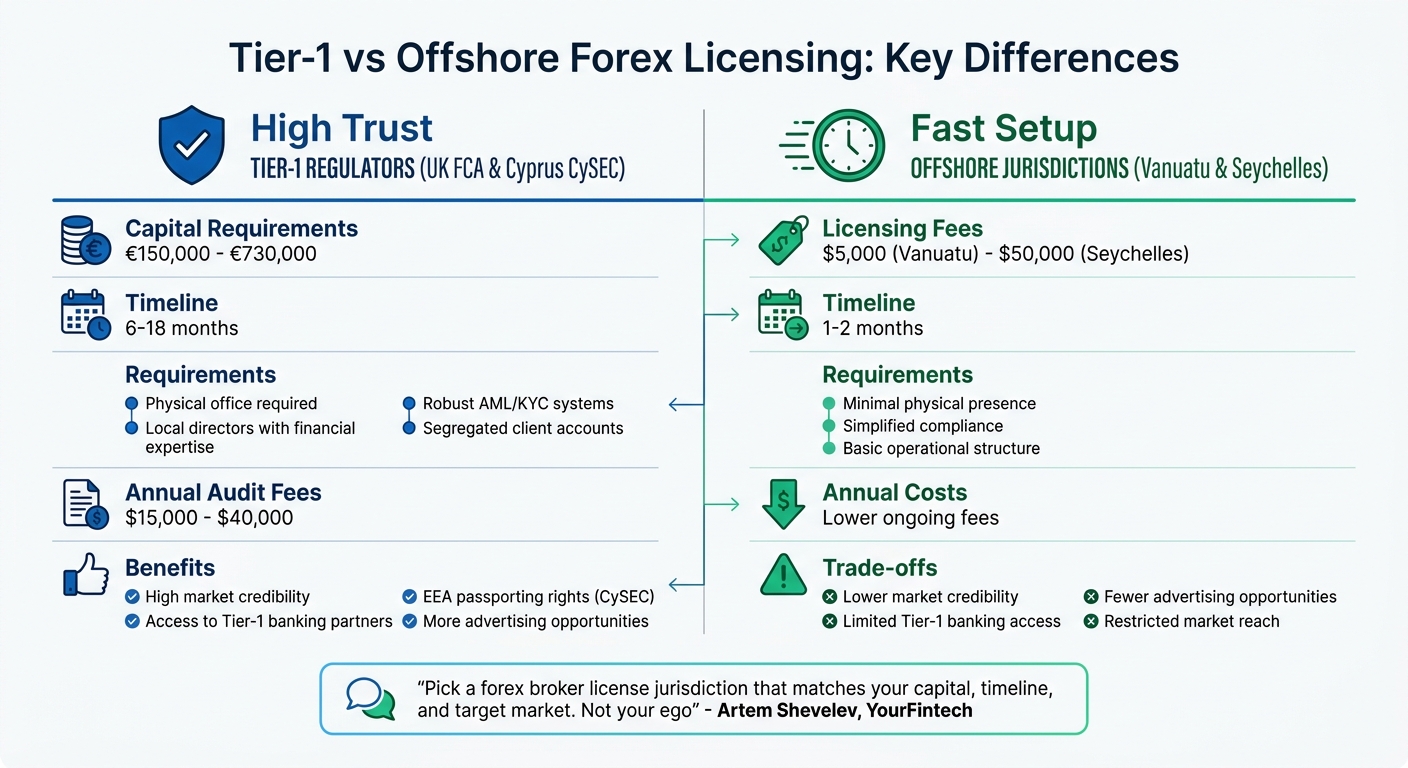 {Forex Licensing Requirements: Tier-1 vs Offshore Jurisdictions Comparison}
Once you've assessed the specific needs of your target market, the next step is navigating the legal and regulatory landscape. This is essential for operating legally, marketing responsibly, and establishing credibility in any region.
Complying with Regional Forex Regulations
Each jurisdiction enforces its own licensing rules, and understanding these is crucial. For instance, Tier-1 regulators like the UK's FCA and Cyprus's CySEC have stringent requirements. In the UK, you'll need at least €730,000 in capital, while in Cyprus, the range is between €150,000 and €730,000. The licensing process can take anywhere from 6 to 18 months [7]. Additionally, you'll need a physical office, local directors with financial services expertise, and robust AML (Anti-Money Laundering) and KYC (Know Your Customer) systems [7]. A CySEC license also allows you to offer services across the European Economic Area (EEA) [7].
On the other hand, offshore jurisdictions provide faster and more affordable options. For example, licensing fees in Vanuatu start at $5,000, and in Seychelles, they hover around $50,000. These licenses can be secured in as little as 1 to 2 months [7]. However, the trade-offs include lower market credibility, limited access to Tier-1 banking partners, and fewer advertising opportunities [7]. Artem Shevelev, a contributor to YourFintech, sums it up well:
"Pick a forex broker license jurisdiction that matches your capital, timeline, and target market. Not your ego" [7].
Once you secure the license, you'll need to maintain transparent operations. This involves implementing secure IT systems with features like data encryption, audit logs for trading activities, and automated tools to meet regulatory standards such as MiFID II in Europe [1]. You'll also need skilled personnel - an AML Compliance Officer, a Risk Manager, and a local Auditor - to oversee compliance. Segregated client accounts are another requirement to safeguard trader funds. Keep in mind that annual audit fees can range from $15,000 to $40,000, depending on your firm's size and jurisdiction [5].
After ensuring compliance, the next step is adjusting your platform to align with local languages and rules.
Customizing Platforms for Local Languages and Rules
With a solid regulatory framework in place, you can focus on tailoring your platform to meet local needs. Leverage limits, for example, differ widely: EU retail clients are capped at 1:30 under ESMA rules, while South African traders may access up to 1:500 [1]. In Japan, the limit is 1:25, and in Singapore, it's about 1:20 [8].
Language localization goes beyond simple translations. You'll need to account for details like date formats (MM/DD/YYYY in the U.S. versus DD/MM/YYYY in Europe), naming conventions (which vary by culture), and region-specific identity documents [6]. For example, KYC workflows might require a CPF in Brazil, a CURP in Mexico, or an Aadhaar in India [6]. In GCC countries, offering Shariah-compliant (swap-free) accounts is a must [1].
Using a modular or low-code platform architecture can make this process much smoother. These systems allow you to integrate regional language packs, currency ledgers, and compliance workflows without overhauling the entire platform [1]. This not only speeds up your time-to-market but also ensures you can adapt quickly to regulatory changes. As Kavita Kothari from FYNXT notes:
"True FX brokerage localization is about far more than translating your website or changing your logo. It means adapting platform functionality, compliance workflows, payment rails, language support, and local marketing" [1].
Integrating Local Payment Options
When expanding into new regions, offering the right payment methods can make or break your success. Making deposits and withdrawals easy for users is essential, as the wrong payment options can immediately halt a sale. As Gr4vy highlights:
"Offer the wrong payment method at checkout and the sale is already lost" [9].
By 2026, digital wallets are projected to account for 54% of global e-commerce transactions [9]. However, the specific digital wallets or payment systems that matter vary greatly by region. For example:
- In the Philippines, GCash and Maya dominate, with credit card usage limited to just 21% of adults [10].
- Brazil’s Pix system, backed by the government, is used by 76.4% of the population [9].
- India’s UPI system processes over 13 billion transactions every month as of 2026 [9].
- In the Netherlands, iDEAL historically handles about 92% of online payments [9].
- Mexico relies heavily on OXXO, a voucher-based system serving the 63% of adults who are unbanked, through a network of over 20,000 convenience stores [12].
- Kenya’s M-PESA has become essential, serving more than 91% of the population and processing over 81 billion transactions in 2025 [10].
To succeed in any market, focus on supporting the top 3–4 payment methods most relevant to your target audience [10]. This approach keeps things manageable while ensuring maximum impact [11].
Once you’ve identified the right methods, the next step is ensuring smooth technical integration.
Adding Regional Payment Gateways and Digital Wallets
Choosing the right payment methods is only half the battle - how you implement them is just as crucial. Switching from cross-border to domestic payment processing in regions like Latin America can boost approval rates from 20–45% to over 80% [12]. This is because many locally issued cards don’t support international transactions, making local acquiring partners essential for reducing declines [12].
Your platform should dynamically display payment options based on the user’s location and device. For instance, iDEAL should only appear for Dutch users [9]. Achieving this requires either building custom integrations for each region or partnering with payment aggregators that offer access to hundreds of local methods through a single API [11]. Aggregators can simplify the process, but your backend must handle asynchronous payment confirmations. Systems like Brazil’s Boleto or Mexico’s OXXO may take hours to confirm transactions [13].
Real-world testing is non-negotiable. Sandbox environments often miss regional issues like biometric authentication timeouts or carrier-specific SMS delays. For instance, in Brazil, 73% of transactions can fail within the first 48 hours of launch if payment systems aren’t localized properly [13].
Once local payment systems are integrated, displaying transactions in the user’s currency further enhances trust.
Offering Trading in Local Currencies
Showing all costs and balances in the user’s local currency is a simple but powerful way to build trust. It also accounts for differences in regional purchasing power. As Mark Stiltner from Rapyd explains:
"Displaying prices in local currency builds trust and can boost conversions" [12].
However, managing foreign exchange (FX) risk is a significant challenge for businesses operating in multiple currencies. In fact, 83% of treasury teams cite FX risk as their top economic concern [14]. Despite this, only 57% of organizations use a Treasury Management System (TMS), while 36% still rely on manual processes for managing currency [14]. Manual tracking is not only time-consuming but also prone to errors during reconciliation [15].
To handle these complexities, businesses need automated systems for managing payments and currency conversions. Integrate your ERP and financial systems into a single FX risk management platform to gain real-time visibility into your multi-currency positions [14]. Develop a clear FX policy that outlines your hedging strategy and risk tolerance before market volatility strikes [14]. Additionally, keep in mind that settlement timelines vary by payment method - some offer instant settlement, while others may use gross or net settlement. Your reconciliation systems must be equipped to handle these differences effectively [11].
Creating Region-Specific Marketing Campaigns
Once you've localized your platform and payment methods, it's time to fine-tune your marketing strategies for each region. Broad, one-size-fits-all campaigns simply don't cut it. Instead, understanding and integrating regional nuances can make all the difference. For instance, localized marketing campaigns have been shown to boost click-through rates by 133% and increase conversion rates from 8% to 19% - a clear indication of their impact [16].
Your marketing efforts should reflect the same attention to detail as your platform localization. This means going beyond just translating content - your messaging should resonate with local values, slang, and customs. Visual elements also matter; for example, featuring the London skyline in an ad aimed at Tokyo audiences would miss the mark. Highlighting region-specific trading assets, like Gold (XAUUSD) for Asia or Euro currency pairs for European markets, can further enhance relevance. Similarly, displaying local leverage limits (e.g., 1:30 for ESMA regions versus 1:500 in other areas) and offering familiar payment methods such as Pix in Brazil or Momo in Vietnam can significantly improve user engagement [16][3]. In fact, well-executed localized campaigns can deliver up to 15× profit and boost monthly ROI from 110% to 245% [16].
This level of customization also sets the foundation for building strategic partnerships with local influencers.
Partnering with Local Influencers and Organizations
Teaming up with local trading educators and influencers can be a game-changer for building trust and credibility. Collaborating with regional experts allows you to provide market insights and platform tutorials in the local language, positioning your company as a supportive partner rather than just another service provider [2]. Vitaly Makarenko, Chief Commercial Officer at Quadcode, sums it up perfectly:
"Traders convert because the platform feels designed for their reality, not because they were convinced to compromise" [2].
Introducing Brokers (IBs) play a key role in fostering these connections. Many cultivate vibrant communities through platforms like Telegram or Discord, which are especially effective in emerging markets where a blend of digital and in-person marketing still holds sway [16][17]. Supporting these partners with tools like automated commission tracking, multi-level structures for sub-IBs, and tailored marketing materials can strengthen relationships. With tier-1 CPA rates for qualified traders typically ranging from $800 to $1,200, firms are increasingly adopting hybrid affiliate models that combine upfront CPA payments with long-term revenue-sharing agreements [16].
Building Educational Resources for Regional Markets
To complement your targeted ads and influencer collaborations, invest in educational resources tailored to the unique challenges of each region. These materials should address issues like local market access restrictions, tax considerations, and broader economic conditions [2]. For example, a headline like "Hedging Against Local Inflation with USD Pairs" can resonate differently depending on the region [16].
Given that over 85% of traders in Africa and Southeast Asia rely on mobile devices, ensure your educational content is optimized for mobile use. Set up regional Telegram or Discord groups where users can discuss topics in their native language, and host webinars scheduled to match local trading hours [16][17]. Always have AI-transcreated materials reviewed by native speakers to ensure accuracy and cultural appropriateness, especially for financial terminology [16].
Developing a comprehensive educational ecosystem can further enhance client engagement. This could include academies, courses, certifications, and live Q&A sessions. Focus on the financial instruments most relevant to each region, and offer daily technical analysis tailored to local trading hours [16][17].
Using MyReadyMade for Regional Market Entry
Launching a new regional Forex operation can be a time-consuming process, often stretching between 12 and 36 months. MyReadyMade offers a shortcut: acquiring an operational, licensed business. This approach lets you skip the lengthy regulatory and compliance setup phases. Instead of spending years establishing banking relationships and compliance systems, you can step into an existing operation with active clients and established revenue streams [18].
Buying Licensed Forex Businesses
MyReadyMade provides a marketplace of operational Forex businesses in over 50 jurisdictions, all meeting strict compliance standards [18]. These aren't dormant or inactive licenses - they are fully functioning businesses. They come equipped with features like active IBAN issuance, SEPA and Faster Payments connectivity, established banking correspondent relationships, and reliable compliance systems. For example, you could acquire a CySEC-licensed firm managing around $16 million in segregated client funds, complete with staff and technology infrastructure already in place [18].
The benefits are obvious: speed and certainty. As TechBullion explains:
"A dormant licensed entity gives you regulatory standing. An operational regulated business gives you something far more valuable: an operational engine" [18].
This means you're not just buying a license; you're gaining immediate access to the market. This is particularly advantageous in high-growth regions like APAC (via Labuan-licensed brokers) or Sub-Saharan Africa (through South African FSP-licensed entities) [18]. Once the acquisition is complete, MyReadyMade ensures a smooth transfer of the license.
Managing License Transfers Across 50+ Jurisdictions
MyReadyMade simplifies the Change of Control process, handling regulatory applications and shareholder transitions in just 3–6 months [18]. Their M&A advisory team guides you through the specific requirements of each jurisdiction, from preparing "fit and proper" documentation to coordinating with regulatory bodies.
The quality of the initial application plays a critical role. As TechBullion highlights:
"The difference between a smooth three-month approval and a protracted eighteen-month process often comes down to the quality of the initial application and the relationship with the relevant authority" [18].
MyReadyMade's advisors use their expertise, including experience with processes like Section 178 FSMA notifications in the UK, to keep your transfer on track. With 24/7 deal support and an average transaction close time of 30 to 45 days, MyReadyMade helps you navigate what could otherwise be a complicated and lengthy process.
Measuring and Improving Regional Performance
To ensure your localized strategies are working, it’s crucial to measure how each region performs. Once you’ve entered a specific market, tracking the right metrics can reveal whether your approach is hitting the mark. Regional performance can’t be judged by global averages - what works in Vietnam might flop in Germany due to differences in regulations and behaviors [19]. Instead, you need to benchmark against standards specific to each area. With these benchmarks in mind, focus on metrics that give you a clear picture of how well your localization efforts are paying off.
Monitoring Performance Indicators
Start by keeping an eye on Time to First Time Deposit (FTD) - the time it takes for a user to make their first deposit after registering. For instance, deposits in Africa often happen within 12–24 hours, while in the European Union, the average is 3–5 days. Another key metric is the KYC approval rate, which can reveal how well your process handles local documentation challenges. In the EU, KYC approval rates hover around 92%, but in Africa, they’re closer to 55% [19]. If your approval rates are falling short, consider offering visual guides or alternative document options for users who may lack standard utility bills.
Click-through rates (CTR) also vary widely by region. Africa averages a CTR of 5.1%, while the EU lags at around 1.8% [19]. But don’t just focus on high CTRs - profitability matters more. For example, a region with a 2% CTR but a 15% FTD rate could outperform one with a 5% CTR and a 5% FTD rate. Additionally, tracking inactive leads - users who complete KYC but never deposit - can highlight opportunities for re-engagement. Monitoring churn rates is another critical step, as it helps you understand whether your marketing efforts are attracting long-term traders or short-term users [20].
By comparing these indicators across regions, you can uncover trends and pinpoint opportunities for improvement.
Analyzing Performance Across Different Regions
Regional benchmarking is essential. For example, Southeast Asia typically sees a CTR of 4.5%, with FTD timelines of 24–48 hours, while LATAM shows a CTR of 3.8% and FTD timelines of 2–4 days [19]. Platform preferences also vary - MT4 remains popular with expert advisor users, while MT5 is gaining traction for its ability to handle a mix of assets like cryptocurrencies and indices [19]. Mobile users often show higher CTRs but deposit smaller amounts initially, whereas desktop users tend to be professional traders with higher lifetime value. These behavioral differences should shape both your marketing and platform design strategies.
To stay agile, conduct weekly tactical reviews and monthly strategic assessments to fine-tune your marketing budgets and reduce conversion timelines [19]. Focus your resources on regions where the Time to FTD is shortest and user friction is minimal. Ads in native languages generally outperform English-language ads by about 30%, and a simple 5-minute "welcome call" can increase deposit rates by up to 40% [19]. Testing these tactics in regions with lower conversion rates can help you refine and improve your overall strategy.
Conclusion
Expanding into new Forex markets requires strategies that reflect the unique characteristics of each region. This involves everything from understanding local trading habits and mobile preferences to aligning with regional regulations and offering payment methods that resonate with local traders. Vitaly Makarenko, Chief Commercial Officer at Quadcode, emphasizes:
"Localization means building a trading platform, services, and marketing that align with the legal, cultural, and behavioral realities of the target market" [2].
By treating compliance and adaptation as opportunities rather than obstacles, companies can gain a competitive edge.
However, success also hinges on overcoming regional challenges. A staggering 75% of companies fail due to inadequate market research and hasty market entry [4]. Whether it's meeting MiFID II transparency rules in Europe, navigating country-specific regulations in LATAM, or handling relationship-driven licensing in the GCC, each region presents distinct hurdles. Tailored payment systems further streamline transactions and boost conversion rates [1].
For businesses aiming to fast-track their entry, acquiring an existing licensed entity can save months of regulatory hurdles. Platforms like MyReadyMade offer verified listings in regulated industries, handling everything from mergers and acquisitions to license transfers across over 50 jurisdictions. This approach is particularly effective in regions where obtaining a new license demands significant local investment and compliance [1].
FAQs
How do I choose the right forex license jurisdiction for my target region?
Choosing the right forex license jurisdiction involves weighing factors like regulatory standards, associated costs, and the preferences of your target audience.
- Tier 1 jurisdictions (such as the UK FCA or USA CFTC) are known for their strong credibility. However, they come with stricter regulations and higher operational costs.
- Tier 2 jurisdictions (like Cyprus CySEC) strike a middle ground, offering a balance between regulatory oversight and accessibility.
- Offshore jurisdictions (for example, Seychelles) are more affordable but may lack the same level of credibility as Tier 1 or Tier 2 options.
Your choice should reflect your business objectives and your ability to meet compliance requirements.
Which local payment methods should I integrate first in a new market?
When stepping into a new market, it's essential to offer the local payment methods that customers trust and use most. This minimizes barriers and can help improve conversion rates. Tailor your approach to the region:
- In Brazil, Pix has become a must-have payment option.
- For the Netherlands, iDEAL leads the way as the preferred choice.
- In North America, credit cards remain dominant, but digital wallets like Apple Pay and Google Pay are gaining traction fast.
Adapting to these preferences can make the buying process smoother and more appealing for your audience.
What metrics best prove localization is improving conversions by region?
When evaluating how localization impacts conversions across different regions, three key metrics stand out:
CTR (Click-Through Rate): This measures how effectively localized content grabs user attention and drives them to take action. A higher CTR often indicates that the messaging resonates well with the target audience.
KYC Processing Times: Efficient Know Your Customer (KYC) processes are critical. Shorter processing times suggest that localized workflows align better with regional expectations and regulations, making it easier for users to complete onboarding.
Time to FTD (First Time Deposit): This metric tracks how quickly users make their first deposit after signing up. Faster times often signal that localized strategies are creating a smoother, more intuitive user experience tailored to specific market needs.
These metrics collectively provide a clear picture of how well localization efforts are engaging users and streamlining their journey in different regions.
Related Articles
KYC vs. AML for Payment Processors: What to Know
KYC confirms identity at onboarding, but only continuous AML monitoring stops payment processors from becoming conduits for financial crime.

Checklist for Secure Player Database Transfers
Step-by-step checklist for secure player database transfers: compliance, encryption, vendor vetting, zero-trust, integrity checks, and audits.

Ultimate Guide to Payment Compliance in iGaming
Roadmap for building compliant iGaming payment systems: AML/KYC, PCI‑DSS, multi‑PSP setup, chargeback controls and jurisdictional risks.
Looking to Buy or Sell?
Get in touch with our team for personalized assistance