Ultimate Guide to Earnout Negotiations in M&A

Ultimate Guide to Earnout Negotiations in M&A
Earnouts are common in M&A deals, especially in industries like iGaming, Crypto, Forex, and Fintech, where valuations are tricky due to market uncertainty. They allow buyers and sellers to share risks by tying part of the purchase price to future performance. While earnouts can bridge valuation gaps, they are also one of the most disputed deal elements.
Key Points:
- What is an Earnout? A deferred payment tied to specific performance metrics, such as revenue, EBITDA, or milestones.
- Industries That Use Earnouts: High-growth, high-risk sectors like Fintech and Crypto.
- Typical Earnout Period: 1–5 years, with 10–30% of the purchase price deferred.
- Common Structures: Revenue-based (growth-focused), EBITDA-based (profit-focused), and milestone-based (non-financial goals).
- Risks for Sellers: Manipulation of metrics, unclear terms, and disputes over calculations.
- Negotiation Tips: Define clear metrics, secure protections against buyer interference, and include clauses for acceleration or minimum payouts.
Earnouts can be valuable tools, but only if structured and negotiated carefully. Missteps can lead to disputes or missed payments, so clarity and legal safeguards are essential.
Earnouts in M&A Explained – Real Life Examples and The Risks Involved
Common Earnout Structures in Regulated Industries
::: @figure 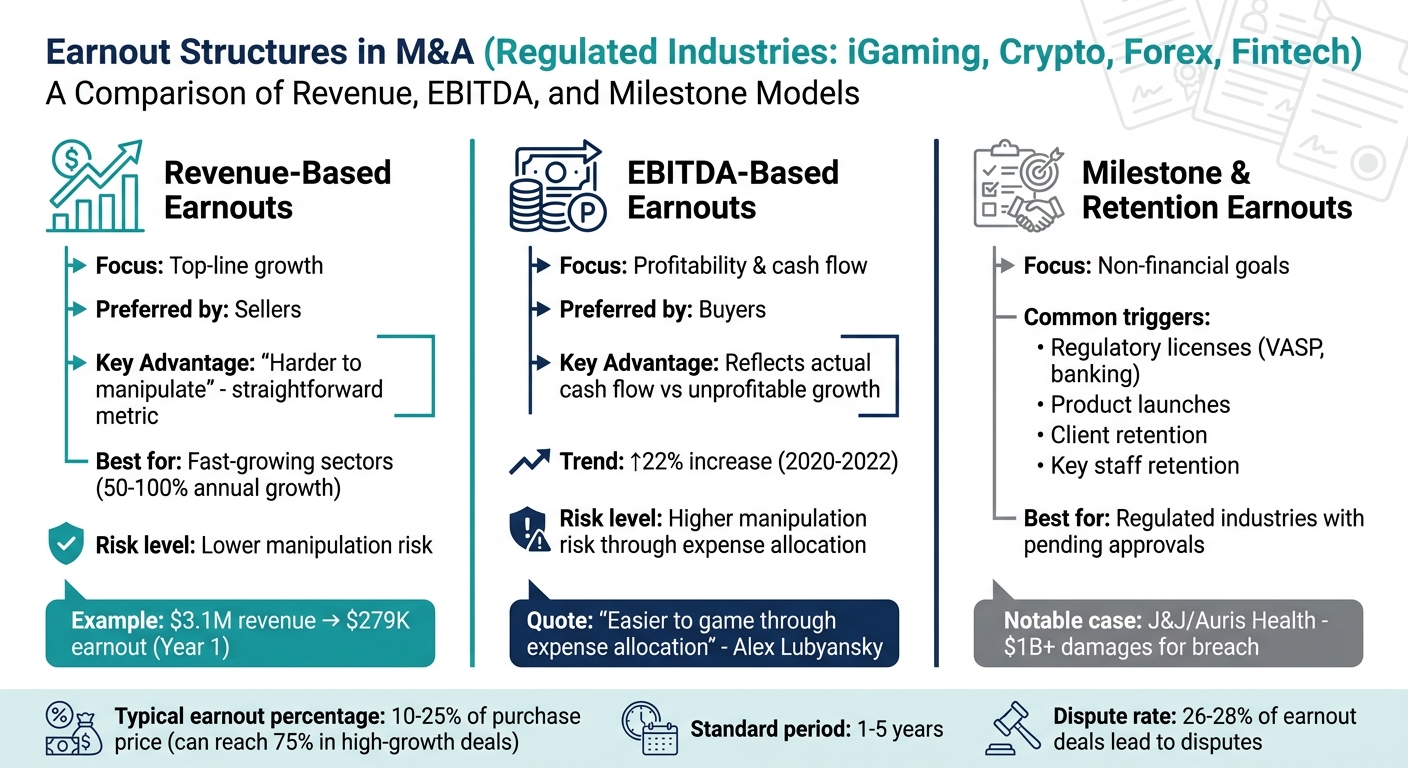 {Three Types of Earnout Structures in M&A Deals Compared}
Earnout structures in iGaming, Crypto, Forex, and Fintech deals generally fall into three categories: revenue-based, EBITDA-based, and milestone or retention-based. These structures are designed to address different priorities and carry varying levels of risk for buyers and sellers. In most cases, 10% to 25% of the purchase price is deferred as earnouts, though this can rise to 75% in high-growth deals, with cash making up 70% to 80% of mid-market transactions [9].
The choice of earnout structure depends on factors like the business's maturity, post-acquisition integration plans, and the regulatory hurdles specific to the industry. Understanding these structures is crucial for negotiating terms that safeguard your interests while keeping the deal on track. Below, we break down the three primary types of earnout structures.
Revenue-Based Earnouts
Revenue-based earnouts link payments to top-line growth, making them a popular choice in fast-growing sectors like Fintech and Crypto. Sellers often prefer this structure because revenue is a straightforward metric, less prone to manipulation through post-closing accounting adjustments or expense allocations.
Take the example of a professional services firm acquisition detailed by Acquisition Stars: A buyer closed a $3.2 million deal with a $650,000 valuation gap, bridging it through a revenue-based earnout over two years. In Year 1, the firm generated $3.1 million in revenue, leading to a $279,000 earnout payment. In Year 2, revenue rose to $3.4 million, triggering a $371,000 payout. By focusing on revenue rather than EBITDA, the deal avoided disputes over expense allocation [7]. This approach is especially effective when the acquired company will be integrated into the buyer’s operations, where tracking profit-based metrics becomes challenging [3].
For high-growth businesses - those scaling at 50% to 100% annually - revenue-based earnouts help reconcile current valuations with future potential [9]. However, sellers should negotiate operational safeguards to prevent buyers from undermining revenue growth, such as cutting marketing budgets or redirecting revenue streams during the earnout period [2][3].
While revenue-based earnouts focus on growth, EBITDA-based earnouts prioritize profitability.
EBITDA-Based Earnouts
EBITDA-based earnouts focus on profitability, measuring Earnings Before Interest, Taxes, Depreciation, and Amortization. Buyers favor this approach because it reflects actual cash flow rather than unprofitable growth. However, these earnouts are more susceptible to disputes over accounting practices and cost allocations [4][9].
Between 2020 and 2022, EBITDA-based earnouts gained popularity, increasing by 22%, while revenue-based earnouts declined by 23%. This shift reflects a broader market focus on sustainable profit over raw growth [5].
"Revenue-based earnouts are harder to manipulate; EBITDA-based earnouts are easier to game through expense allocation and accounting changes." - Alex Lubyansky, M&A Attorney [7]
For sellers, the main risk lies in buyers controlling the "bottom line." Buyers may suppress EBITDA by adding corporate overhead, management fees, or other costs to the acquired business. To mitigate this, sellers should negotiate clauses requiring the business to operate "consistent with past practices" and define specific line items rather than relying on vague references to "GAAP" [4][7]. Sellers should also request regular performance reports and formal audit rights to monitor progress toward earnout targets [4].
Milestone and Client Retention Earnouts
Milestone-based earnouts tie payments to specific non-financial goals, such as obtaining a regulatory license, launching a new product, or achieving a technical R&D milestone [4][2]. In regulated industries, these earnouts are often critical when the deal hinges on pending licenses in new jurisdictions [4][9]. For instance, a Crypto exchange acquisition might include earnout payments tied to securing VASP (Virtual Asset Service Provider) licenses in the EU or banking licenses in certain U.S. states.
Retention-based earnouts, on the other hand, are common in service-driven Fintech and Forex deals. These structures link payments to retaining key clients or ensuring the continued employment of founders and essential staff [4][9]. This approach is particularly effective when the business's value depends on specific relationships or expertise that could be lost post-acquisition.
A notable example occurred in 2024 when Johnson & Johnson failed to meet its "commercially reasonable efforts" covenant after acquiring Auris Health, leading to damages exceeding $1 billion [7]. This case underscores the importance of defining "commercially reasonable efforts" with clear, objective benchmarks rather than leaving it to buyer discretion.
To protect themselves, sellers should include acceleration clauses that require immediate payment of the earnout if the buyer sells the target company or terminates key personnel without cause [4][2]. These provisions safeguard sellers from situations where the buyer’s actions - whether intentional or not - make it impossible to achieve the agreed-upon milestones.
How Sellers Can Negotiate Better Earnout Terms
Earnouts are a common feature in 20% to 30% of middle-market M&A deals, often deferring 10% to 30% of the purchase price [7]. The wording of the earnout terms in your agreement is critical. As M&A attorney Alex Lubyansky explains: "The earnout language in your purchase agreement determines whether you collect or litigate" [7].
Industries like iGaming, Crypto, Forex, and Fintech - where valuations are tricky due to market volatility and regulatory challenges - often rely on earnouts to address these uncertainties. Sellers aiming for strong earnout terms focus on three main areas: setting clear and measurable performance targets, securing operational protections to prevent manipulation, and structuring payment mechanisms to balance risks and rewards. These elements should ideally be negotiated during the Letter of Intent (LOI) stage, before the buyer gains more leverage later in the process [10][12].
Setting Clear and Achievable Performance Targets
When crafting earnout agreements, precision in defining performance metrics is crucial. Choosing the right metric is the first step. Revenue-based earnouts are generally harder to manipulate compared to EBITDA-based metrics, which can be skewed through changes in expense allocation or accounting practices [7][11].
Once the metric is selected, define it in unambiguous terms. Your agreement should specify that calculations adhere to GAAP, applied consistently with past practices. This prevents buyers from altering revenue recognition policies or capitalization methods after closing [10][11]. Including a sample calculation as an exhibit can further clarify how the metric will be derived [7].
Avoid structuring earnouts as "all-or-nothing" deals. Instead, negotiate proportional payouts for performance that comes close to the target [7]. If the acquired business is integrated into the buyer's operations, require separate books and records for the acquired unit to ensure accurate performance tracking without mixing results [3][11].
Protecting Against Buyer Manipulation
The Delaware Chancery Court has awarded over $1 billion in damages in cases where buyers failed to meet their "commercially reasonable efforts" obligations, highlighting the need for protective clauses [7].
To safeguard your earnout, start by negotiating operating covenants. These should require the buyer to allocate specific resources - like marketing budgets, sales staff, and R&D funding - to support the agreed business plan [7][10]. Avoid language that gives the buyer unchecked discretion over operations. A Medtronic case serves as a cautionary tale, where sellers lost a $100 million milestone payment because the buyer had absolute operational control [7].
Include "no manipulation" clauses to prevent the buyer from taking actions that would reduce earnout payments [10]. For EBITDA-based earnouts, exclude corporate overhead, management fees, and one-time integration costs from the calculation [7][11]. Regular quarterly reporting and full access to the buyer’s records are also essential for verifying performance calculations [7][10].
To further protect payments, add anti-offset provisions that prevent the buyer from withholding earnout payments to cover unrelated indemnification claims. Secure payments through escrow accounts, parent company guarantees, or letters of credit to ensure funds are available when targets are met [7][11].
Once operational safeguards are in place, it’s time to focus on financial limits and acceleration clauses to provide additional protection.
Structuring Payment Caps, Floors, and Acceleration Clauses
Payment floors are a way to guarantee a minimum payout, even if the business underperforms due to buyer mismanagement [1][12]. Around 26% of middle-market M&A deals include earnout floors as part of the agreement [12]. If you agree to a payment cap, ensure it doesn’t apply in cases where the buyer acts in bad faith [12].
Acceleration clauses can protect you if the earnout becomes unachievable due to circumstances like the buyer selling the business, filing for bankruptcy, or terminating your employment without cause. About 22% of earnout agreements include clauses that accelerate payments upon a change in control [8]. Define these trigger events clearly, and if you stay on as a manager, ensure the clause activates if you are terminated "without cause" or resign for "good reason" [2][13]. These provisions protect you from buyer actions that could undermine your ability to collect the earnout.
Negotiating these terms early, during the LOI stage, is critical. Payment floors, caps, and acceleration clauses are key valuation elements and should be locked in before moving to the definitive purchase agreement [12].
Common Earnout Mistakes and How to Avoid Them
When negotiating earnouts, sellers must tread carefully to avoid common pitfalls that often spark post-closing disputes. Earnouts are a feature in 20% to 30% of middle-market M&A deals, but they’re also one of the most contentious parts of purchase agreements. In fact, up to 26% of earnout transactions lead to formal disputes after closing [7][12]. Most of these conflicts arise from three main issues: mismatched valuation expectations, unclear performance calculations, and poorly defined operational control terms.
Misaligned Valuation Expectations
A frequent source of tension in earnout negotiations is the gap in valuation expectations. Disagreements over a business’s fair market value often range from 15% to 30% [7]. Industries like iGaming, Crypto, Forex, and Fintech are particularly prone to these valuation gaps, as they often involve uncertainties like growth sustainability, regulatory hurdles, or differing risk assessments [7][3].
The choice of performance metric plays a big role in determining risk allocation. Sellers typically lean toward revenue-based earnouts since they’re less vulnerable to manipulation through expense allocations [7][11]. On the other hand, buyers favor EBITDA-based metrics, which focus on profitability but are more prone to disputes over accounting adjustments [7].
To minimize valuation conflicts, your agreement should include a clear, structured dispute resolution process. This usually involves the buyer providing calculations, a review period for the seller (30 to 60 days is standard), a negotiation phase, and, if necessary, a binding decision by an independent accountant [7]. Additionally, ensure that all metrics are calculated according to GAAP, applied consistently with historical practices, and include a sample calculation as part of the agreement to eliminate any ambiguity [7][11]. These steps are essential for addressing valuation-related disputes, which often overlap with issues in performance calculations.
Disputes Over Performance Calculations
When performance metrics aren’t clearly defined, disputes are almost inevitable. This is especially true for EBITDA-based earnouts, which are highly susceptible to manipulation through excessive expense allocations or corporate overhead charges [7][15].
"EBITDA-based earnouts are easier to game through expense allocation and accounting changes."
- Alex Lubyansky, M&A Attorney, Acquisition Stars [7]
To avoid these disputes, take steps to safeguard the integrity of the performance calculations. For example:
- Exclude buyer-level corporate overhead, management fees, and inter-company charges from EBITDA calculations.
- Require the buyer to stick to consistent accounting practices, preventing changes in areas like revenue recognition or reserve policies from undermining earnout targets [7][14].
- Negotiate for quarterly financial reports and the right to audit the books to maintain transparency in post-closing performance assessments [7][8].
It’s also crucial to define the role of any third-party decision-maker. Specify whether they are acting as an expert or as an arbitrator, as courts tend to give much greater weight to arbitration decisions [14][15].
Unclear Operational Control Terms
Surprisingly, only 25% of earnout agreements include specific post-closing covenants, such as requirements to operate the business in line with past practices or as a stand-alone entity [6]. However, the absence of clear operational terms can lead to significant disputes.
Take the Johnson & Johnson/Auris Health case as an example. J&J acquired Auris Health for $3.4 billion upfront, with an additional $2.35 billion in earnouts tied to regulatory milestones. After closing, J&J shifted resources from Auris Health’s "iPlatform" to its own competing robotic system. In 2024, the Delaware Chancery Court found J&J in breach of its "commercially reasonable efforts" covenant and awarded over $1 billion in damages to the sellers [7].
The lesson here is that operational covenants must be precisely defined. Avoid clauses granting buyers "sole and absolute discretion" over operations, as courts often uphold such language even when it undermines the earnout. Instead, insist that the buyer operates the business in line with historical staffing levels, sales coverage, and marketing budgets [7][12]. Prohibit actions like diverting customers, contracts, or key personnel to other subsidiaries [2][12]. Additionally, set clear limits on how and when the buyer can integrate, consolidate, or restructure the business, especially if such changes could impact earnout metrics [12].
Understanding these common mistakes and addressing them upfront is critical to reducing the risk of disputes and ensuring a smoother earnout process.
Other Ways to Bridge Valuation Gaps
When it comes to bridging valuation gaps in regulated industries like iGaming, Crypto, Forex, and Fintech, earnouts aren’t the only tool in the box. There are several other structures that can align the interests of buyers and sellers without relying on performance-based payments.
One option is rollover equity, where the seller keeps a stake in the business - usually between 20% and 40% - even after the sale. This approach allows the seller to benefit from future growth, which is particularly appealing in fast-growing sectors like Fintech and Crypto. It also sends a strong signal of confidence in the business's potential, often justifying a higher valuation compared to an all-cash deal[16][17].
Another practical method is seller financing, or seller notes. Here, the seller essentially acts as a lender, financing part of the purchase price. The buyer repays this amount with interest over time. This structure is especially useful in industries like Crypto and Forex, where securing traditional bank financing can be challenging. It also provides the seller with a steady income stream while helping the buyer manage upfront costs[16][2].
In cases where the seller’s expertise is critical to the business, consulting agreements can be a smart solution. These agreements offer the seller a multi-year income stream while ensuring the buyer can tap into the seller’s specialized knowledge during the transition. This setup can also reduce the initial purchase price, making it easier for buyers to proceed with the deal[18].
Lastly, milestone-based contingent payments tied to specific, non-financial events can work well in regulated industries. For instance, in an iGaming deal, a payment might be triggered when a specific gaming license or regulatory approval is secured. These milestones are clear and verifiable, reducing the risk of disputes that can arise with performance-based metrics[19][4].
Each of these alternatives offers a way to address valuation gaps while meeting the unique challenges of these industries.
Conclusion: What You Need to Know About Earnout Negotiations
Earnout negotiations in regulated industries like iGaming, Crypto, Forex, and Fintech boil down to three key factors: precise drafting, realistic performance targets, and solid legal safeguards. As M&A attorney Alex Lubyansky puts it:
"The earnout language in your purchase agreement determines whether you collect or litigate" [7].
Earnouts are used in roughly 20–30% of middle-market M&A deals [7], but they only deliver about 21 cents per dollar [13]. This underscores the need for meticulous planning.
Sellers should lean toward revenue-based metrics rather than EBITDA-based ones, as they’re less prone to manipulation. It’s also wise to secure operating covenants requiring buyers to manage the business "consistent with past practices." Including acceleration clauses that ensure full payment if the business is sold or the seller is terminated without cause can also provide added security [7]. Additionally, terms like "commercially reasonable efforts" should be clearly defined with measurable benchmarks, avoiding vague language that leaves room for interpretation [7].
Dispute resolution is another critical area. A well-structured process - starting with negotiation and ending with a binding decision by an independent accountant - can help resolve disagreements over calculations without resorting to expensive litigation [7]. To further safeguard payments, consider using escrow accounts, parent company guarantees, and anti-offset provisions to prevent buyers from withholding earnout payments for unrelated issues [7]. Including sample calculations in the purchase agreement can also help avoid confusion.
For regulated industries, platforms like MyReadyMade offer tailored M&A advisory services, ensuring transactions comply with regulatory requirements across more than 50 jurisdictions. These services address challenges like license transfers and regulatory milestones, which are common in these sectors.
It’s worth noting that disputes over earnouts arise in at least 28% of cases [13], and Delaware courts have awarded over $1 billion in damages in cases where buyers failed to meet their earnout obligations [7]. This highlights the importance of giving earnouts the same level of attention as the upfront purchase price, with a focus on clear drafting, achievable targets, and robust legal protections.
FAQs
What is the safest earnout metric for sellers in regulated deals?
In regulated industries, revenue stands out as the safest metric for sellers when structuring earnout agreements. Unlike EBITDA or other financial indicators, revenue is generally harder to manipulate, offering a more dependable foundation for such deals. This reliability makes it particularly suitable in sectors with strict oversight.
How can I stop a buyer from manipulating my earnout results?
To guard against manipulation, it's crucial to include safeguards in the earnout agreement. Consider these approaches:
- Clear Metrics: Opt for revenue-based metrics since they're less prone to manipulation compared to other performance indicators.
- Operating Covenants: Mandate precise reporting and ensure access to relevant data for transparency.
- Anti-Manipulation Clauses: Explicitly forbid actions that could skew performance metrics or financial results.
- Dispute Resolution: Establish clear procedures for addressing and resolving any disagreements that may arise.
These steps help ensure the earnout reflects the business's actual performance rather than distorted figures.
What clauses ensure I still get paid if the buyer changes plans?
Key clauses to safeguard your earnout payments include security provisions, operating covenants, and dispute resolution mechanisms. These clauses are designed to protect your payments even if the buyer decides to change course.
On top of that, terms like acceleration and anti-offset offer extra layers of protection. These ensure payments are made promptly and fairly, reducing the risk of delays or deductions. Including these elements in your agreement helps preserve your rights, no matter how the buyer’s plans evolve.
Related Articles

How to Draft M&A Definitive Agreements
Guide to drafting M&A definitive agreements covering deal structure, reps & warranties, indemnities, payment terms, and regulatory compliance.

How IP Affects Tokenization Valuation
How tokenizing patents, copyrights, and trademarks adds liquidity and market value—plus legal, regulatory, and valuation steps.

Regulatory Contingencies in M&A: What to Know
Anticipate regulatory approvals, antitrust and licensing risks in M&A—timelines, remedies, and contract protections.
Looking to Buy or Sell?
Get in touch with our team for personalized assistance