Regulatory Contingencies in M&A: What to Know

Regulatory Contingencies in M&A: What to Know
In M&A deals, regulatory contingencies are critical. These are conditions in contracts that require government approval before a transaction closes. They ensure compliance with antitrust laws, national security standards, and industry-specific regulations. Without these approvals, deals can face penalties, delays, or collapse.
Key points:
- Regulatory Delays: Reviews can take months, especially in regulated sectors like gaming, fintech, and crypto.
- Antitrust Reviews: U.S. laws like the Hart-Scott-Rodino (HSR) Act require premerger filings for deals over $133.9M, with penalties for non-compliance.
- Licensing Hurdles: In sectors like iGaming, licenses often can't transfer, requiring new applications that may take up to 24 months.
- Cross-Border Challenges: Foreign ownership restrictions and global standards add complexity.
Takeaway: Early planning, expert advisors, and strong contractual protections (e.g., hell-or-high-water clauses) are essential to navigate these challenges and avoid costly delays.
Webinar: Fast Tracking M&A Approvals | 8 March 2025
sbb-itb-ba142f6
Antitrust Review Processes in M&A
Antitrust reviews are a key safeguard in M&A transactions, especially in high-value deals. In the United States, these reviews aim to prevent monopolistic practices and ensure healthy competition. For many deals, this process can significantly affect timelines and outcomes.
US Antitrust Laws Overview
In the U.S., the Hart-Scott-Rodino (HSR) Act requires parties involved in mergers or acquisitions to file premerger notifications with the Federal Trade Commission (FTC) and the Department of Justice (DOJ) before closing. The minimum filing threshold for transactions is $133.9 million [5]. Deals exceeding $535.6 million must file regardless of company size, while smaller transactions must meet a "size-of-person" test. This test generally requires one party to have at least $267.8 million in assets or revenues, and the other to have at least $26.8 million [5].
Antitrust reviews are primarily guided by Section 7 of the Clayton Act, which prohibits transactions that could "substantially lessen competition" or "tend to create a monopoly." The FTC and DOJ share enforcement responsibilities, with only one agency reviewing each deal following a clearance process. Filing fees vary based on transaction value, ranging from $30,000 to $5.9 million [6]. Non-compliance with HSR requirements can lead to civil penalties of up to $53,088 per day [6]. These rules underscore the importance of regulatory compliance in shaping the M&A landscape.
How Antitrust Reviews Affect M&A Deals
The HSR process typically includes a 30-day waiting period (15 days for cash tender offers) during which regulators conduct a preliminary review [4]. If potential competition issues are identified, regulators may issue a "Second Request" for additional information, pausing the timeline until the parties comply with the request [7]. This deeper investigation can extend the review process by several months.
"A second request transforms a merger filing into a full-scale government investigation... converting what was a procedural filing requirement into an adversarial process with the character of complex litigation discovery."
– Alex Lubyansky, Esq., Managing Partner, Acquisition Stars [7]
For example, in early 2026, the DOJ reviewed Constellation Energy Corporation's acquisition of Calpine Corp. Despite the combined market share being below 30%, concerns about portfolio effects led the DOJ to approve the deal only after the divestiture of six Calpine generating assets [5]. Similarly, the FTC scrutinized Omnicom Group Inc.'s acquisition of Interpublic Group of Companies, Inc., requiring a behavioral consent order to prevent potential coordination that could suppress advertising spending based on political viewpoints [5].
When regulators identify competitive concerns, they often favor structural remedies, such as requiring the sale of overlapping business units, over behavioral commitments. Structural solutions are seen as more effective because they create lasting changes to market dynamics without requiring ongoing oversight.
"Structural relief is the favored approach for FTC and DOJ because it involves a permanent change to the market structure, requires less ongoing monitoring, and reduces the risk of future non-compliance."
– Steptoe LLP [5]
Licensing Requirements in Regulated Sectors
::: @figure 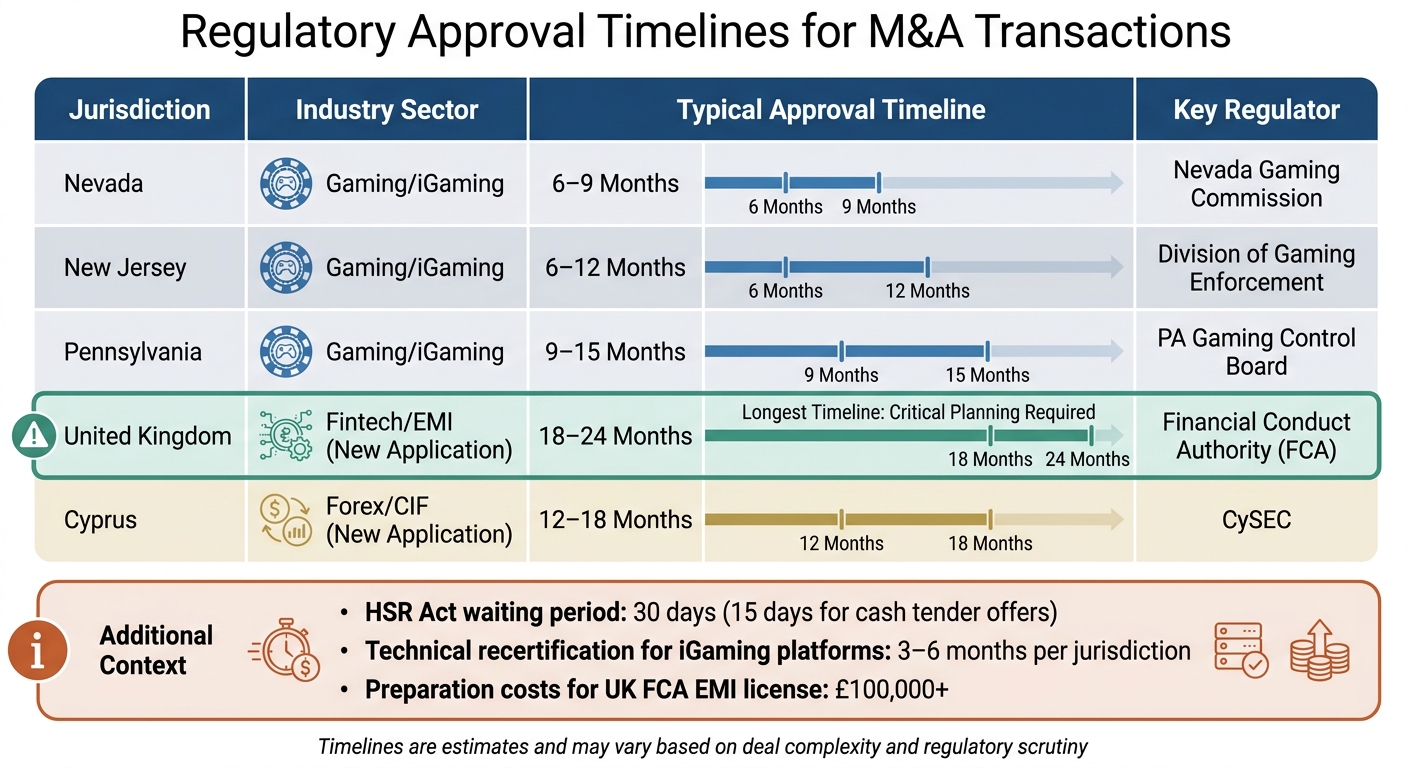 {M&A Regulatory Approval Timelines by Jurisdiction and Industry}
Navigating licensing in industries like iGaming, Crypto, Forex, and Fintech can be a make-or-break factor for mergers and acquisitions (M&A). Unlike antitrust reviews that focus on market competition, licensing requirements dig deeper, evaluating the credibility and legitimacy of prospective owners. These ownership changes are treated as checkpoints, not just formalities [8][1].
License Transfers in iGaming, Crypto, Forex, and Fintech
A company’s license doesn’t automatically transfer during an acquisition. Regulators carefully examine buyers, investors, and funding sources before approving any changes in ownership. This applies whether the acquisition involves a licensed subsidiary directly or its parent company indirectly. Regulators focus on functional control rather than just legal ownership [8][1].
Applicants need to demonstrate "good character, honesty, and integrity." This involves detailed background checks on all principals, with disclosure triggered at 5% ownership and full investigations starting at 10%. These checks can include fingerprinting, a review of a 10-year personal history, and complete documentation of the acquisition’s funding sources to ensure legitimacy [8][1].
"Gaming is among the most heavily regulated industries in the United States, and the regulatory framework governing ownership changes is designed to operate as a checkpoint rather than a notification requirement."
– Acquisition Stars [8]
Timelines for approval vary significantly. In states like Nevada, the process takes 6–9 months, while in New Jersey, it may extend to 6–12 months, and Pennsylvania can take 9–15 months [8]. For fintech companies, applying for a new UK FCA Electronic Money Institution (EMI) license can take 18–24 months, with preparation costs exceeding £100,000 [9]. This is why many buyers prefer acquiring entities that already hold licenses to save time and ensure smoother entry into the market [9].
In iGaming and sports betting, platforms must meet specific technical standards, such as GLI-19 and GLI-33, with recertification taking 3–6 months per jurisdiction. Additionally, new leadership may need "key employee" licenses, which can further delay operations [1].
For Fintech and Forex deals, maintaining existing banking relationships is often as critical as securing the license itself. Disruptions during ownership changes can severely impact a company’s operational value [9].
"In regulated financial M&A, particularly for payment institutions and EMIs, the existing banking relationships are frequently worth as much as the licence itself."
– GlobePRwire [9]
| Jurisdiction | Typical M&A Approval Timeline | Key Regulator |
|---|---|---|
| Nevada (Gaming) | 6–9 Months | Nevada Gaming Commission |
| New Jersey (Gaming) | 6–12 Months | Division of Gaming Enforcement |
| Pennsylvania (Gaming) | 9–15 Months | PA Gaming Control Board |
| UK (Fintech/EMI) | 18–24 Months (New App) | Financial Conduct Authority (FCA) |
| Cyprus (Forex/CIF) | 12–18 Months (New App) | CySEC |
These domestic hurdles hint at even greater complexities in international M&A, where differing global standards add more layers to the approval process.
Cross-Border Regulatory Challenges
Cross-border deals often face additional obstacles due to varying licensing rules, ownership restrictions, and approval processes across jurisdictions. Foreign ownership caps, for instance, can block deals outright. In the U.S., common carrier licenses are capped at 20% direct foreign ownership or 25% indirect ownership unless approved by the FCC [3]. The Committee on Foreign Investment in the U.S. (CFIUS) also reviews certain minority investments in sectors like Technology, Infrastructure, and Data (TID) [3].
For tech-focused targets, even allowing foreign personnel to access sensitive technology during due diligence can trigger "deemed export" rules, requiring a license [3].
Crypto and Fintech sectors face particularly strict oversight. In the UK, FCA-registered crypto businesses have become scarce due to tightened AML5D, FinProm, and CARF regulations [9]. Similarly, in the EU, there’s growing demand for MiCA-compliant Crypto Asset Service Providers (CASPs) [9]. The UK FCA has also introduced a new cryptoasset authorization gateway, with applications open between September 30, 2026, and February 28, 2027, for a regime starting in October 2027 [10].
"As global rules converge and enforcement intensifies, strong governance and technology-driven compliance are no longer differentiators - they are prerequisites for cross-border participation."
– Markus Veith, Partner, Grant Thornton LLP [10]
The transaction structure also plays a key role. Stock acquisitions generally allow the license to stay with the entity, triggering only ownership change reviews. On the other hand, asset acquisitions often require applying for a new license, creating a "pre-operational gap" where the buyer cannot operate until approvals are secured [1].
To navigate these complexities, buyers should identify regulatory requirements early in the process - ideally during the Letter of Intent (LOI) stage. For deals involving U.S. real property interests, buyers must also account for tax liabilities under FIRPTA, withholding 15% of the purchase price from foreign sellers unless IRS Form 8288-B is filed at least 90 days before closing [3].
How to Reduce Regulatory Risks
Regulatory delays can stretch acquisition timelines significantly. From 2022 to 2023, $361 billion in announced deals faced regulatory challenges globally, with nearly all requiring remedies, accounting for $255 billion in transaction value [2]. Tackling regulatory risks effectively from the outset can make a big difference.
Early Antitrust Analysis and Due Diligence
Starting regulatory analysis at the LOI stage helps avoid surprises later on. Begin by identifying relevant markets and calculating market shares to assess the competitive impact [13]. For U.S. transactions, confirm Hart-Scott-Rodino (HSR) thresholds early [12][13].
Cross-border deals require navigating antitrust laws across multiple jurisdictions. While U.S. and EU scrutiny can stretch closures to 12–24 months, Brazil’s average approval time has dropped to just 17 days [2]. Globally, the average time for regulatory outcomes in scrutinized deals is 12 months [2].
It's also crucial to examine the target’s compliance history for prior or ongoing regulatory investigations, audits, or qui tam actions [12][13]. Non-compliance costs can be three times higher than compliance expenses, with large firms spending an average of $10,000 per employee annually on compliance [12].
"In short, it pays to know that your company is operating within the lines."
– DealRoom [12]
Engage third-party clean teams to review sensitive data - like pricing or customer overlaps - without breaching gun-jumping rules, which prohibit premature integration [2][14][15]. This ensures both companies remain independent during the review period while allowing for integration planning [14].
For tech-heavy targets, conduct a deemed export audit to determine if sharing technical data with a foreign buyer requires licensing under Export Administration Regulations (EAR) or International Traffic in Arms Regulations (ITAR) [3]. Also, prepare for worst-case scenarios, such as extended timelines up to two years or mandatory divestitures [2].
Proactive analysis like this lays the groundwork for solid contractual protections.
Using Hell-or-High-Water Provisions
Beyond due diligence, strong contractual commitments help secure deals. Hell-or-high-water provisions are the buyer’s most robust regulatory commitment, requiring them to take "all necessary steps" to gain approval, no matter the cost [16][18]. However, only 6% of public M&A agreements include unqualified hell-or-high-water clauses [17]. Adding qualifiers like "materiality" or "commercially reasonable" weakens their effectiveness and may lead to disputes [17].
In a notable case, Desktop Metal, Inc. v. Nano Dimension Ltd., the Delaware Court of Chancery ruled in March 2025 that the buyer breached its hell-or-high-water clause by delaying and backtracking during the CFIUS approval process. The court ordered specific performance, requiring the buyer to complete the merger [18].
"Hell-or-high-water provisions are the most 'extreme.' They are the strongest possible commitment a party can make in a merger agreement with respect to regulatory approval."
– Delaware Court of Chancery [18]
To avoid disputes, specify required actions, such as divestitures or litigation, directly in the agreement [16]. Set realistic long-stop dates of 12 to 18 months to account for regulatory delays [14]. According to M&A partners, 21% of long-stop dates now average one year, with some extending to 18 months [14].
A "fix-it-first" strategy can also be effective. This involves divesting problematic assets to third parties before seeking regulatory approval, reducing the likelihood of prolonged investigations [14].
Working with Expert Advisors
While contractual clauses reduce risk, expert advisors are essential for managing regulatory timelines. M&A advisors bring critical experience in navigating complex multi-jurisdictional regulations. They can provide realistic expectations for "time-to-control", which is especially important as approval timelines grow longer [14].
"Seeking guidance from advisors who have been through the relevant regulatory processes means you can leverage their experience to anticipate likely timeframes."
– Eversheds Sutherland [14]
Advisors coordinate multi-jurisdictional workstreams, ensuring alignment on issues like tax treaty analysis, FIRPTA withholding (buyers must withhold 15% of proceeds from foreign sellers [3]), and local regulatory filings [3]. For telecommunications infrastructure deals, they manage additional "Team Telecom" reviews by the DOJ, DHS, and DOD, which can add months even after CFIUS clearance [3].
Engage CFIUS and antitrust counsel during the LOI stage to align regulatory timelines with the deal schedule [3]. Developing a comprehensive regulatory map that outlines required approvals, timelines, and interdependencies is critical [3]. For targets in Technology, Infrastructure, or Data (TID) sectors, advisors can determine whether mandatory CFIUS filings apply [3].
Advisors also help set up clean team protocols during the interim period between signing and closing. This ensures necessary information sharing while avoiding hefty antitrust fines for premature integration [14]. Additionally, they assist in negotiating hell-or-high-water provisions and structuring mitigation strategies that can significantly impact deal success.
"Transaction success will increasingly depend on how well buyers anticipate post-signing constraints, extended timelines and staged or conditional integration."
– Eversheds Sutherland [15]
How MyReadyMade Supports Regulatory Contingencies
MyReadyMade steps in to address the specific challenges of regulated industries, offering tailored solutions for M&A transactions in sectors like iGaming, Crypto, Forex, and Fintech. By focusing on these high-stakes industries, the platform bridges critical gaps in managing regulatory complexities.
Verified Listings and Confidential Transactions
Every business listed on MyReadyMade undergoes a thorough verification process. This includes checks on financials, licenses, and operational legitimacy to reduce the chances of uncovering issues like licensing gaps or financial inconsistencies during due diligence [19]. To protect all parties involved, the platform enforces NDA-protected communications, ensuring identities remain confidential until both sides agree to disclosure [19].
The platform's AI-powered valuation tools, combined with a 94% success rate and over $420 million in transaction volume from 130+ closed deals, empower sellers to estimate their business's value with accuracy before entering negotiations [19]. Buyers gain access to 45 iGaming, 28 Cryptocurrency, 19 Forex, and 23 Fintech opportunities - all verified and ready to bypass time-consuming licensing processes [19]. This verification system is further bolstered by expert advisory services, ensuring smooth regulatory filings and license transfers.
Expert Advisory and License Transfer Support
MyReadyMade extends its support beyond listings with dedicated M&A advisors specializing in regulated industries. These experts guide clients through the intricacies of acquisitions, including license transfers across more than 50 jurisdictions and the formal "Change of Control" application process, which can take three to six months in areas like Cyprus [20].
"We focus exclusively on regulated and high-risk industries where expertise matters most."
– MyReadyMade [19]
Advisors also coordinate multi-jurisdictional compliance efforts, ensuring proper alignment on regulatory filings, updated business plans, and documentation required by authorities like the FCA or CySEC [20]. With 24/7 deal support for time-sensitive negotiations, MyReadyMade reduces the average transaction timeline to just 30–45 days [19]. Backed by a 4.9/5 rating from over 500 buyers globally, the platform combines efficiency with reliability, turning regulatory obstacles into seamless transactions [19]. Through its comprehensive approach, MyReadyMade simplifies the complexities of regulated M&A deals, ensuring secure and efficient outcomes.
Key Takeaways on Regulatory Contingencies
Regulatory contingencies play a pivotal role in determining whether an M&A deal goes through smoothly, faces delays, or falls apart entirely. In the iGaming industry, the stakes are heightened by license limitations, which demand attention as early as the LOI (Letter of Intent) stage[1]. Over in the crypto sector, companies must navigate a maze of rules, including MSB registration, the EU's MiCA framework, and the UK FCA's cryptoasset authorization set to take effect in September 2026[10].
Strict compliance with AML (Anti-Money Laundering) regulations is non-negotiable, as evidenced by hefty penalties like Binance's $4.3 billion fine and OKX's $500 million settlement[10]. To avoid last-minute surprises, early efforts to map out beneficial ownership, understand change-of-control definitions, and address technical certification requirements are crucial[1].
The regulatory landscape is also evolving. The GENIUS Act, effective July 2025, expanded oversight of payment stablecoins under the Bank Secrecy Act, requiring thorough AML and OFAC screening measures[10]. Additionally, the SEC and CFTC's Memorandum of Understanding from March 2026 highlights a more coordinated approach to digital asset oversight[11]. Buyers who invest in robust AML due diligence and use blockchain analytics to evaluate jurisdictional exposure can significantly reduce risks after closing.
To tackle these challenges, platforms like MyReadyMade offer valuable support. They provide verified listings with clean compliance records, expert advisors to handle multi-jurisdictional filings across 50+ regions, and assistance with license transfers. This approach can shorten transaction timelines to just 30–45 days, turning regulatory obstacles into more manageable tasks.
Ultimately, proactive planning and expert guidance are key to navigating regulatory complexities and ensuring smoother closings in regulated M&A transactions.
FAQs
When should we start planning for regulatory approvals in an M&A deal?
Planning for regulatory approvals needs to start as early as the deal structuring phase. This gives you the chance to work through various regulatory frameworks, anticipate any potential delays, and address compliance requirements. Starting early helps minimize setbacks and keeps the transaction process on track.
How do we choose between a stock deal and an asset deal to avoid licensing delays?
When deciding between a stock deal and an asset deal, licensing requirements often play a critical role.
- Asset deals allow buyers to pick and choose specific assets, which can help avoid the need for transferring licenses - a process that might otherwise cause delays.
- Stock deals, on the other hand, involve the transfer of the entire company, including its licenses. This usually triggers regulatory reviews, which can extend timelines.
In highly regulated industries like iGaming, careful planning and early communication with regulatory authorities are essential to keep delays to a minimum, regardless of the deal structure.
What does a hell-or-high-water clause actually force the buyer to do?
A "hell-or-high-water" clause in M&A agreements obligates the buyer to do whatever it takes to secure regulatory approvals and finalize the deal, regardless of the difficulties or adverse conditions they might encounter. Essentially, the buyer is required to put in maximum effort to address and resolve any challenges that come up during the process.
Related Articles

Ultimate Guide to Earnout Negotiations in M&A
Structure and negotiate earnouts in regulated M&A with clear metrics, anti-manipulation covenants, and acceleration or escrow protections.

How to Draft M&A Definitive Agreements
Guide to drafting M&A definitive agreements covering deal structure, reps & warranties, indemnities, payment terms, and regulatory compliance.

How IP Affects Tokenization Valuation
How tokenizing patents, copyrights, and trademarks adds liquidity and market value—plus legal, regulatory, and valuation steps.
Looking to Buy or Sell?
Get in touch with our team for personalized assistance