How IP Affects Tokenization Valuation

How IP Affects Tokenization Valuation
Tokenizing intellectual property (IP) is transforming how assets like patents, copyrights, and trademarks are valued. By converting these assets into digital tokens, IP becomes tradable, increasing its market value through improved liquidity and transparency. However, assigning accurate valuations to tokenized IP is challenging due to illiquidity, territorial regulations, and the need for blockchain-specific metrics. Here's what you need to know:
- What is Tokenization Valuation? It determines the market value of digital tokens tied to assets, blending financial analysis with blockchain factors like liquidity and smart contracts.
- Why IP Matters: IP contributes $6.6 trillion annually to the U.S. economy. Tokenization turns these intangible assets into liquid, tradable units, attracting global investors.
- Challenges: Valuing IP involves predicting future revenue, navigating territorial IP laws, and ensuring compliance with global regulations.
- How IP Adds Value: Patents, copyrights, and trademarks benefit from automated royalties, fractional ownership, and real-time pricing, enhancing their appeal.
- Accurate Valuation Steps: Legal audits, measuring liquidity gains, and applying blockchain-specific metrics are critical for reliable valuations.
Tokenization is reshaping IP valuation, but success hinges on legal structuring, smart contract accuracy, and market-driven pricing.
Tokenization in Action: Commodities, IP, and Art
sbb-itb-ba142f6
Problems with IP Assessment in Tokenized Platforms
Valuing intellectual property (IP) within tokenized platforms introduces a host of challenges that go well beyond traditional appraisal methods. These issues are even more complex in regulated sectors like cryptocurrency, fintech, and iGaming, where cross-border operations and intricate legal frameworks make the process even harder to navigate.
IP Illiquidity and Market Challenges
A major hurdle lies in the inherent illiquidity of IP assets. Unlike stocks or bonds, IP assets - such as patents, trademarks, and copyrights - are not easily fragmented or traded. This makes assigning a clear price to them a difficult task. Despite the global value of intangible assets being estimated at $80 trillion in 2024, less than 0.1% of global IP is represented on blockchain platforms[10].
This gap exists largely because IP valuation depends on its future revenue potential rather than historical cost. Predicting future earnings is inherently uncertain, which complicates standardized pricing models[9][1]. As Chainlink highlights:
"IP's value is based on future potential. This uncertainty makes pricing difficult."[9]
Unlike physical assets like real estate or commodities, IP lacks the concrete benchmarks that facilitate valuation, further complicating its integration into tokenized systems.
Why Traditional Valuation Methods Fall Short
Conventional appraisal methods approach IP as a static asset, typically managed through offline documentation and periodic reviews. Tokenization, however, redefines IP as a dynamic financial instrument with programmable rights and the potential for continuous, global trading[9]. This shift introduces factors that traditional methods fail to consider, such as:
- Liquidity premiums from fractional ownership
- Real-time performance data available on-chain
- Revenue flows managed through smart contracts[9][3][11]
Additionally, IP tokens often come with added utility, like automated licensing or governance features, which standard models overlook[3][1]. These gaps highlight the need for a more nuanced approach to valuing tokenized IP that reflects its unique characteristics.
The Impact of Regulatory Variations
Another layer of complexity arises from how IP rights, such as trademarks and patents, are territorial. Registration in one country does not automatically provide protection in another. Meanwhile, blockchain operates globally, creating valuation inconsistencies and increasing the risk of infringement when assets cross borders[4]. As Casper Schouten, VP at Teknos Associates, explains:
"Trademarks are territorial, meaning that registration in one country does not guarantee rights in another."[4]
This territorial nature poses serious challenges for cross-border tokenized transactions. Under IRC § 482, for instance, transfers must meet the "arm's length standard" for tax purposes. Incorrect valuations can lead to hefty tax penalties and regulatory scrutiny due to income-shifting concerns[4].
Moreover, platforms operating in multiple jurisdictions must navigate a patchwork of laws, including varying levels of IP protection, securities regulations (such as those enforced by the SEC in the U.S. versus ESMA in Europe), and conflicting privacy rules like GDPR[2][5]. Each jurisdiction adds its own layer of complexity, making traditional valuation methods ill-equipped to address the needs of tokenized IP in regulated industries.
How IP Increases Tokenization Valuation
Tokenized platforms are showing how well-structured intellectual property (IP) can significantly enhance market value. While IP valuation comes with its challenges, it remains a powerful tool for driving value. When organized effectively, IP can unlock fresh revenue opportunities, improve liquidity, and attract higher valuations during mergers and acquisitions. Here's a closer look at how different types of IP contribute to platform valuation.
Patents and Automated Licensing Revenue
Patents can deliver steady and verifiable revenue streams through the use of smart contracts. These contracts automate licensing and royalty payments, streamlining processes that once relied on manual approvals. For example, licenses are automatically issued when predefined conditions - like payment or KYC verification - are met, eliminating delays common in traditional systems[7][8].
Smart contracts also handle royalty calculations and payouts, enabling real-time settlements based on usage metrics or revenue sharing agreements[7]. This setup transforms patents, traditionally seen as illiquid assets, into digital units that can be traded. Owners can monetize their inventions across various industries or regions simultaneously through specific scopes, such as "field-of-use" or "time-limited" agreements[8].
On-chain activity and immutable licensing records provide clear pricing signals, making valuation models more precise and dynamic compared to subjective traditional methods[7][3]. Tokenized patents can even act as collateral for financing, helping research-heavy companies access new funding sources[3]. Essentially, tokenization turns static patents into flexible, revenue-generating assets.
| Feature | Traditional Patent Licensing | Tokenized Patent Licensing |
|---|---|---|
| Settlement Speed | Weeks to months (manual) | Near-instant (automated) |
| Ownership | Often binary/undivided | Fractionalized and liquid |
| Royalty Payouts | Delayed, prone to errors | Real-time, programmable splits |
| Transparency | Opaque, private contracts | Immutable, on-chain audit trail |
| Access | Limited to large entities | Global, democratized access |
Other forms of IP also bring distinct benefits that enhance tokenization's overall impact.
Copyrights and Fractional Trading Liquidity
Copyrights offer the ability to fractionalize high-value assets, converting them into digital tokens. This opens up investment opportunities to smaller investors and retail participants, breaking down barriers that previously favored larger studios or wealthy individuals. Unlike traditional copyright transactions, which can take months, tokenized copyrights are traded around the clock on blockchain marketplaces, providing immediate liquidity.
For instance, fractional tokenization of copyrights has shown how it can democratize access to revenue streams while offering instant liquidity. Standards like ERC-2981 make this even more attractive by using smart contracts to automate revenue distribution from activities like streaming, licensing, or sales. These payouts are transparent and instant, making the assets more appealing to investors.
Creators can sell a portion of their copyright tokens to generate liquidity while still retaining majority ownership and creative control over their work. This model not only provides financial flexibility but also strengthens the appeal of tokenized copyrights.
Trademarks and Brand Value Multiples
Trademarks play a critical role in boosting platform valuation by providing verifiable provenance and reducing the risk of legal disputes. Tokenized trademarks offer an immutable transaction history and proof of ownership, which helps combat counterfeiting and maintain brand integrity[6][13]. This level of transparency often results in higher valuation multiples, especially during mergers and acquisitions.
Through fractional ownership, tokenized trademarks invite a wider pool of global investors and increase asset liquidity[6][3]. Unlike traditional trademarks, which rely on infrequent and subjective valuations, tokenized trademarks generate real-time pricing signals thanks to on-chain trading activity[7]. In virtual spaces, trademarked assets - such as digital fashion or "digital twins" - gain value from factors like social status and community perception. In some cases, the digital version of a branded product can even surpass the value of its physical counterpart[13].
As PatentPC explains:
"In the metaverse, IP valuation is less about supply and more about perception, scarcity, and community."[13]
Smart contracts can also enforce specific usage rights and quality controls for brand collaborations. This ensures that a brand's value remains intact when licensed across decentralized platforms[8]. By replacing paper-based agreements with dynamic, real-time systems, tokenization introduces a new way to manage and preserve brand value. This shift highlights how tokenization is reshaping traditional IP valuation.
How to Accurately Value IP in Tokenized Platforms
Valuing intellectual property (IP) on tokenized platforms requires blending traditional legal evaluations with blockchain-specific metrics. With the global IP market valued at $80 trillion but less than 0.1% of it operating on blockchain, the untapped potential is massive [10].
Step 1: Conduct IP Ownership and Legal Audits
To begin, confirm the legal ownership of the IP. Before assigning any value, ensure the asset can legally be tokenized. Define the IP clearly - whether it’s a patent, trademark, copyright, or trade secret - and assess its commercial potential.
Verify the chain of title to confirm that the entity has the legal right to tokenize the asset. Often, this involves transferring the IP into a legal entity, such as a Cayman Foundation or Special Purpose Vehicle, which then issues rights tied to the digital token. The token should include metadata linking to immutable legal agreements and registration documents.
For collaborative projects, examine joint R&D agreements to clarify ownership percentages based on contributions. Cross-border operations require recording transfers with the appropriate trademark or patent offices to avoid complications. As Casper Schouten, VP at Teknos Associates, cautions:
"Without a defensible valuation, the IRS may argue that the U.S. entity undercharged for the transfer, resulting in improper income shifting offshore."
Maintain detailed IP registers, logging assets like patents, trade secrets, and software code repositories. Embedding legally binding documents into the NFT metadata ensures they are recognized in traditional legal systems. Once ownership is verified, the focus shifts to quantifying the liquidity premium created by tokenization.
Step 2: Measure Liquidity Gains from Tokenization
Liquidity premiums are a key driver of value for tokenized IP. To measure these gains, compare the tokenized asset to similar security tokens trading on secondary markets. This benchmarking reflects actual investor demand and helps establish Fair Market Value (FMV) [14]. The tokenized asset market is expected to grow from $36 billion in early 2026 to $400 billion by the end of the same year [15].
Calculate the liquidity premium by comparing the value of a whole, illiquid IP asset to the sum of its fractionalized, tradable parts. Monitor adoption metrics such as user growth, transaction volume, and ecosystem activity [16]. Use data from regulated marketplaces to refine valuations as market conditions change.
Some advanced valuation tools now leverage AI to integrate historical data with predictive analytics, showing how fractionalization impacts demand. Peter Gaffney, Head of Research at Security Token Advisors, notes:
"The ability for Ovenue to act as a pseudo benchmark for security tokens to trade against and reflect the proper Fair Market Value."
Your valuation model should incorporate network effects, including adoption rates, transaction activity, and ecosystem utility. For income-focused approaches, include revenue from token-based royalties and platform fees. Real-world asset (RWA) tokens are expected to exceed $100 billion in total value locked by the end of 2026 [15].
With liquidity gains calculated, refine the valuation further using blockchain-specific metrics.
Step 3: Use Blockchain-Specific Valuation Metrics
Blockchain-specific metrics bring a dynamic edge to IP valuation. They incorporate factors like ecosystem adoption, user growth, transaction throughput, and token utility - addressing the limitations of static traditional methods. Smart contracts can integrate off-chain data (e.g., music streams or product sales) to automate royalty payouts.
On-chain trading activity, historical transactions, and licensing revenue provide real-time pricing signals, enabling frequent updates to valuations. For early-stage tokens, consider volatility starting from their ICO dates rather than fixed calendar periods. For vested tokens under lock-up, models like the Ghaidarov Average Strike Protective Put Option Model are often better suited than Black-Scholes in high-volatility scenarios exceeding 150% [17].
Use a mix of cost-, market-, and income-based approaches for a comprehensive valuation. Identify the exchange with the highest trading volume for the token to determine the most accurate "exit price." Be cautious of trading volumes around ICO events, as these can be artificially inflated by market makers [17].
| Valuation Approach | Application in Tokenized IP | Key Metric to Factor In |
|---|---|---|
| Cost-Based | Historical R&D and legal costs | Replacement cost of the protocol |
| Market-Based | Comparable licensing or token trades | Secondary market transaction volume |
| Income-Based | Discounted cash flows from royalties | Token-based revenue share percentages |
| Option-Based | Speculative/early-stage projects | Potential future network adoption |
For platforms with active token economies or royalties, income-based methods often work best. For early-stage technologies with uncertain revenue but high potential, option-based valuation is more appropriate. As Law Gratis points out:
"IP value depends on: Token utility and revenue potential, Ecosystem adoption, [and] Contribution to platform governance and network security."
To provide transparency for investors, funds holding tokenized IP can implement proof of reserve through automated on-chain verification. This transforms IP from a static legal asset into a liquid, programmable digital asset that can be fractionalized and traded globally.
Applying IP Valuation in Tokenized M&A Transactions
::: @figure 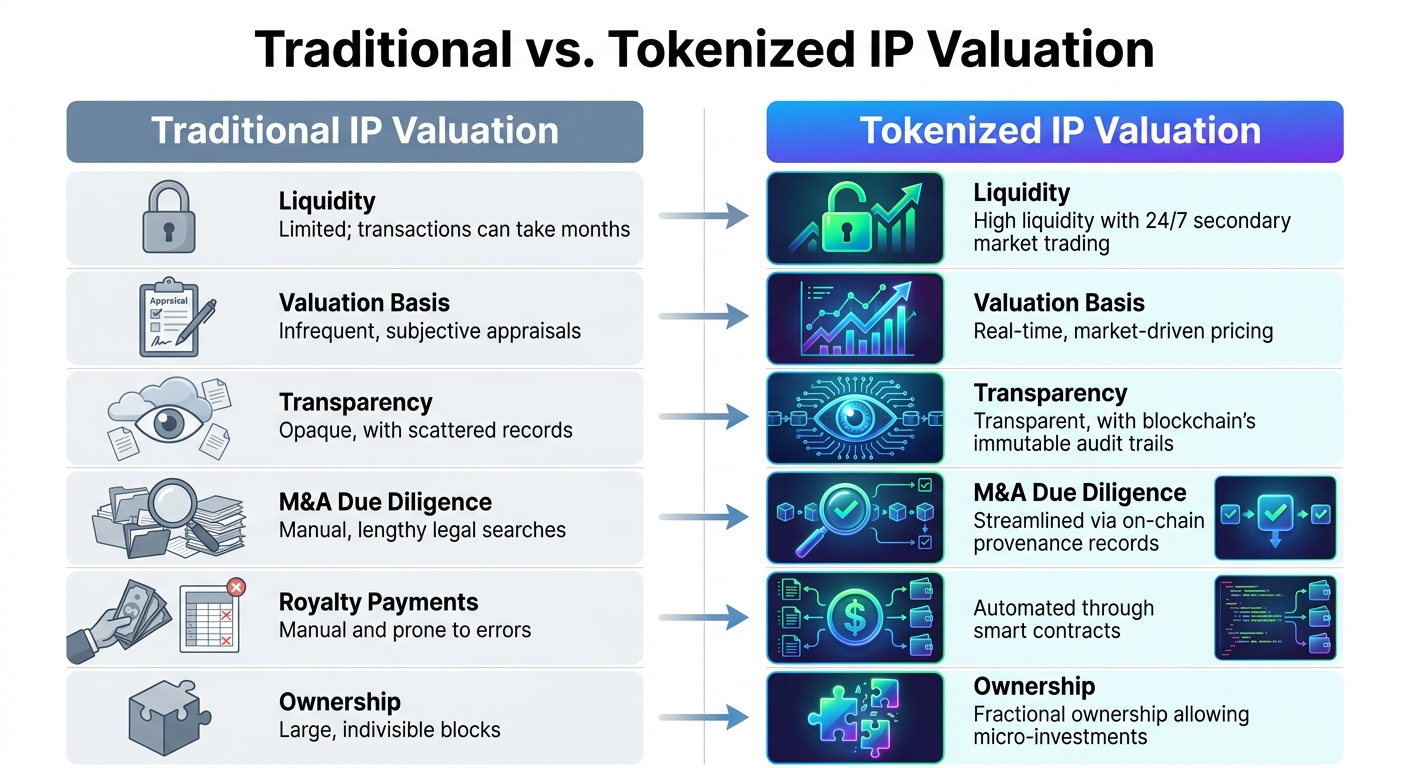 {Traditional vs Tokenized IP Valuation: Key Differences in M&A Transactions}
When buying or selling a tokenized platform, evaluating intellectual property (IP) is a crucial part of structuring the deal. Unlike traditional mergers and acquisitions (M&A), where IP is often buried within complex financial statements, tokenized IP provides real-time market data that reshapes negotiations. This shift from static appraisals to blockchain-based pricing introduces both opportunities and challenges for dealmakers.
Traditional vs. Tokenized IP Valuation
The way IP is valued in traditional settings compared to tokenized platforms significantly impacts timelines, pricing accuracy, and post-deal processes. Traditional IP transactions often drag on for months due to manual legal procedures and fragmented ownership records. Tokenized IP, on the other hand, benefits from blockchain's transparency, speeding up due diligence and finalizing deals faster.
| Feature | Traditional IP Valuation | Tokenized IP Valuation |
|---|---|---|
| Liquidity | Limited; transactions can take months | High liquidity with 24/7 secondary market trading |
| Valuation Basis | Infrequent, subjective appraisals | Real-time, market-driven pricing |
| Transparency | Opaque, with scattered records | Transparent, with blockchain's immutable audit trails |
| M&A Due Diligence | Manual, lengthy legal searches | Streamlined via on-chain provenance records |
| Royalty Payments | Manual and prone to errors | Automated through smart contracts |
| Ownership | Large, indivisible blocks | Fractional ownership allowing micro-investments |
These differences highlight how tokenized IP can revolutionize the IP valuation process, creating opportunities for specialized platforms to thrive.
One standout advantage of tokenized IP is the automation of royalty payments using smart contracts. This feature simplifies post-merger integration. As Gabrielle, a blockchain expert, explains:
"Smart contracts enable licenses to be issued automatically once predefined conditions are satisfied... reducing administrative overhead and minimizing settlement delays."
How MyReadyMade Simplifies IP Valuation
MyReadyMade’s platform is designed to address the complexities of valuing tokenized IP during M&A transactions. Using an AI-powered business valuation system, it combines traditional financial data with blockchain-specific metrics like on-chain transaction volume, token utility, and ecosystem adoption. This comprehensive approach ensures a well-rounded valuation for cryptocurrency and fintech platforms.
Beyond valuation, MyReadyMade offers expert M&A advisory services, including pre-sale IP audits (typically conducted 12–18 months before a sale), resolution of ownership disputes, and detailed documentation of AI models and data sources. Their platform supports license transfers across more than 50 jurisdictions, helping businesses navigate the maze of regulatory requirements.
Deals on MyReadyMade often close within 30–45 days - significantly faster than traditional M&A timelines. This efficiency is achieved through NDA-protected communication, 24/7 support, and a success-based fee structure, where sellers only pay when their business is sold.
Due Diligence Checklist for Tokenized IP
A thorough due diligence process is critical for ensuring the integrity and value of tokenized IP. Here are key elements to verify:
Asset Identification and Legal Mapping: Confirm the specific IP rights being transferred - whether ownership, licensing, or royalties - and ensure there’s a legally enforceable link between the physical asset and its digital token.
Chain of Title Verification: Validate ownership or licensing rights using off-chain notarization or verifiable credentials to avoid acquiring unenforceable IP.
Smart Contract Audit: Check that legal terms such as royalty splits, territorial scope, and expiration dates are accurately coded into the smart contract.
Market-Based Valuation Signals: Review secondary market activity and on-chain licensing revenue to ensure pricing reflects current market trends.
Regulatory Compliance Review: Verify that the tokenized IP complies with local IP laws, U.S. securities regulations (e.g., SEC requirements), and AML/KYC standards for token holders.
Metadata Security: Ensure sensitive IP details are securely linked to on-chain tokens using cryptographic hashes, ideally stored on decentralized solutions like IPFS or Arweave to prevent tampering.
Royalty Standards: Confirm that tokens follow established standards like ERC-2981 to ensure consistent royalty payments and safeguard revenue streams post-acquisition.
Following this checklist helps protect the value of tokenized IP and ensures a smoother transaction process in M&A deals involving blockchain technology.
Conclusion
Valuing intellectual property (IP) in tokenized platforms demands a shift from old-school appraisal methods to flexible, market-driven approaches. Tokenization not only upholds legal IP protections but also boosts commercial value by introducing transparent, real-time pricing through secondary market trading and automated royalty tracking via smart contracts.
IP adds an impressive $6.6 trillion annually to the U.S. economy and makes up nearly 40% of GDP in developed nations [12]. Tokenization tackles long-standing valuation issues by offering verifiable, blockchain-backed audit trails. This transforms IP from being a static legal concept into a liquid, tradable asset.
For mergers and acquisitions (M&A), the key point is clear: a token’s worth hinges on enforceable legal rights. Without proper legal structuring, a token is nothing more than a digital collectible, not a legitimate IP claim [18]. This underscores the importance of conducting detailed legal audits before tokenization, confirming ownership, and ensuring smart contracts accurately reflect royalty arrangements, territorial rights, and expiration details.
Platforms like MyReadyMade are stepping up to address these challenges with practical solutions. MyReadyMade integrates traditional financial data with blockchain-specific metrics, such as on-chain transaction volumes and token functionality, through its AI-powered valuation system. Supporting license transfers across 50+ jurisdictions and enabling deals to close in just 30–45 days, the platform simplifies processes that typically take months. Sellers benefit from pre-sale IP audits and expert advisory services, while buyers gain access to transparent, market-based valuations and verified listings. This blend of legal precision and tech-driven efficiency sets a new standard for IP valuation.
The future of IP valuation lies in combining blockchain’s transparency with strict legal compliance. Whether it’s patents, copyrights, or trademarks, the foundation remains the same: solid legal rights, automated revenue tracking, and ongoing market-based pricing.
FAQs
Does tokenizing IP change who legally owns it?
Tokenizing intellectual property doesn’t change who legally owns it. Instead, it converts ownership rights into digital tokens, which represent shares or portions of the asset. The original owner still holds the legal rights.
How do territorial IP laws affect a global IP token?
Territorial intellectual property (IP) laws can make enforcing, transferring, and licensing global IP tokens a complex task. To keep tokenized rights valid and protected across different regions, it's crucial to comply with varying legal frameworks. Navigating these differences demands careful attention to ensure both legal and operational alignment.
What on-chain metrics matter most for valuing IP tokens?
Key factors for assessing the value of IP tokens on-chain include liquidity, trading volume, and overall market activity. These metrics reveal how much interest the market has in the tokens and how easily they can be traded - both of which are essential for determining their true value.
Related Articles

Ultimate Guide to Earnout Negotiations in M&A
Structure and negotiate earnouts in regulated M&A with clear metrics, anti-manipulation covenants, and acceleration or escrow protections.

How to Draft M&A Definitive Agreements
Guide to drafting M&A definitive agreements covering deal structure, reps & warranties, indemnities, payment terms, and regulatory compliance.

Regulatory Contingencies in M&A: What to Know
Anticipate regulatory approvals, antitrust and licensing risks in M&A—timelines, remedies, and contract protections.
Looking to Buy or Sell?
Get in touch with our team for personalized assistance