Legal Due Diligence for Tokenized Asset Platforms

Legal Due Diligence for Tokenized Asset Platforms
Acquiring a tokenized asset platform in 2026 is a complex process that demands a detailed legal review. Missteps can lead to penalties, significant delays, or even operational shutdowns. Here's what you need to know:
- Token Classification Matters: Mislabeling tokens as "utility" or "governance" can lead to violations of securities laws. Regulators focus on the token's actual economic function, not how it's marketed.
- Regulatory Compliance Is Key: Platforms must adhere to strict AML/KYC protocols, secure proper licenses, and align with evolving global regulations like MiCA (mandatory in the EU by July 1, 2026).
- Smart Contract Integrity: Legal frameworks must match the platform's blockchain operations. Poorly designed contracts can result in enforcement gaps and compliance risks.
- Data Privacy and Governance: Weak governance and mishandling of personal data can expose platforms to regulatory scrutiny and financial penalties.
- Cost of Non-Compliance: Penalties can reach 10% of global turnover, while remediation costs for switching platforms can range from $50,000 to $150,000.
Platforms like MyReadyMade streamline the due diligence process by offering pre-verified listings, license transfer support, and expert M&A advisory services. This helps buyers identify risks early and avoid costly mistakes.
Bottom Line: Legal due diligence is no longer optional - it’s essential for mitigating risks and ensuring a smooth acquisition process.
Common Legal Risks in Tokenized Asset Platform Acquisitions
::: @figure 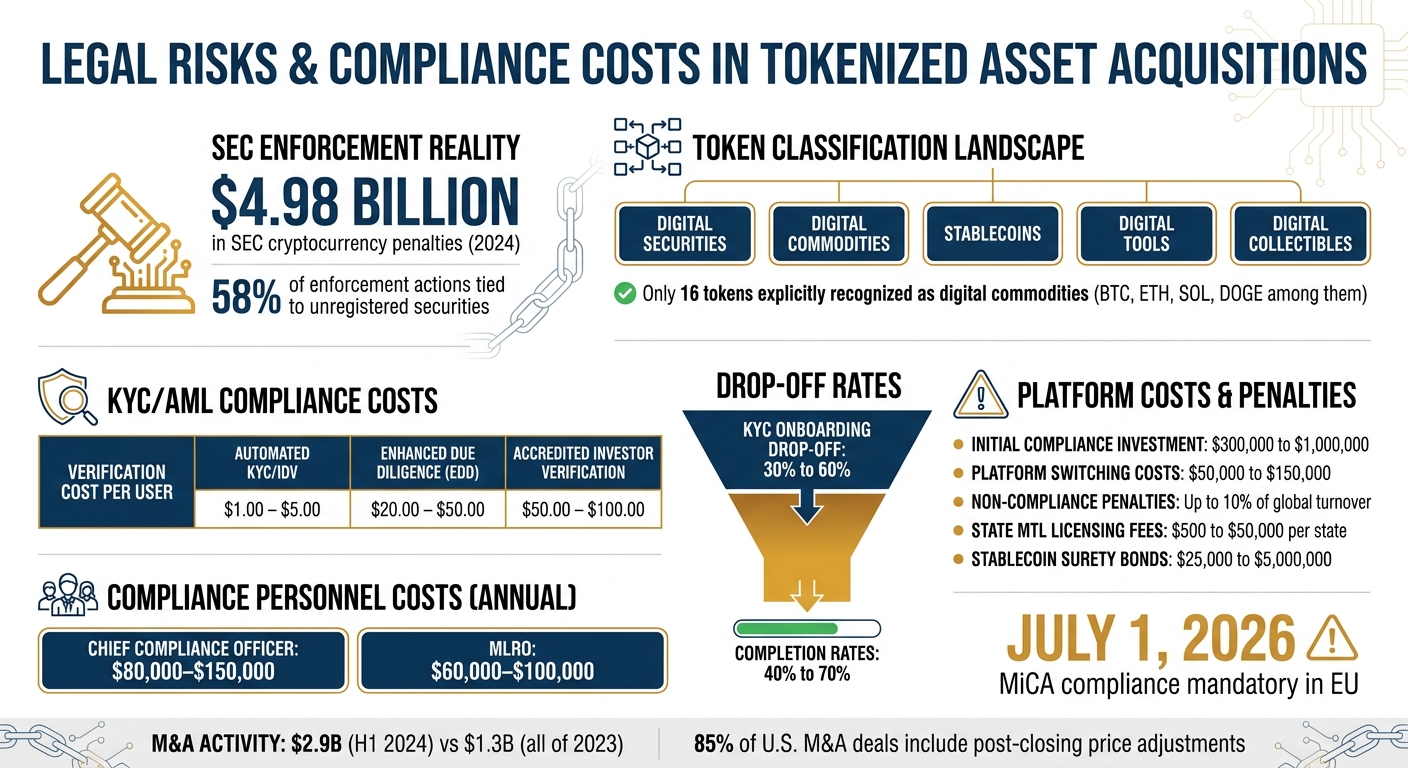 {Legal Risks and Costs in Tokenized Asset Platform Acquisitions 2024-2026}
Acquiring a tokenized asset platform comes with significant legal risks that can escalate quickly and cost a fortune. For instance, the SEC's cryptocurrency enforcement program collected $4.98 billion in penalties during 2024, with 58% of enforcement actions tied to unregistered securities offerings [12]. These liabilities don’t vanish with a change in ownership - they stick with the platform. Below, we’ll break down the key legal risks and their implications.
Token Classification and Regulatory Uncertainty
The SEC and CFTC issued a five-category token taxonomy in their 2026 Joint Interpretive Release, covering digital securities, digital commodities, stablecoins, digital tools, and digital collectibles [6][7]. However, only 16 tokens are explicitly recognized as digital commodities under the CFTC's jurisdiction, including BTC, ETH, SOL, and DOGE [6]. For all other tokens, classification requires careful scrutiny.
Labeling tokens as "utility" or "governance" often creates a false sense of security. If a token distributes revenue, pays dividends, or gives holders claims on an asset pool, it’s likely a digital security requiring SEC registration [6]. Regulators use the "substance-over-form" doctrine, focusing on the token's economic function rather than its marketing label. As Astraea Counsel puts it:
"The taxonomy tells you what your token is. Howey tells you whether how you sold it created a security" [6].
Yield-bearing stablecoins are especially risky. If they fall outside the GENIUS Act's "payment stablecoin" safe harbor and issuers make active representations, they may be classified as securities [6][7]. Even tokens traded on secondary markets can be problematic if issuers continue making public statements (e.g., on social media or through roadmaps) [7]. Documents like pitch decks, Discord chats, and social media posts are often used as evidence of an investment contract, regardless of disclaimers [6][8].
Beyond token classification, compliance also depends on strong AML/KYC protocols.
AML/KYC and Licensing Deficiencies
Operating without proper licenses can lead to immediate shutdowns and even fund confiscation. In the EU, the deadline is July 1, 2026, when MiCA compliance becomes mandatory [10]. Any platform operating without authorization after this date will be in breach of the law.
"From 2026 onward, MiCA is no longer a future compliance topic. It becomes an operational baseline. Any crypto business that falls within its scope without proper authorization will be operating unlawfully." – Ilona Maklakova, Web3 Legal Expert [10]
Weak KYC processes can allow noncompliant investors onto the platform, creating liability for the acquirer. Stringent KYC requirements often result in onboarding drop-off rates of 30% to 60%, with completion rates ranging from 40% to 70% [9]. Verification costs vary widely:
| Verification Type | Typical Cost per User |
|---|---|
| Automated KYC/IDV | $1.00 – $5.00 |
| Enhanced Due Diligence (EDD) | $20.00 – $50.00 |
| Accredited Investor Verification | $50.00 – $100.00 |
AML shortcomings can lead to loss of banking relationships and payment processing services, which can cripple the business. Fines for non-compliance may reach 10% or more of global turnover [4]. Additionally, state-level licensing fees for Money Transmitter Licenses range from $500 to $50,000 per state, while surety bonds for stablecoin issuers can cost between $25,000 and $5,000,000 [6].
On top of licensing challenges, data privacy and governance are critical for maintaining platform integrity.
Data Privacy and Governance Failures
Many platforms fail to align governance practices with tokenized operations. A common issue is neglecting to update traditional fund documents to reflect token-specific features like voting rights or automated distributions [1]. Smart contract governance often doesn’t match the rights outlined in legal agreements, creating enforcement gaps.
Regulators also scrutinize centralized control. Platforms where teams retain full control over protocol upgrades or admin keys are often flagged as securities [12]. Poor custody governance - such as the absence of multi-signature protocols or disaster recovery plans - can result in total capital loss if key holders are compromised [1][11].
Data privacy is another weak spot. Many platforms don’t securely handle sensitive personal information collected during onboarding, such as tax returns or bank statements for accredited investor verification [12]. Without formal conflict-of-interest policies, platforms also risk falling foul of MiCA requirements [12][10].
Technical Infrastructure and Audit Weaknesses
Compliance gaps often stem from poor integration of regulatory requirements into smart contracts. For instance, failing to use standards like ERC-3643 can allow secondary transfers to bypass restrictions, exposing the platform to legal risks. Token standards must align with transfer restrictions, and distribution mechanisms must reflect legal waterfall provisions [1][11].
Switching tokenization platforms mid-project due to compliance or technical issues can cost anywhere from $50,000 to $150,000 [3]. Platforms without thorough smart contract audits face even greater risks. Initial compliance investments for a medium-sized platform generally range from $300,000 to $1,000,000, while annual costs for compliance personnel include:
- Chief Compliance Officer: $80,000–$150,000
- MLRO (Money Laundering Reporting Officer): $60,000–$100,000 [4]
These costs highlight the importance of robust technical and compliance due diligence when acquiring tokenized asset platforms.
sbb-itb-ba142f6
Solutions for Legal Challenges in Tokenized Asset Platform Acquisitions
Navigating the legal complexities of acquiring tokenized asset platforms requires a well-structured plan that blends regulatory insight, technical safeguards, and operational precision. Below are practical strategies to tackle these challenges.
Establishing Token Classification and Compliance
The first step is securing a legal opinion on token classification, referencing the SEC and CFTC's five-category taxonomy issued on March 17, 2026. This classification clarifies compliance requirements and associated costs. For instance, digital securities involve SEC registration fees of about $150 per $1 million registered, whereas digital commodities face fewer regulatory hurdles [6]. Regulators use the substance-over-form rule, focusing on a token's economic reality rather than its label. The taxonomy identifies what the token represents, while the Howey test determines if its sale constitutes a security [6].
To ensure compliance, apply a three-step stress test:
- Assess user intent (consumption vs. speculation).
- Monitor secondary market trading activity.
- Review communications on platforms like Discord, Telegram, and whitepapers to avoid any guarantees of returns [8].
For cross-border acquisitions, combine Regulation D (for U.S. accredited investors) with Regulation S (for non-U.S. persons). The SEC v. Telegram case highlights the risks of veering from this structure. Telegram's failure to prevent token flow back into U.S. markets resulted in $1.2 billion returned to investors and an $18.5 million penalty [14]. Additionally, review historical marketing materials, as promotions emphasizing price growth can create lingering risks of being classified as investment contracts [6].
These efforts establish a solid foundation for implementing AML/KYC protocols, which are explored next.
Improving AML/KYC and Licensing Readiness
To address gaps in licensing and KYC processes, integrate automated compliance tools from providers like Sumsub, Jumio, or Persona. These tools perform document and biometric checks, helping reduce the 30% to 60% user drop-off often caused by strict KYC measures.
Consider using on-chain identity protocols that verify users without exposing sensitive data. Token standards like ERC-3643 or ERC-1404 can programmatically block transfers to unverified wallets. For centralized platforms, ensure the target holds necessary VASP or CASP authorizations. Implement geoblocking in jurisdictions with unclear regulations and continuously monitor transactions to detect anomalies like velocity spikes or structuring. Additionally, ensure custody arrangements comply with investment adviser rules, using qualified custodians with multi-signature controls for private key management [1].
Strengthening Data Privacy and Governance Practices
Effective governance and data privacy measures are key to ensuring compliance and operational efficiency. Map governance functions embedded in smart contracts to the rights outlined in legal agreements, ensuring all layers - legal, regulatory, technical, and operational - work seamlessly together [1]. Use multi-signature protocols for administrative keys and include upgrade mechanisms to avoid centralized vulnerabilities.
For data privacy, adopt a hybrid storage model. Store personally identifiable information off-chain in secure databases, while recording only cryptographic hashes or attestations on the blockchain. This approach aligns with GDPR’s "right to be forgotten" and other frameworks like Singapore's Personal Data Protection Act [2][13]. Streamline subscription processes by integrating legal documentation, AML/KYC checks, and token issuance into a single, auditable workflow. Prepare a compliance playbook covering incident response, regulatory reporting, secondary transfer approvals, and disaster recovery plans for private key management [1][2].
Building Better Technical and Audit Frameworks
Technical robustness is essential for successful acquisitions. Commission third-party audits to evaluate code maturity, upgrade mechanisms, and oracle reliability before finalizing the deal [2]. Ensure the chosen token standard complies with the regulatory requirements of the jurisdiction to avoid unauthorized transfers and associated legal risks [1]. Use institutional-grade custody solutions with HSM-based or enterprise key management systems, and conduct regular penetration testing to uncover vulnerabilities [2]. Cybersecurity insurance can also provide coverage for breaches and support disaster recovery efforts [1][2].
For platforms operating in multiple regions, adopt a multi-ledger architecture. This allows tokens to be deployed on different blockchains, accommodating varying regulatory classifications - such as a utility token in Singapore, a security in the U.S., or an e-money token under MiCA in the EU [14].
Using MyReadyMade for Legal Due Diligence
Acquiring tokenized asset platforms can be a regulatory maze, requiring careful navigation through compliance checks and multi-jurisdictional license transfers. MyReadyMade (https://myreadymade.com) simplifies this process with a marketplace tailored for high-risk and regulated industries like cryptocurrency and fintech. The platform tackles a common issue in tokenized projects: fragmented structuring. Often, legal, technical, and operational decisions are made in silos, leading to project failures. MyReadyMade offers an integrated framework to address these challenges [1]. Here's how it delivers key advantages.
Benefits of Using MyReadyMade
One standout feature of MyReadyMade is its ability to minimize the risks tied to non-compliant entities. It provides pre-verified listings that flag past regulatory issues, making it especially useful when evaluating licensed entities that might have hidden compliance problems or unresolved supervisory findings [17]. The platform also offers expert M&A advisory services to navigate the intricate regulations surrounding tokenized securities, including exemptions under the Investment Company Act and classifications for security-based swaps [15].
Denys Chernyshov, CEO of Eternity Law International, emphasizes the importance of this approach:
"A sound legal process, structured regulatory communication, expert advisory support to ensure strategic planning is properly aligned with regulatory requirements" [17].
This is crucial because financial regulators can revisit an institution's compliance even after ownership changes, requiring new owners to pass "fitness and propriety" evaluations [17].
MyReadyMade also streamlines license transfers across more than 50 jurisdictions, handling everything from Broker-Dealer or ATS registrations to change-of-control notifications and fitness checks [17]. NDA-protected communications safeguard sensitive regulatory data and proprietary smart contract details during due diligence. Plus, with 24/7 transaction support, buyers have access to immediate legal assistance throughout the acquisition process.
Features That Reduce Legal Risks
MyReadyMade combines advisory services with cutting-edge tools to tackle compliance and valuation issues. For instance, its AI-powered valuation tools help buyers uncover whether a "tokenization wrapper" is inflating enterprise values. By comparing tokenized asset pricing with traditional benchmarks, MyReadyMade reduces the risk of overpaying for assets prone to price volatility [11][3][16].
The platform also ensures that legal documentation, like Operating Agreements, aligns seamlessly with smart contract functionality. This prevents enforcement gaps post-acquisition, an issue Tetiana Kot, Legal Expert at Legal Nodes, highlights as critical:
"The difference between successful and struggling tokenized structures lies in early structuring decisions" [1].
With an average transaction close time of just 30-45 days and access to verified listings across regulated jurisdictions, MyReadyMade provides the tools and infrastructure to conduct thorough legal due diligence while reducing delays and compliance risks.
Conclusion
Acquiring a tokenized asset platform without thorough legal due diligence is now a high-stakes gamble. In 2024 alone, the SEC imposed $4.98 billion in cryptocurrency enforcement penalties, with 58% of actions targeting unregistered securities offerings [12]. The days of "launch first, ask questions later" are over. By 2026, buyers are expected to prioritize compliance from the outset - or risk facing outcomes like Terraform Labs, which settled for $4.5 billion in April 2024 and was forced to shut down entirely [12].
To avoid such pitfalls, platforms must focus on clear token classification, robust AML/KYC measures, precise legal–tech documentation, and technical safeguards. This coordinated approach is essential for avoiding operational setbacks and reducing post-acquisition liabilities. Without proper integration between legal and technical frameworks, enforcement gaps often emerge during token distributions or secondary transfers, potentially costing millions to address.
These regulatory shifts are reshaping the digital asset market. M&A activity in the sector hit $2.9 billion in just the first half of 2024, a significant jump from $1.3 billion for all of 2023 [5]. This growth signals increased institutional confidence - but only in platforms that prioritize compliance. In fact, 85% of U.S. M&A deals in 2023 included post-closing price adjustments to account for identified risks [5]. Buyers are now demanding proof of regulatory readiness before finalizing deals.
Enter MyReadyMade, a platform designed to tackle these challenges directly. By offering pre-verified listings, expert M&A advisory, and streamlined license transfers across 50+ jurisdictions, MyReadyMade ensures a seamless, compliance-driven process. Its integrated solutions address the fragmented structuring that undermines many tokenized projects. With NDA-protected communications throughout, MyReadyMade transforms legal due diligence into a strategic advantage - helping buyers navigate the regulatory maze while minimizing risks and operational disruptions.
FAQs
What documents prove a token isn’t a security?
Documents that help establish that a token isn’t classified as a security often include legal analyses and due diligence reports. These documents typically explain how the token’s design, intended use, and ownership framework fall outside the scope of what federal laws define as a security. Additionally, compliance checklists and legal assessments play a key role in verifying that the token adheres to relevant regulations.
What licenses should a tokenized asset platform have by 7/1/2026?
By July 1, 2026, tokenized asset platforms in the U.S. are required to align with securities regulations. This includes either registering with the SEC or qualifying for exemptions under rules such as Regulation D, Regulation A+, or Regulation Crowdfunding. They must also adhere to relevant state-level licensing requirements. Meeting both federal and state standards is crucial for maintaining legal operations.
What should I audit first: smart contracts, custody, or KYC?
To ensure a strong foundation for tokenized assets, begin by auditing smart contracts. These are the backbone of the technology and must be thoroughly checked for vulnerabilities or errors. Next, evaluate custody arrangements to guarantee the security of the assets. Finally, review KYC (Know Your Customer) processes to ensure compliance with regulatory standards. Addressing these areas in this sequence tackles both technical and legal risks in a structured manner.
Related Articles

Ultimate Guide to Earnout Negotiations in M&A
Structure and negotiate earnouts in regulated M&A with clear metrics, anti-manipulation covenants, and acceleration or escrow protections.

How to Draft M&A Definitive Agreements
Guide to drafting M&A definitive agreements covering deal structure, reps & warranties, indemnities, payment terms, and regulatory compliance.

How IP Affects Tokenization Valuation
How tokenizing patents, copyrights, and trademarks adds liquidity and market value—plus legal, regulatory, and valuation steps.
Looking to Buy or Sell?
Get in touch with our team for personalized assistance