How to Assess Debt Levels in M&A Deals

How to Assess Debt Levels in M&A Deals
Understanding a target company's debt is a critical step in M&A transactions. Debt directly affects the equity purchase price, as every dollar of debt reduces what buyers pay. Misjudging liabilities or hidden obligations can lead to disputes, reduced valuations, or even failed deals. Here's what you need to know:
- Net Debt Formula:
(Cash + Cash-Like Items) - (Debt + Debt-Like Items). This calculation adjusts the final price by accounting for liabilities like unpaid bonuses, deferred revenue, or lease obligations. - Key Ratios: Metrics like Debt-to-Equity, Debt-to-EBITDA, and Interest Coverage Ratio help assess leverage and financial health.
- Timing Matters: Debt is typically measured at closing, with adjustments ("true-ups") post-closing to reconcile discrepancies.
- Red Flags: Watch for hidden liabilities, aggressive accounting adjustments, or unusual changes in financial patterns before the sale.
- Regulated Industries: Sectors like iGaming and Fintech face unique challenges, including compliance costs and licensing requirements, which can significantly impact valuations.
Without thorough due diligence, you risk overpaying or inheriting unexpected liabilities. The article provides a detailed guide to identifying, calculating, and addressing debt in M&A deals effectively.
::: @figure 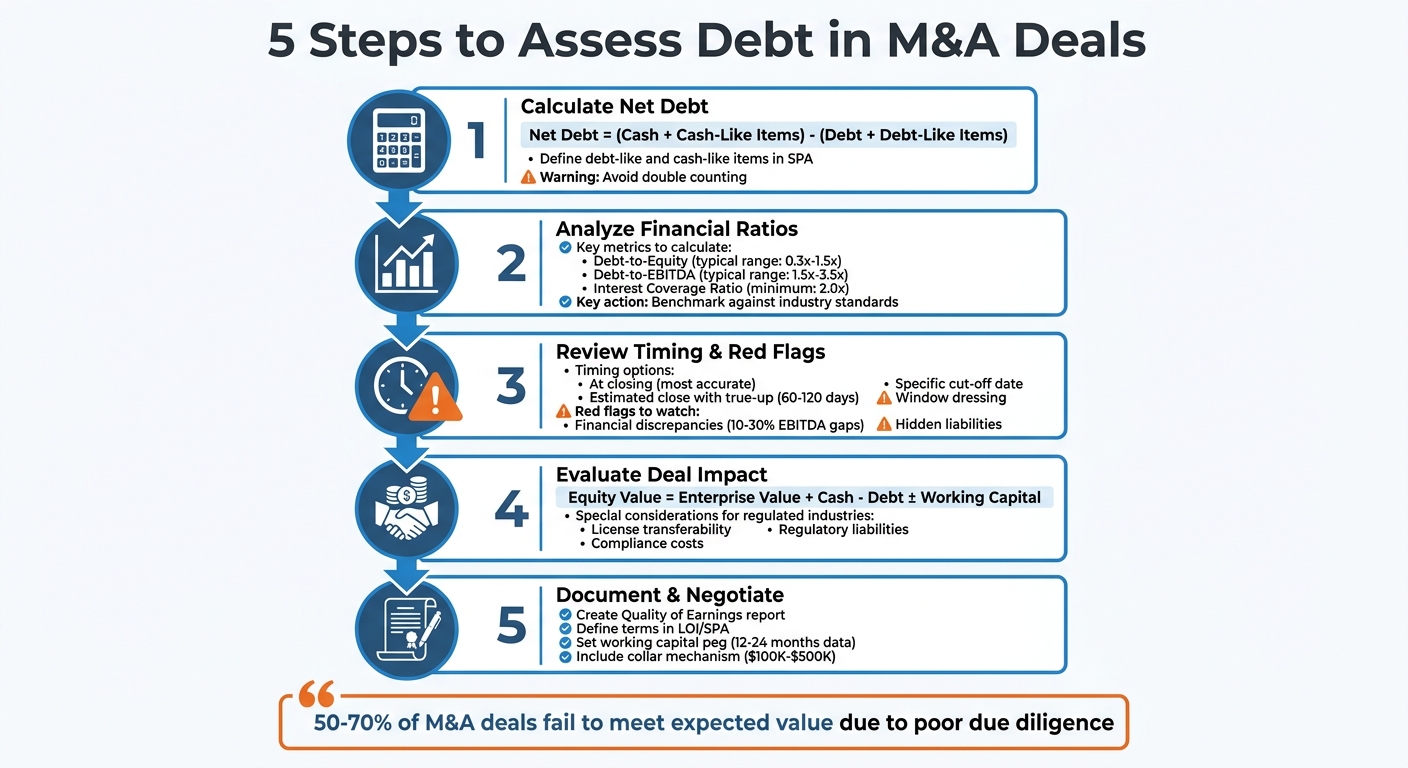 {5-Step Process for Assessing Debt Levels in M&A Transactions}
Net Debt - Guide to M&A (M&A #4)
Step 1: Calculate Net Debt and Identify Debt-Like Items
To get an accurate picture of debt, start with this formula: Net Debt = (Cash + Cash-Like Items) - (Debt + Debt-Like Items) [3]. This formula directly impacts the final purchase price because every dollar classified as a debt-like item reduces the equity value, while every dollar of cash-like items increases it.
The Sale and Purchase Agreement (SPA) is your go-to guide for determining what counts as debt, cash, or working capital [2]. These definitions are critical, as most M&A deals operate on a cash-free, debt-free (CFDF) basis. In this structure, the seller keeps their cash and clears all debt before the deal closes [5].
"A buyer would want to classify as many items as possible as debt-like, to ensure that there is a higher level of working capital delivered at the closing date and a lower overall purchase price." - Michael L. Lipschutz, CPA, CM&AA Director, Transaction Advisory [5]
However, the tricky part is dealing with "grey area" items - things like customer deposits on iGaming platforms or unpaid performance bonuses. These don't always look like traditional debt but can still affect the valuation [2][5].
Define Debt-Like and Cash-Like Items
Cash-like items include assets that are liquid and easily convertible into cash, such as unrestricted cash, marketable securities, short-term investments (3–12 months), and certain recoverable tax claims with clear value and timing [3]. These items boost the purchase price by adding liquid value to the deal.
Debt-like items, on the other hand, go beyond just loans. They encompass liabilities like lease obligations under IFRS 16, unpaid taxes, deferred revenue, legal settlements, unpaid bonuses, and even long-overdue payables [3][5].
| Category | Examples | Impact on Purchase Price |
|---|---|---|
| Cash-Like Items | Unrestricted cash, Treasury bills, marketable securities, supplier overpayments, recoverable tax claims | Increases equity value |
| Debt-Like Items | Bank loans, bonds, lease liabilities, corporation tax, unpaid bonuses, deferred revenue, legal settlements, customer deposits | Decreases equity value |
| Working Capital | Inventory, accounts receivable, accounts payable, accrued wages | Neutral if at target level |
When drafting the Letter of Intent (LOI), it's important to define these classifications clearly. Buyers and sellers often have conflicting goals: buyers aim to classify more items as debt-like to lower the purchase price, while sellers push for these items to be included in working capital to maximize their net proceeds [5].
Create a Debt-Like and Cash-Like Schedule
Once you've defined these items, the next step is to create a detailed schedule. This document should list each item along with supporting evidence, such as financial records or contractual terms [2]. For items that fall into a gray area - like deferred revenue or contingent liabilities - include explanatory notes to justify their classification.
One key rule to follow: avoid double counting. Each item must be assigned exclusively to either the net debt calculation or the net working capital (NWC) calculation - not both [3]. For example, trade receivables belong in working capital, while bad debts, if material and confirmed, might qualify as debt-like items [3].
"Detailed schedules, reconciliations as well as explanatory notes should support net debt calculations. All of such adjustments must be related to financial records and contractual terms." - Priscilla J.P, Finance Practitioner [2]
Set a clear cut-off date - usually the closing date - and reconcile any timing differences. For businesses with seasonal fluctuations, using a trailing 12-month (LTM) average can help smooth out the impact of one-off events or seasonal trends [3][4].
In highly regulated sectors like iGaming and Fintech, pay special attention to items such as customer deposits and compliance-related liabilities. These can have a significant effect on valuation and must be carefully documented to meet regulatory requirements during license transfers [2].
Step 2: Analyze Key Financial Ratios for Debt Capacity
Once you've calculated net debt and pinpointed debt-like items, the next step is to dive into key financial ratios. These ratios help assess the target company's leverage, risk, and ability to handle its financial obligations post-acquisition. The goal here is to determine if the target can generate enough cash flow to comfortably cover its debt payments without disrupting operations.
This analysis is especially crucial in today’s market (2026), where interest rates for quality mid-market credits hover between 9% and 11% [8].
Debt-to-Equity and Debt-to-EBITDA Ratios
The Debt-to-Equity (D/E) ratio provides insight into how a company balances debt and equity in its capital structure. It’s calculated as Total Interest-bearing Debt ÷ Shareholders' Equity [6]. This ratio reflects the company’s ability to absorb losses. For most mature non-financial companies, D/E ratios fall between 0.3x and 1.5x, while anything above 2.0x suggests higher risk and potential default [6]. Companies in tech-heavy industries often operate with even lower ratios [12].
The Debt-to-EBITDA ratio shifts the focus to cash flow. It’s calculated as Total Debt ÷ EBITDA [6][8]. This metric shows how many years of earnings would be needed to pay off the debt. Investment-grade firms generally maintain ratios between 1.5x and 3.5x, whereas private equity deals often range from 4.0x to 6.0x [6].
For a more refined view, consider the Net Debt-to-EBITDA ratio, which adjusts for cash on hand. It’s calculated as (Total Interest-bearing Debt - Cash and Cash Equivalents) ÷ EBITDA [6][7]. For example, B2B software and SaaS companies typically have ratios between 0.0x and 2.5x [7], while regulated utilities with steady cash flows can sustain levels between 3.0x and 5.5x [7].
Currently, deal leverage has dropped to around 4.0x–5.0x EBITDA, down from over 6.0x before 2022 [8]. When analyzing a target, adjust EBITDA for non-recurring expenses, restructuring costs, and synergies to create a "pro forma" view of post-acquisition debt capacity [7].
| Metric | Formula | Typical Range (Investment Grade) | What It Reveals |
|---|---|---|---|
| Debt-to-Equity | Total Interest-bearing Debt / Shareholders' Equity | 0.3x – 1.5x | Mix of debt and equity, loss-absorption capacity |
| Debt-to-EBITDA | Total Debt / EBITDA | 1.5x – 3.5x | Years of earnings required to repay debt |
| Net Debt-to-EBITDA | (Total Debt - Cash) / EBITDA | 1.0x – 3.0x | Leverage adjusted for cash reserves |
These ratios provide a comprehensive view of the target’s ability to manage its debt load and set the stage for stress testing.
Interest Coverage Ratio
Another key aspect to evaluate is the company’s ability to handle its ongoing interest payments. The Interest Coverage Ratio (ICR) measures this by comparing operating earnings to interest expenses. It’s calculated as EBIT ÷ Interest Expense [9]. Many analysts prefer using EBITDA instead of EBIT for a more cash-flow-oriented perspective, especially in capital-intensive industries [10][11].
Lenders typically expect a minimum ICR of 2.0x. Investment-grade companies often exceed 3.0x, while high-yield issuers usually range between 1.5x and 3.0x [10]. An ICR below 1.5x is seen as a strong indicator of default risk [9].
"The interest coverage ratio strips away the complexity of corporate finance to answer a simple but essential question: can this company afford its debt?" - MacroSpire [10]
Tracking trends over time is just as important as the ratio itself. For instance, an improvement from 5x to 8x signals positive momentum, even more than a static 8x does [10]. A real-world example: Disney’s ICR rose from 5.1x in Q4 FY2025 to 8.7x in Q1 FY2026, driven by higher profitability in its streaming and parks divisions. On the other hand, Boeing reported a negative ICR of -1.24x in Q4 2025, highlighting its reliance on cash reserves to meet interest payments [10].
When analyzing companies in regulated industries like iGaming or Fintech, sector-specific benchmarks are critical. For instance, software firms often require an ICR of at least 2.5x–3.0x for stability. Meanwhile, a Debt-to-EBITDA ratio exceeding 4.0x in the software sector often raises red flags due to operational volatility [13][7].
To ensure resilience, simulate scenarios where EBITDA drops by 15–20% and interest rates rise by 200+ basis points. The target should still maintain a Fixed Charge Coverage Ratio of at least 1.0x–1.2x and have 15–25% covenant headroom [8].
Step 3: Review Timing, True-Ups, and Red Flags
Once you've analyzed financial ratios, it’s time to tackle three essential questions: when to measure debt, how to reconcile discrepancies between signing and closing, and what warning signs could jeopardize the deal. Misjudging timing or overlooking red flags can transform a promising acquisition into a financial headache.
Determine Measurement Timing
Net debt should be calculated at closing, ensuring the financial statements align with the deal’s final numbers [2]. A common issue arises when the valuation relies on financials prepared at a different date than the actual closing, creating gaps that require meticulous reconciliations and cut-off procedures [2].
There are three primary timing options to consider:
- At closing: This approach provides the most accuracy but can be challenging to execute in real-time.
- Estimated close with true-up: Common in mid-market deals, this method bases the price on an estimate, then adjusts it post-close based on actual figures. While it minimizes delays, it introduces the risk of disputes after the deal closes [15].
- Specific cut-off date: Using a fixed date (like month-end) before closing offers certainty in calculations but can miss significant "leakage" during the interim period [2].
True-ups typically occur 60 to 120 days after closing to finalize the balance sheet [4]. If the actual debt at closing deviates from the agreed-upon "peg" (target), the purchase price adjusts dollar-for-dollar [4]. Most agreements include a "collar" or "basket" (usually 1–2% of the purchase price) to avoid minor fluctuations triggering adjustments [4].
"The net debt value can be miscalculated and ultimately misrepresent the enterprise value, goodwill and post-acquisition financial metrics." - Priscilla J.P, Finance Practitioner [2]
To prevent surprises, the Sale and Purchase Agreement (SPA) must clearly define what qualifies as debt, surplus cash, and debt-like items (e.g., lease liabilities, deferred revenue, or unpaid bonuses) [2][16]. Using a trailing 12-month average instead of a single high-water month for setting debt or working capital targets can help safeguard against sellers manipulating receivables or payables before closing [1].
With timing resolved, the focus shifts to identifying financial red flags that could impact post-closing valuations.
Identify Potential Red Flags
Spotting warning signs during due diligence is critical. Financial discrepancies often hint at deeper accounting problems [1]. In mid-market deals, the gap between seller-provided EBITDA and Quality of Earnings (QoE)-adjusted EBITDA can range from 10% to 30% [1]. Be wary of aggressive add-backs, such as unsupported owner expenses or inflated salaries, which can artificially boost value.
Beware of window dressing. Sellers might delay supplier payments (stretching payables) or offer steep discounts to accelerate receivables, inflating cash before closing [14]. A sudden improvement in the cash conversion cycle (CCC) in the months leading up to a sale should raise questions [14]. Similarly, a spike in deferred revenue (customer prepayments) could indicate the seller is "harvesting" cash before the deal closes [1][17].
Hidden liabilities are another common pitfall. These frequently include accrued but unpaid bonuses, commissions, paid time off (PTO), unfunded pensions, and deferred compensation [17]. Off-balance-sheet obligations, such as undisclosed leases, related-party transactions at non-market rates, or contingent liabilities like pending lawsuits or regulatory fines, can significantly alter the deal’s economics [1][17].
"Due diligence is the single most expensive failure mode in M&A. Every major post-closing dispute... traces back to something that was missed or underweighted before signing." - Alex Lubyansky, M&A Attorney, Acquisition Stars [1]
For businesses in regulated sectors like iGaming, Cryptocurrency, Forex, and Fintech, pay close attention to change-of-control clauses in key contracts. These can trigger debt acceleration or contract termination, potentially derailing the deal [1]. In Canadian transactions, audit payroll remittances and source deductions carefully, as unpaid "trust amounts" could lead to personal liability for directors [16].
To avoid shifting targets, lock in accounting policies in the SPA by specifying methods (e.g., FIFO vs. LIFO) during the lookback period [4]. The SPA should also outline clear dispute resolution processes, including the option to refer disagreements over the true-up to an independent accounting firm [4]. Research shows that 50% to 70% of M&A deals fail to deliver the expected value, with poor due diligence often to blame [1].
Step 4: Evaluate Debt Impact on Deal Valuation and Structure
Once you’ve flagged potential issues, the next step is understanding how debt influences the actual amount of money exchanged in the deal. This step bridges the gap between the headline Enterprise Value (EV) and the cash that changes hands at closing.
Net Debt Adjustments to Purchase Price
The cash exchanged at closing rarely matches the headline Enterprise Value. Here’s the formula:
Equity Value = Enterprise Value + Cash and Cash-Like Items – Debt and Debt-Like Items ± Working Capital Adjustment [3][17].
For example, if a business is valued at $20 million (EV) and carries $5 million in net debt, the seller ends up with $15 million before factoring in transaction costs and escrows [17].
"The real price of a transaction that is being made in mergers and acquisitions is seldom as reported in the headline." - Priscilla J.P, Medium [2]
It’s important to dig into the details. Debt-like items aren’t limited to bank loans - they can include accrued bonuses, unpaid taxes, deferred revenue (customer prepayments), and lease liabilities, all of which reduce the final price [3][17]. On the flip side, cash-like items such as short-term investments and recoverable tax assets can increase the seller’s take-home amount [3]. These categories must be clearly defined in the Sale and Purchase Agreement (SPA) and the Letter of Intent (LOI) to avoid costly disputes on closing day [17].
"Closing-day surprises around these definitions [Net Debt] are among the most expensive mistakes in M&A." - Ben Gonzalez, Managing Director, Harney Capital [17]
Another critical point: avoid double counting. Each item should be classified as either Net Debt or Working Capital - never both [2][3]. For instance, if deferred revenue is treated as a debt-like item, it shouldn’t also reduce working capital. Misalignment between Net Debt definitions in the Purchase Price Allocation (PPA) and the SPA can lead to audits and legal disputes [2]. To minimize issues, agreements often include a collar (typically 1%–2% of the purchase price) to absorb minor fluctuations without triggering adjustments [4].
Considerations for Regulated Industries
For regulated industries, additional adjustments beyond standard debt items are often necessary. Regulatory liabilities, such as fines or compliance issues, can significantly lower valuations. For instance, issues like regulatory investigations, claims related to responsible gaming, or underreported AML/BSA violations can create post-closing liabilities that directly impact the purchase price.
In industries like iGaming, license transferability becomes a major factor. Ownership changes (often triggered when a buyer acquires 5% or 10% of a company) require approval from regulatory commissions. Stock acquisitions typically allow for license retention but still require ownership change approval. Asset acquisitions, on the other hand, may require entirely new licenses, potentially causing revenue freezes during the pre-operational period [19]. For example, Nevada gaming regulations define "control" as owning more than 10% of voting securities, which triggers full licensure requirements [19]. As of 2026, real-money iGaming is permitted in only seven U.S. states, while sports betting operates in 38 states and the District of Columbia [19].
In Fintech and banking deals, valuation often hinges on a premium to book value rather than Enterprise Value [18][20]. Debt in these transactions might include shareholder loans or unsecured parent-level debt, which are treated as separate deductions from the purchase price [20]. For wealth management M&A, adjustments are often tied to metrics like client retention, Assets Under Management (AUM), or revenue run rate to mitigate buyer risk from post-closing attrition [18][20].
Crypto transactions bring their own challenges. Misclassifying tokens (e.g., utility versus security) can result in enforcement actions that create contingent liabilities. Additionally, multi-jurisdictional compliance costs - such as those tied to MiCA in the EU or VARA in Dubai - must be factored into both valuation and post-closing plans. In iGaming, platforms requiring technical recertification (e.g., GLI-19 or GLI-33 standards) can face delays of 3–6 months, impacting cash flow and deal structure.
Platforms like MyReadyMade can simplify these processes. They provide expert support for navigating regulatory approvals, particularly for license transfers across more than 50 jurisdictions. For businesses in regulated industries, this kind of assistance can be key to managing debt adjustments and ensuring accurate valuations.
Step 5: Document Findings and Negotiate Adjustments
The final step in your debt assessment involves documenting your findings and negotiating terms to protect your interests. This stage builds on the detailed debt classification you tackled in Step 1.
Compile a Due Diligence Report
Start by creating a Quality of Earnings (QoE) report and a Legal Due Diligence Memo. These documents should clearly define debt categories such as short-term versus long-term and secured versus unsecured obligations. Be sure to include all financial covenants - like minimum interest coverage requirements - and any change-of-control provisions that could accelerate debt or require lender approval at closing. Cross-check your findings against multiple sources, such as audited financial statements and tax returns, to catch any inconsistencies or overly optimistic adjustments.
It’s worth noting that research shows 50% to 70% of M&A deals fail to meet their expected value, with insufficient due diligence being a leading factor [1].
"Every finding translates into a deal term: price adjustment, indemnification, escrow holdback, or walk-away right. The attorney's job is to make that translation." - Alex Lubyansky, M&A Attorney, Acquisition Stars [1]
Armed with a thorough report, you can now integrate these insights into your Letter of Intent (LOI) and Sale and Purchase Agreement (SPA).
Negotiate LOI Definitions and True-Up Mechanisms
Use your findings to define key deal terms in the LOI and SPA. Clearly outline what qualifies as debt-like items, such as lease liabilities, unfunded pensions, earnout obligations, deferred compensation, and contingent liabilities. This step is critical to ensure that these definitions align with your Purchase Price Allocation (PPA) and avoid disputes over valuation after the deal closes.
When setting a working capital peg, rely on 12–24 months of historical data instead of a single high-performing month. This approach reduces the risk of last-minute manipulation of receivables or payables. To account for normal fluctuations, include a collar mechanism - typically between $100,000 and $500,000, depending on the size of the deal - that won’t trigger price adjustments unnecessarily. Ensure that true-up mechanisms are tied to well-defined cut-off dates and scrutinize management add-backs to confirm they are genuinely one-time expenses, not recurring costs.
For deals in regulated industries, platforms like MyReadyMade offer specialized M&A advisory services. They can assist with navigating license transfers across over 50 jurisdictions, structuring deal terms to account for compliance expenses and regulatory approval timelines.
Conclusion
A comprehensive debt assessment is a critical step in safeguarding M&A transactions. Successfully navigating this process requires pinpointing debt-like items - such as operating lease obligations, unfunded pension liabilities, and contingent liabilities - that directly influence enterprise value. Additionally, calculating key financial ratios, like the interest coverage ratio and debt-to-EBITDA, is essential. These metrics help benchmark the target's leverage against industry norms and evaluate its ability to meet financial obligations. Falling below industry benchmarks could signal potential risks, including default or insufficient debt capacity.
The consequences of inadequate due diligence are severe. Missing hidden liabilities or underestimating debt risks can lead to costly post-closing disputes and even deal failures.
"Due diligence is the single most expensive failure mode in M&A. Every major post-closing dispute, every deal that closed and then unraveled, traces back to something that was missed or underweighted before signing." - Alex Lubyansky, M&A Attorney [1]
An effective debt assessment hinges on accurately identifying liabilities, conducting thorough ratio analyses, and documenting findings to adjust the purchase price appropriately.
For acquisitions in regulated industries - including iGaming, Cryptocurrency, Forex, and Fintech - the stakes are even higher. Debt levels directly impact capital ratios and regulatory licenses, while hidden liabilities like unreported AML or KYC failures can result in hefty penalties. Platforms like MyReadyMade specialize in guiding businesses through these complexities. They offer support for license transfers across more than 50 jurisdictions and provide advice on structuring transactions to address compliance-related costs. For companies operating in these sectors, adopting these strategies is essential to mitigate unforeseen liabilities effectively.
FAQs
What counts as a debt-like item in net debt?
Debt-like items in net debt are obligations that resemble debt but don’t necessarily fall under traditional interest-bearing liabilities. These can include things like accrued interest, taxes, legal settlements, related party payables, vacation pay, 401(k) contributions, bonuses, self-insurance accruals, credit card liabilities, overdue payables, and deferred revenue or customer deposits. Such items play a crucial role in understanding a company’s financial position, especially during mergers and acquisitions (M&A) evaluations, as they can directly influence overall financial health.
How do true-ups change the price after closing?
True-ups in M&A deals are used to adjust the purchase price after the deal closes, ensuring it reflects the target company's actual financial position. These adjustments typically address differences in areas like net working capital, cash, debt, or other financial metrics that were estimated at the time of signing but finalized at closing. For instance, if the actual net working capital turns out to be higher than the target amount, the purchase price goes up. Conversely, if it’s lower, the price decreases. This process helps ensure the final price aligns with the company's actual condition.
What debt risks are unique in iGaming and Fintech deals?
Debt risks in the iGaming and Fintech sectors stand out because of challenges like frequent regulatory shifts, hefty contingent liabilities, and the complicated web of licensing and compliance requirements. These factors can heavily influence a company's ability to manage its debt and impact its valuation. For this reason, conducting detailed due diligence is absolutely critical.
Related Articles

Ultimate Guide to Earnout Negotiations in M&A
Structure and negotiate earnouts in regulated M&A with clear metrics, anti-manipulation covenants, and acceleration or escrow protections.

How to Draft M&A Definitive Agreements
Guide to drafting M&A definitive agreements covering deal structure, reps & warranties, indemnities, payment terms, and regulatory compliance.

How IP Affects Tokenization Valuation
How tokenizing patents, copyrights, and trademarks adds liquidity and market value—plus legal, regulatory, and valuation steps.
Looking to Buy or Sell?
Get in touch with our team for personalized assistance