How to Ensure IP Compliance in M&A Deals

How to Ensure IP Compliance in M&A Deals
IP compliance is critical in M&A deals to secure ownership, mitigate risks, and ensure smooth asset transfers. Without proper diligence, buyers risk acquiring assets they can't use, enforce, or legally own. Here's a quick breakdown of what to focus on:
- IP Ownership: Confirm legal ownership of patents, trademarks, copyrights, trade secrets, and software. Missing assignments or unclear ownership can derail deals.
- Cross-Border Challenges: Different countries have unique IP rules. For example, moral rights in Canada or limited software patent protections in India may complicate transfers.
- Open-Source Risks: Ensure compliance with open-source licenses to avoid legal exposure, especially with copyleft licenses like GPL or AGPL.
- Regulatory Reviews: Industries like fintech, crypto, and iGaming face stricter scrutiny, including data localization rules and export controls.
- Documentation: Use secure Virtual Data Rooms (VDRs) to organize and protect IP records.
Key takeaway: A thorough IP audit, risk assessment, and regulatory compliance review are essential to protect your investment and avoid costly disputes. Let's dive deeper into the steps to get it right.
::: @figure 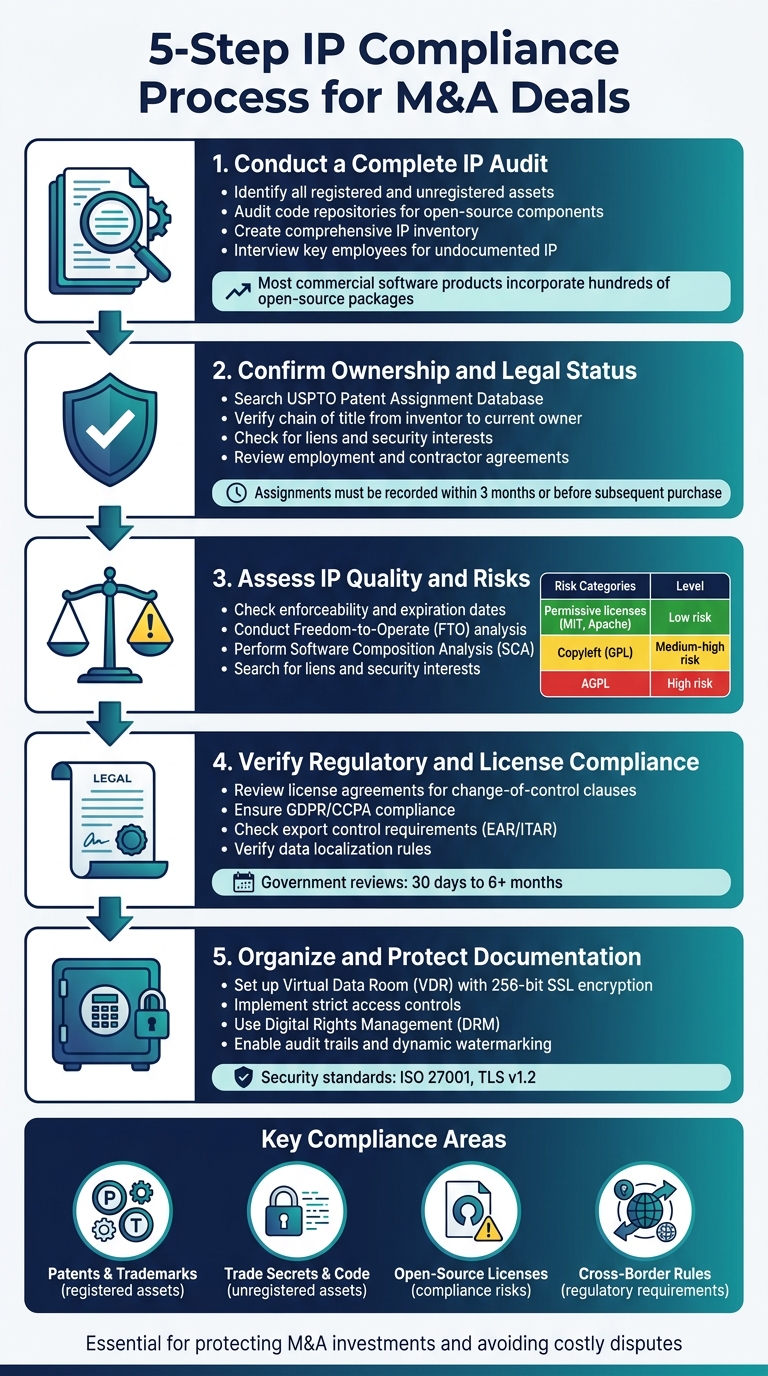 {5-Step IP Compliance Process for M&A Deals}
IP and M&A Transactions
Step 1: Conduct a Complete IP Audit
Start by identifying every asset associated with the deal - both registered and unregistered. This includes registered assets like patents and trademarks, as well as unregistered ones such as trade secrets, proprietary methods, and customer databases [6][7]. Don’t overlook digital assets either - this means domain names, social media accounts, branded hashtags, and app store profiles [3][4].
As CrossBorder IP explains:
The most valuable IP assets frequently exist in informal documentation, employee knowledge, or undocumented processes that could be lost without systematic capture. [6]
For tech companies, this process also involves auditing code repositories to identify proprietary algorithms and ensuring compliance with open-source components [6]. Considering that most commercial software products incorporate hundreds of open-source packages [8], this step is essential. Skipping it could leave buyers with a product they legally can’t use or modify.
Create an IP Inventory
Compile a detailed inventory of all intellectual property. A master spreadsheet works well for this, documenting each asset’s creation date, developer, and purpose. Cross-reference these details with employment and contractor agreements to confirm the presence of "work made for hire" provisions or IP assignment clauses for every asset [6][3].
The inventory should cover:
- Technical assets: Software source code, algorithms, database compilations.
- Creative content: Training materials, marketing collateral, website content.
- Digital identifiers: Social media handles, slogans, app store profiles [3][4].
Once the inventory is complete, double-check to ensure no assets have been left out.
Find Missing or Undocumented IP
To identify any gaps, interview key employees and review prior invention schedules. Look closely at informal materials like training manuals, process guides, and customer databases for overlooked innovations or trade secrets [3][6].
Alex Lubyansky, M&A Attorney and Managing Partner at Acquisition Stars, highlights the risks:
Missing founder IP assignments are a significant diligence finding, particularly for companies whose core technology was developed by the founders before seed funding. [8]
If you discover issues - like a missing contractor signature - secure written assignments before closing the deal to resolve them [8]. Without a clear chain of title, the buyer risks acquiring a business stripped of its core intellectual property.
Step 2: Confirm Ownership and Legal Status
Once you've compiled a full inventory of intellectual property (IP), the next step is to confirm the company’s legal ownership of these assets. This involves tracing the ownership chain from the original creator to the current owner to ensure there are no gaps or third-party claims. This verification process is crucial before diving into detailed ownership records and legal agreements.
As PatentPC explains:
Just because IP is being used by the target company doesn't mean it legally belongs to them. That's a crucial difference. [3]
In the U.S., patent rights initially belong to the named inventors [9]. This makes the first transfer - from the inventor to the employer - an essential step. Missing or unrecorded assignments can create significant legal vulnerabilities.
Review the Ownership History
Start by searching the USPTO Patent Assignment Database for the Abstract of Title for each IP asset. This document lists all recorded transfers, conveyances, and security interests in chronological order [9]. Look for any missing links in the chain of title, ensuring a clear path from the original inventor to the current owner.
Mary Lou Wakimura of Hamilton Brook Smith Reynolds emphasizes:
The sequence (date order) of the recorded component parts in the Abstract of Title informs the searcher of the so-called title and any intervening third-party rights in the patent asset. [9]
Timing is critical. Under 35 U.S.C. § 261, an assignment must be recorded with the USPTO within three months of the transfer or before a subsequent purchase, or it may be void against a later buyer [9]. If you discover mismatches - such as discrepancies between the registered owner and the acquiring entity - address these issues through corrective assignments before finalizing the deal.
Additionally, check for liens or security interests. If the IP was used as loan collateral, the lender might retain a claim that could persist after the transaction [9]. Cross-check public records with internal company documents to confirm the correct legal entity holds the title and that there are no encumbrances.
Once the ownership trail is verified, shift your focus to employment and contractor agreements to ensure the proper transfer of rights.
Check Employment and Contractor Agreements
Review all employment and contractor agreements to confirm that present-tense IP assignment clauses (e.g., "hereby assigns") are in place [10] [4]. These clauses ensure that the transfer of rights happens immediately upon creation.
Make sure written agreements explicitly transfer ownership rights. In many jurisdictions, contractors and freelancers do not automatically transfer IP rights to the hiring entity [10] [1]. For instance, in Canada, the concept of "work-for-hire" doesn’t apply, and creators retain moral rights unless they are specifically waived [4].
PatentPC highlights the importance of this step:
Ownership is the foundation. If that's shaky, everything else - enforcement, licensing, investment - starts to wobble too. [10]
If you find missing signatures - especially from founders who developed key technology before the company was incorporated - resolve these outstanding assignments before closing the transaction [12] [10].
To streamline this process, use the following categories to ensure all IP rights are properly assigned:
| Document Category | Key Items to Review | Purpose |
|---|---|---|
| Internal Personnel | Employment Agreements, Founder Assignments, Exit Forms | Verify worker-created IP ownership |
| External Personnel | Contractor Agreements, Freelance Contracts, Agency Agreements | Confirm IP transfers from non-employees |
| Public Records | USPTO Abstract of Title, Trademark Registries, UCC Filings | Confirm recorded ownership; check for liens |
| Third-Party Rights | Joint Venture Agreements, Inbound Licenses | Identify restrictions or shared ownership |
Step 3: Assess IP Quality and Risks
After confirming ownership in Step 2, the next step is to evaluate each intellectual property (IP) asset's enforceability and potential liabilities. Even if ownership appears clear, issues like expired rights, encumbrances, or third-party obligations could complicate the deal. Here’s how to thoroughly verify the legal strength and risks tied to the IP.
Check Enforceability and Expiration Dates
Start by confirming that patents, trademarks, and copyrights are active and properly maintained. For instance, U.S. patents require maintenance fees at 3.5, 7.5, and 11.5 years [8]. Conduct a Freedom-to-Operate (FTO) analysis to check if the target’s products or technologies might infringe on third-party patents or trademarks [7] [3]. Additionally, review the target company’s litigation history, including lawsuits or cease-and-desist letters, which could indicate high-risk IP that may lead to future disputes.
It’s also crucial to remember that IP rights are territorial. A U.S. patent or trademark won’t protect the asset in other countries unless it has been filed and maintained in those specific jurisdictions [8]. For cross-border deals, confirm that protections are in place across all relevant markets.
Review Open-Source and Third-Party Risks
Beyond registration concerns, software components and third-party obligations demand close examination. Conduct a Software Composition Analysis (SCA) to identify open-source components and their licenses [8] [13]. License types determine the level of risk: permissive licenses, like MIT or Apache, generally pose minimal risk, requiring only attribution and license notice inclusion. However, strong copyleft licenses, such as GPL, can require the release of proprietary source code if the software is distributed. Even stricter, AGPL licenses demand source code disclosure for software accessed over a network [8] [13].
M&A attorney Alex Lubyansky offers a strong warning:
A buyer who closes without a clean chain of title to the target's core IP owns the shell of a business, not the business itself. [8]
If problematic copyleft code is identified, options include replacing it with permissively licensed alternatives, isolating the component, or obtaining a retroactive commercial license. If these risks can’t be resolved before closing, consider implementing safeguards like specific indemnities, escrow accounts, or purchase price holdbacks (typically lasting 12–24 months) to shift financial risk to the seller [11].
Search for Liens and Security Interests
IP assets are often used as collateral for loans or debts, which can complicate acquisitions. If the target company has pledged patents or trademarks as security, those interests may persist after the deal and limit your control over the IP [9].
To uncover these issues, search the USPTO Assignment Recordation Branch online database for any recorded security interests, mortgages, or encumbrances. Under 35 U.S.C. § 261, third-party claims against a patent may be void unless recorded with the USPTO within three months of the conveyance or before your purchase [9].
As Mary Lou Wakimura and Giovanna Fessenden-Fairbank of Hamilton Brook Smith Reynolds explain:
An interest in a patent asset may be statutorily void against a subsequent purchaser or mortgagee unless that interest is recorded at the USPTO within three months from the conveyance/assignment/grant of rights, or prior to the date of such subsequent purchase or mortgage. [9]
Ensure all recorded security interests have been formally released to confirm clear title. Unresolved liens can delay the deal, create uncertainty, and lower the transaction’s valuation [11]. If clearing liens before closing isn’t possible, use tools like escrow accounts or purchase price holdbacks to protect against potential post-closing disputes.
Step 4: Verify Regulatory and License Compliance
After evaluating IP quality and potential risks, the next step is to dive into the regulatory requirements and licensing obligations tied to those assets. This becomes especially important for cross-border transactions in regulated industries like iGaming, Crypto, Forex, and Fintech. In these cases, IP transfers often trigger government reviews that can take anywhere from 30 days to more than six months [2].
Examine License Agreements
Carefully review all inbound and outbound license agreements for change-of-control or anti-assignment clauses. These provisions are common in IP licenses and can automatically terminate the buyer's rights once the deal is finalized [3][14]. Losing access to essential APIs, data feeds, or third-party software could disrupt business operations.
It’s also crucial to analyze exclusivity terms, geographic limits, and royalty obligations. If the target company licenses its IP to third parties, figure out whether these agreements will remain active, terminate, or need renegotiation post-acquisition. For SaaS businesses, take a close look at customer contracts for clauses that grant clients ownership of customizations or configurations. Such clauses could block the seller from transferring a clear title to the buyer [8].
In tech-driven industries like Crypto and Fintech, ensure compliance with open-source software licenses through a Software Composition Analysis (SCA). Pay particular attention to strong copyleft licenses, which may require disclosure of proprietary code [5][14].
Once the license terms are clear, shift your focus to the regulatory mandates that may impact IP transfers within specific industries.
Meet Industry-Specific Regulations
Different industries come with their own compliance requirements that can directly affect IP assets. For example, ensure sensitive data aligns with GDPR (Europe) and CCPA/CPRA (California) standards [13]. This involves reviewing Data Processing Agreements (DPAs), privacy policies, and records that show how the company handles data subject rights requests. Under GDPR, any data breach must be reported to the applicable supervisory authority within 72 hours of discovery [13].
For cross-border deals, confirm whether data localization rules apply in the relevant jurisdictions [2]. Transferring IP tied to encryption (common in Crypto) or cybersecurity could also trigger export control reviews under U.S. Export Administration Regulations (EAR) or International Traffic in Arms Regulations (ITAR) [2][13]. In industries like defense, telecommunications, healthcare, AI, semiconductors, and critical infrastructure, IP transfers often face additional government scrutiny [2].
In sectors where algorithms represent key assets - such as Fintech trading platforms - ensure trade secrets are adequately protected. This involves verifying the use of NDAs and access controls. In jurisdictions like India, which lack specific trade secret laws, compliance must rely on confidentiality clauses and use restrictions in contracts [4]. As Sarah Ann Gatti, Senior Corporate Counsel at Drift.com, Inc., aptly puts it:
Data, particularly personal data, is the new asset class requiring scrutinous review [4].
Step 5: Organize and Protect Documentation
After completing your IP audit and compliance checks, the next critical step is securely organizing your documentation. This step acts as a safeguard against disputes that might arise post-deal. A well-structured Virtual Data Room (VDR) becomes your key tool for protecting valuable IP assets throughout the transaction process [15].
Set Up a Virtual Data Room
Choose a VDR platform equipped with top-tier security features like 256-bit SSL encryption, ISO 27001 compliance, and TLS v1.2 to keep your data safe [15]. Your VDR should serve as a centralized repository for all essential IP-related documents, such as:
- Patents, trademarks, and copyrights
- Confidentiality and invention assignment agreements
- Technology licenses
- Open-source software disclosures
- Domain name registrations
- Source code and R&D reports
- Proprietary algorithms [14][3]
To maintain control over sensitive information, enforce strict access controls. For instance, limit access to highly sensitive files like source code or R&D reports to a select group of stakeholders or legal advisors [15]. For proprietary algorithms, consider using view-only mode and disallow downloads to prevent unauthorized sharing. Dynamic watermarking can further deter theft and help trace leaks, should they occur [15].
A VDR’s audit trail is another invaluable feature. It logs every interaction, including who accessed each document, for how long, and whether they downloaded or commented on it [15]. These logs can provide critical evidence to resolve disputes about what information was shared during the deal. As CapLinked explains:
The right VDR transforms a risky process into a secure and controlled environment for thorough and transparent due diligence, without compromising IP security [15].
Once your VDR is secure, you can implement additional measures to further protect confidential information.
Safeguard Confidential Information
To add an extra layer of protection, use Digital Rights Management (DRM) tools. These tools allow you to set time limits on access and revoke permissions even after a document has been downloaded. This ensures that individuals no longer involved with the transaction cannot retain access to sensitive information [15].
Before uploading documents, redact sensitive data and scan all code for open-source components to avoid potential licensing issues [15][4][14]. This step is especially important for trade secret formulas, personally identifiable information (PII) in customer databases, or proprietary pricing models. For international deals, ensure your VDR accommodates jurisdiction-specific requirements, such as moral rights waivers in Canada or software copyright records in India [4].
Finally, include explicit disclaimers in the VDR and the acquisition agreement. These disclaimers should clarify that the seller is only making the representations explicitly stated in the agreement. This helps protect against future fraud claims and ensures the scope of warranties is clearly defined [14].
Conclusion and Key Takeaways
M&A IP compliance requires careful planning and thorough execution. From conducting a detailed IP audit to securely managing documentation in a Virtual Data Room, every step plays a role in preserving your acquisition's value and minimizing the risk of disputes after closing. As PatentPC aptly puts it:
IP is not just paperwork. It's power. And diligence is how you make sure you're actually buying it.
Cross-border deals, in particular, bring unique challenges. For example, unassignable moral rights in Canada and limited software patent protections in India can complicate IP transfers. The diligence phases outlined in Steps 1–5 are designed to address these complexities and ensure a smooth IP transfer during international M&A.
IP Compliance Checklist
To help secure your IP investment, here’s a practical checklist:
- Catalog all IP assets: Include registered and unregistered patents, trademarks, copyrights, trade secrets, and proprietary code.
- Verify ownership: Review employment and contractor agreements to confirm proper IP assignment.
- Conduct Freedom-to-Operate reviews: Identify infringement risks and address open-source license issues.
- Review license agreements: Check for clauses like change-of-control or non-transferability that could impact rights post-acquisition.
- File assignments with registries: Submit documentation to national authorities (e.g., USPTO) to ensure enforceability.
- Categorize risks: Use a framework (e.g., Green for no issues, Yellow for manageable risks, Red for critical concerns) to prioritize actions.
Using Specialized Platforms for M&A
In regulated industries like iGaming, Cryptocurrency, Forex, and Fintech, compliance can be particularly complex. Platforms like MyReadyMade (https://myreadymade.com) simplify these challenges by offering expert advisory services and facilitating license transfers across over 50 jurisdictions. Their verified listings and confidential transaction framework make them a valuable resource for navigating the intersection of IP compliance and licensing requirements.
Additionally, specialized software tools can process large amounts of code to detect open-source license conflicts before they escalate into major issues. These tools help transform what could be a chaotic and risky process into a structured, transparent transaction that protects both parties involved.
FAQs
What IP issues can stop an M&A deal from closing?
When it comes to mergers and acquisitions, intellectual property (IP) issues can throw a wrench into the process. Here are some of the most common challenges that can delay - or even derail - a deal:
- Unclear IP ownership: If ownership of intellectual property isn’t properly documented or verified, it can lead to significant legal uncertainties.
- Third-party disputes: Active infringement claims or disputes with third parties can create serious risks for the buyer.
- Weak IP protection: Missing, expired, or improperly managed IP registrations can reduce the perceived value of these assets.
- Cross-border transfer complications: Transferring IP rights across different jurisdictions often involves regulatory hurdles that can slow things down.
To tackle these challenges, conducting thorough due diligence is absolutely essential. It helps identify and address potential risks before they become deal-breakers.
How do I prove the target actually owns its core IP?
When verifying that a target company owns its core intellectual property (IP), conducting detailed due diligence is key. Start by reviewing registration records for patents, trademarks, and copyrights to confirm ownership. It's also important to examine licensing agreements, employment contracts, and assignment documents to ensure all rights have been transferred correctly.
Don't overlook trade secrets and proprietary processes - ensure these assets are properly documented and accounted for. This comprehensive review not only establishes clear ownership but also minimizes potential IP-related risks during the transaction process.
How can open-source licenses create hidden M&A liabilities?
Open-source licenses can introduce unexpected risks in M&A deals, primarily through ongoing legal obligations. For example, copyleft licenses like GPL and AGPL might require companies to disclose their source code or even apply open licensing to proprietary software if it incorporates copyleft components.
On top of that, skipping critical steps - like failing to review a Software Bill of Materials (SBOM) - can leave potential license obligations, security vulnerabilities, or legal exposures unnoticed. This makes thorough compliance checks a crucial part of any acquisition process.
Related Articles

Ultimate Guide to Earnout Negotiations in M&A
Structure and negotiate earnouts in regulated M&A with clear metrics, anti-manipulation covenants, and acceleration or escrow protections.

How to Draft M&A Definitive Agreements
Guide to drafting M&A definitive agreements covering deal structure, reps & warranties, indemnities, payment terms, and regulatory compliance.

How IP Affects Tokenization Valuation
How tokenizing patents, copyrights, and trademarks adds liquidity and market value—plus legal, regulatory, and valuation steps.
Looking to Buy or Sell?
Get in touch with our team for personalized assistance