Top Covenants for Regulated Business M&A

Top Covenants for Regulated Business M&A
When buying or selling businesses in regulated sectors like Forex, Fintech, iGaming, or Crypto, covenants play a critical role in protecting deal value and ensuring compliance. These contractual promises safeguard both buyers and sellers during the risky period between signing and closing, especially in industries with complex regulatory requirements. Here's what you need to know:
- Regulatory Approvals: Deals often hinge on securing licenses and meeting regulatory conditions before closing. Missing these can halt transactions.
- AML/KYC Compliance: Ensures buyers don’t inherit liabilities from financial crimes or non-compliance.
- Operational Stability: Prevents sellers from making changes that could harm the business before the deal closes.
- Post-Closing Obligations: Includes tax filings, license transfers, and regulatory cooperation to avoid future issues.
Without strong covenants, deals risk regulatory delays, financial penalties, or loss of value. Properly structured agreements can mitigate these risks while keeping transactions on track.
::: @figure 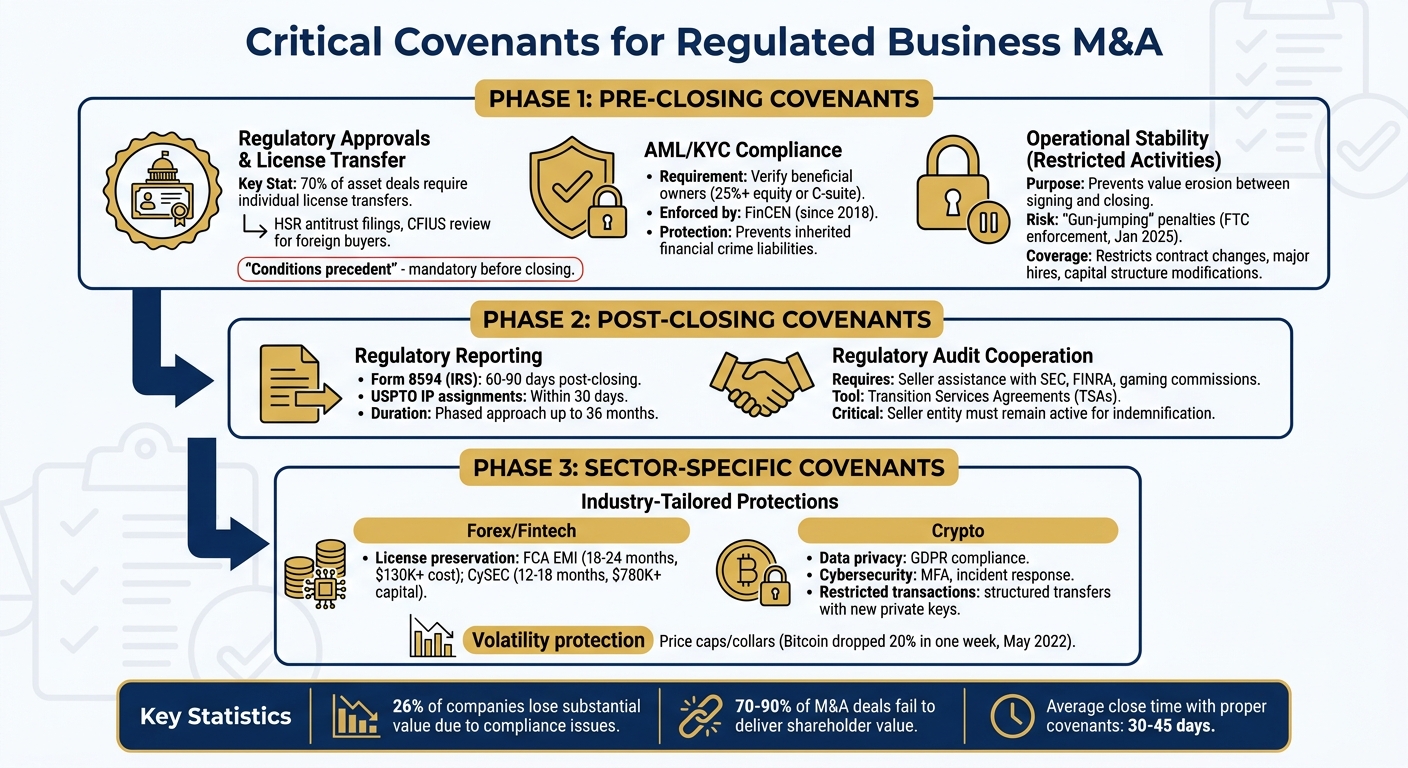 {Critical Covenants in Regulated Business M&A Transactions}
Critical Covenants for Regulated Business Transactions
Regulatory Approval and License Transfer Covenant
In regulated industries, every M&A agreement must establish that regulatory approvals are "conditions precedent" - essentially, these approvals are mandatory before the deal can close [4]. Without them, the transaction cannot proceed legally. In the United States, this often involves Hart-Scott-Rodino (HSR) antitrust filings. For deals involving foreign buyers acquiring U.S. assets, a review by the Committee on Foreign Investment in the United States (CFIUS) is also required [4][6].
For around 70% of small to mid-sized asset deals, licenses need to be individually listed and transferred [6]. On the other hand, stock purchases are generally less complex because the entity remains intact, keeping its licenses. However, these transactions may still trigger change-of-control provisions, which require regulatory notification or approval to proceed [6][7]. Attorneys often stress the importance of planning ahead:
"Obtaining regulatory approvals can be a particularly lengthy process." – Carpenter Wellington PLLC [4]
To address this, parties usually agree to use "commercially reasonable efforts" to secure necessary approvals. However, this phrase must be clearly defined to avoid disputes over whether enough effort was made [4]. Early contract diligence is critical - identify anti-assignment or change-of-control clauses in licenses before the Letter of Intent (LOI) is signed [4][7].
AML and KYC Compliance Covenant
Beyond license transfers, financial compliance measures like AML (Anti-Money Laundering) and KYC (Know Your Customer) are essential in industries such as Forex, Crypto, and Fintech.
These covenants protect buyers from inheriting regulatory fines or liabilities tied to financial crimes [8]. Sellers are required to conduct thorough customer due diligence (CDD) and verify beneficial ownership, particularly for individuals owning 25% or more of the equity or holding key roles such as CEO or CFO [8].
Since 2018, the Financial Crimes Enforcement Network (FinCEN) has enforced updated KYC rules for federally regulated financial institutions, making compliance a legal obligation [8]. Non-compliance can lead to penalties, fines, or even termination of the deal. U.S. Bank highlights the broader value of this process:
"The KYC check process – instead of being an obstacle – can actually help create stronger connections and drive success for you and your clients." – U.S. Bank [8]
Buyers should promptly verify critical information - such as legal names, dates of birth, and Social Security numbers - of beneficial owners to avoid sanctions and identify politically exposed persons (PEPs) [8]. Partnering with an experienced escrow agent can also ensure all required KYC data is collected in line with FinCEN regulations [8].
Restricted Activities Pending Regulatory Approvals
To maintain operational stability during the interim period between signing and closing, operational stability covenants are often included. These covenants prevent sellers from making significant changes that could affect the business's value, ensuring the buyer receives the business as negotiated [9].
Without these restrictions, sellers could alter contracts, delay necessary expenditures, or make disruptive decisions, such as hiring key personnel [9]. Many agreements now include "no survival" clauses, meaning pre-closing covenants and representations expire once the deal closes. This can limit legal options if breaches are discovered post-closing [9]. Sara Duran and Danielle Sismour of Sidley warn that breaches of operational stability can significantly harm deal value [9].
In January 2025, the Federal Trade Commission (FTC) penalized crude oil producers for unlawful pre-merger coordination, highlighting the risks of "gun-jumping" - exerting control before regulatory approval is granted [1]. To avoid such issues, agreements should clearly outline "reserved matters" requiring buyer consent, such as new financings or capital structure changes, while still allowing sellers to handle routine operations like product updates or engineering hires [3].
Post-Closing Covenants in Regulated M&A
Post-Closing Regulatory Reporting Covenant
Once the deal closes, regulated M&A transactions enter a new phase filled with regulatory and operational responsibilities. For example, both parties are required to file Form 8594 with the IRS to report the purchase price allocation under Section 1060. This filing typically happens within 60 to 90 days of closing, and discrepancies between filings can lead to audit risks. Beyond tax obligations, buyers must also register intellectual property assignments with the USPTO within 30 days to secure public ownership and maintain enforceability. Other critical tasks include filing UCC-1 statements, transferring titles, and updating business registrations.
In certain regulated industries, some contract consents or regulatory approvals may still be pending even after the deal closes. This can require the seller to continue fulfilling obligations under existing contracts to ensure the buyer receives the economic benefits until all approvals are finalized. Alex Lubyansky, Esq., Managing Partner at Acquisition Stars, captures this dynamic well:
"The moment signatures are exchanged, a new set of obligations begins: financial adjustments, regulatory filings, integration tasks, contractual notifications, and legal exposure that can extend for years." [10]
To manage these obligations effectively, a phased approach is often used, typically spanning no more than 36 months. Buyers are advised to maintain a "consent chase" tracker to monitor outstanding regulatory approvals that are essential for long-term operational stability. [10]
In addition to these reporting requirements, maintaining ongoing regulatory cooperation is equally crucial.
Cooperation in Regulatory Audits Covenant
Post-closing collaboration between buyers and sellers becomes especially important when regulatory audits or inquiries arise. Sellers often have established relationships with regulatory bodies, making their participation key to resolving pending consents or compliance issues. For this reason, cooperation clauses should obligate sellers to assist with regulatory filings and audits for a specific period following the deal's closure [10] [11]. This is particularly critical in highly regulated sectors like Forex, Crypto, and Fintech, where transferring licenses can take months and involve extensive reviews by agencies such as the SEC, FINRA, or state gaming commissions [5]. Sellers should also avoid dissolving their entities prematurely, as active entities may be needed to address indemnification claims [10].
Transition Services Agreements (TSAs) are often employed to ensure the seller provides post-closing support in areas like legal compliance, accounting, payroll, and HR administration. These agreements should include "exit assistance" provisions, requiring sellers to assist with the buyer's eventual transition away from shared services. Without clearly defined cooperation, buyers risk creating gaps in the legal chain of title, which could complicate future financing, insurance, or operational activities. [10]
How I Would Structure a Business Purchase Agreement as an M&A Lawyer
Sector-Specific Covenant Considerations
When navigating mergers and acquisitions (M&A), specific industries require tailored covenants to address their unique regulatory and operational challenges. These covenants are crucial for safeguarding critical assets and ensuring compliance during the transition.
License Preservation in Forex and Fintech
In Forex and Fintech transactions, protecting regulatory licenses is a top priority. For example, obtaining an FCA EMI license can take 18–24 months and cost over $130,000, while securing a CySEC license requires 12–18 months and at least $780,000 in capital [12]. These extensive timelines and costs explain why strategic buyers often prefer acquiring already-licensed entities rather than applying for new ones.
To ensure banking continuity, covenants should restrict sellers from actions that might jeopardize banking relationships, such as triggering termination clauses or causing financial institutions to de-risk during the transition. Maintaining experienced teams and operational processes is also critical for smooth regulatory reviews by authorities like the FCA and CySEC [12]. As highlighted by GlobePRwire, FinancialContent:
"A change of ownership that disrupts banking relationships can fundamentally impair the operational value of the acquired entity. Sophisticated buyers structure acquisitions specifically to preserve banking continuity through and beyond completion" [12].
Additionally, technical platforms lose much of their value without their original operating personnel, making it vital to include covenants that prevent such disruptions.
Data Privacy and Cybersecurity in Crypto
Crypto transactions face intense scrutiny around data privacy and cybersecurity. Violations in these areas can lead to significant liabilities and delay deals [13]. Beyond standard cybersecurity checks, privacy diligence must include a thorough legal review of data processing practices. For instance, EU authorities have imposed hundreds of millions of euros in fines for GDPR violations related to improper consent mechanisms [13].
Covenants should address these risks by requiring verification of data role classifications, adherence to 2021 Standard Contractual Clauses, and completion of Transfer Impact Assessments to handle cross-border compliance issues [13]. M&A attorney Alex Lubyansky emphasizes:
"A buyer that closes an acquisition without conducting structured privacy diligence inherits every pre-closing violation of the target" [13].
Post-closing, compliance covenants should mandate updates to privacy notices and technical measures like tenancy-level segregation in cloud environments and region-specific data storage. Recent updates to the FTC's Safeguards Rule also require measures such as multi-factor authentication and incident response planning, underscoring the need for precise technical and legal safeguards [13][14].
Restricted Crypto Transactions Covenant
In many jurisdictions, acquiring a registered crypto firm without prior regulatory approval is a criminal offense. Restricted transaction covenants are essential to prevent the target company from engaging in high-risk activities that could harm the buyer's compliance standing or trigger AML/KYC investigations.
To address crypto volatility, covenants can include price protection mechanisms like caps or collars. Structured cryptocurrency transfers are also critical, as they generate new private keys and ensure clear chain-of-title documentation. For example, in May 2022, Bitcoin's value dropped 20% in a single week, while Ethereum fell 26%. Between late 2020 and mid-2022, Bitcoin's value fluctuated dramatically - from $20,000 to over $67,000 before plummeting back below $20,000 [15]. Starting in 2026, U.S. digital asset brokers will report crypto sales to the IRS using Form 1099-DA for transactions from 2025 onward [16]. Effective covenants can help avoid inheriting tax liabilities by requiring precise cost-basis and wallet-level tracking.
Osborne Clarke advises:
"A transfer should always be of the cryptocurrency holding to the new holder, which will generate a new and unique private key in the recipient's wallet" [15].
Covenants should explicitly prohibit simple "wallet transfers" (i.e., passing private keys) and instead require structured transfers that preserve clear ownership records. These measures demonstrate the level of detail required in regulated M&A to balance operational stability with sector-specific compliance.
Conclusion
Covenants play a key role in protecting M&A value by ensuring operational stability and regulatory compliance before a deal closes. Without them, issues like unauthorized contract changes, skipped capital investments, or compliance lapses can erode value quickly[9].
For industries like Forex, Fintech, and Crypto, covenants are especially crucial. They help keep licenses active and transferable while ensuring adherence to AML, KYC, and data privacy laws. As Sara Duran and Danielle Sismour from Sidley Austin LLP explain:
"A breach of the conduct of the business covenant addressing the target company's operations in the period between signing and closing of the transaction could result in significant value destruction"[9].
This is particularly concerning when you consider that 26% of companies lose substantial value due to compliance issues uncovered during due diligence. Moreover, between 70% and 90% of M&A deals fail to deliver shareholder value[17][2].
The trend toward "no survival" deals - where representations and warranties end at closing - further underscores the importance of well-crafted covenants. Buyers should aim for interim operating covenants to remain in effect for at least 60 to 120 days post-closing, aligning with the purchase price adjustment period[9]. Additionally, linking covenant breaches to "no change" representations can trigger representations and warranties insurance, adding a valuable safety net.
Expert Support for Regulated M&A Transactions
Given these complexities, expert guidance is often indispensable. Platforms like MyReadyMade provide tailored solutions to address these covenant challenges, particularly in heavily regulated industries like iGaming, Cryptocurrency, Forex, and Fintech. MyReadyMade offers a suite of services, including expert M&A advisory, verified business listings, and license transfer support across more than 50 jurisdictions.
Their focus on regulated sectors ensures smooth transitions by managing intricate licensing requirements and maintaining regulatory continuity. With an average close time of 30–45 days and round-the-clock deal support, MyReadyMade helps buyers and sellers implement effective covenants, safeguard value, and navigate the regulatory maze with confidence.
FAQs
What does “commercially reasonable efforts” mean for getting regulatory approvals?
"Commercially reasonable efforts" describes actions that align with the buyer's standard practices for obtaining regulatory approvals. This might involve activities such as conducting research, performing development work, and securing required approvals. However, it does not demand taking extraordinary steps beyond what the buyer would typically undertake.
How can buyers avoid inheriting AML/KYC or sanctions liabilities in a deal?
Buyers can reduce the chance of taking on AML/KYC or sanctions-related liabilities by conducting detailed due diligence to verify that the target company complies with all relevant regulations. Additionally, they should incorporate contractual protections, such as representations, warranties, and indemnities that explicitly cover AML/KYC and sanctions compliance.
What pre-closing controls prevent gun-jumping while protecting deal value?
Pre-closing controls often involve interim operating covenants, which allow buyers to have approval rights over significant decisions made by the seller. This ensures oversight without shifting operational control too early. Following antitrust laws, such as the HSR Act and Sherman Act, is essential to prevent gaining ownership benefits or diminishing competition before the deal is finalized. Using expert advice and compliance tools can help maintain regulatory compliance while protecting the value of the transaction.
Related Articles

Ultimate Guide to Earnout Negotiations in M&A
Structure and negotiate earnouts in regulated M&A with clear metrics, anti-manipulation covenants, and acceleration or escrow protections.

How to Draft M&A Definitive Agreements
Guide to drafting M&A definitive agreements covering deal structure, reps & warranties, indemnities, payment terms, and regulatory compliance.

How IP Affects Tokenization Valuation
How tokenizing patents, copyrights, and trademarks adds liquidity and market value—plus legal, regulatory, and valuation steps.
Looking to Buy or Sell?
Get in touch with our team for personalized assistance