10 Red Flags to Watch When Buying a Fintech Business

10 Red Flags When Buying a Fintech Business
Buying a fintech company can be risky if you overlook critical warning signs. From compliance issues to financial mismanagement, ignoring these red flags could lead to costly consequences. Here's a quick rundown of the top 10 risks to watch for:
- Missing Regulatory Licenses: Ensure the company has all required licenses; missing even one can lead to shutdowns or fines.
- Unaudited Financial Records: Inconsistent or unaudited books can hide fraud or misrepresentation.
- Questionable Revenue Practices: Premature or exaggerated revenue claims are a red flag.
- Legacy Technology: Old systems and technical debt can lead to high maintenance costs and delays.
- Weak Cybersecurity: Poor data protection can result in breaches, fines, and loss of customer trust.
- Customer Concentration: Relying on a few clients for most revenue increases risk.
- Inflated User Metrics: Misleading user numbers and high churn rates signal deeper issues.
- Lack of Competitive Edge: Companies without clear differentiation struggle to stay relevant.
- Governance Problems: Legal issues or weak leadership can derail acquisitions.
- Disorganized Documentation: Missing or messy records indicate hidden risks.
Key takeaway: Conduct thorough due diligence to assess compliance, financial health, technology, customer metrics, and governance before making a deal. Missing these red flags can lead to financial losses, legal trouble, and operational headaches.
Invest Smart, Build Right: Business and Technical Due Diligence for Fintechs and Investors
1. Missing or Incomplete Regulatory Licenses
When assessing a fintech acquisition, ensuring the company holds the right regulatory licenses is a critical step. Any fintech handling clients' money or offering financial services must have the proper licenses to operate legally. In the U.S., the regulatory framework is a maze of federal and state requirements that depend on the services provided and the states where the company operates.
A fintech company might need multiple licenses to comply with regulations across various regions. For instance, a company dealing with virtual currency in New York must obtain a BitLicense from the Department of Financial Services. If it also transmits fiat currency, a Money Transmitter License is required. Missing even one of these licenses can lead to significant compliance issues, including operational shutdowns or hefty fines.
By December 8, 2025, FinCEN reported 29,394 registered Money Services Businesses (MSBs), an increase of 98 registrations in just six days. Additionally, the number of fintech companies operating in the U.S. grew to 10,412 in 2024, a sharp rise from 2,881 in 2012.
It's a mistake to assume that a federal registration covers all regulatory obligations. For example, registering as an MSB with FinCEN does not eliminate the need for state-specific licenses. To verify licenses, use official resources: the FinCEN MSB Registrant Search for federal registrations, the New York Department of Financial Services "Who We Supervise" page for state-level licenses, and the California DFPI database for operations on the West Coast. Always cross-check these findings with the company's internal records to avoid relying on outdated public registries. These steps are vital to understanding the risks tied to improper licensing arrangements, such as those involving Banking-as-a-Service (BaaS) partnerships.
One common pitfall is over-reliance on BaaS partners. While working with a licensed bank can reduce the need for direct licensing, some fintechs misuse loosely regulated BaaS agreements instead of securing their own licenses. This approach can lead to indirect regulatory liabilities. Make sure the target company holds all necessary licenses and isn't solely depending on partnership agreements to meet compliance requirements.
2. Unaudited or Inconsistent Financial Records
In fintech transactions, inconsistent or unaudited financial records can be a ticking time bomb. Financial transparency isn’t just a nice-to-have - it’s essential. Without it, the risks of fraud, misrepresentation, or overpaying for a company skyrocket. Sellers may inflate a company’s value by manipulating earnings through subjective estimates like revenue recognition, inventory reserves, or warranty calculations. If these records haven’t been independently verified, buyers are left relying solely on the seller’s data - a risky gamble.
Accounting inconsistencies, such as mixing cash and accrual methods or failing to reconcile bank accounts, can disrupt the continuity of financial statements and erode confidence in the numbers. A company that can’t produce a cohesive set of financial documents - income statement, balance sheet, and cash flow statement - may be signaling deeper financial mismanagement issues.
The consequences of overlooking these red flags are all too real. Consider this: in June 2025, Builder.ai collapsed into insolvency after it was revealed the company had significantly overstated its revenues, leaving investors blindsided. In another case, Charlie Javice was convicted in 2021 for defrauding JP Morgan by exaggerating her startup Frank’s user base, leading to a $175 million acquisition. Internal auditors later found missing customer authentication documentation. Similarly, Stenn, a UK fintech once valued at $1 billion and backed by major players like Goldman Sachs, Barclays, and HSBC, fell apart when lenders discovered that supposed customer payments were actually coming from fake entities.
These examples drive home the importance of professional audits.
"While startups may not have audited financials in their early stages, companies at scale should have professionally audited statements. The absence of audits could indicate either poor internal controls or attempts to obscure financial realities."
— FinLead
Thorough financial scrutiny during due diligence is non-negotiable. Pay close attention to fluctuations in account balances, changes in accounting policies, and related-party transactions that could hide the company’s true financial health. For instance, if operating cash flow remains consistently negative while net income appears positive, it could signal inflated sales figures. It’s worth noting that nearly half of all deals fall apart during due diligence because investors uncover hidden liabilities or misrepresentations by founders.
Rigorous audits and financial checks aren’t just due diligence - they’re your safety net.
3. Questionable Revenue Recognition Methods
Revenue recognition is often a hotbed for questionable practices. When fintech companies jump the gun by booking revenue prematurely, misclassify deferred income, or lean on AI-driven estimates without proper documentation, they create an illusion of strong financial performance while concealing deeper problems lurking beneath the surface. This becomes even trickier in modern revenue models that rely heavily on automated data, making it easier for these practices to go unnoticed.
Many fintech firms use AI-powered systems to calculate revenue based on metrics like API calls, transaction volumes, or active user counts. When these models lack traceability or rely on unexplained logic, it raises red flags. Similarly, if revenue flows through multiple APIs into the general ledger without clear documentation or records of modifications, auditors may struggle to verify its accuracy.
"Revenue leakage is more dangerous than traditional revenue loss because it's hidden. It happens inside your existing revenue streams, not outside them. And unless you're actively monitoring your billing, contracts, and revenue recognition, you won't see the leaks, until they've already cost you millions."
— Harshita Kala, Zenskar
The financial impact of these issues is staggering. In 2025, MGI Research highlighted that revenue leakage could drain 1–5% of a business's EBITDA annually - equivalent to losses ranging from $500,000 to $5 million for many companies. Take Yembo, for example: by automating its billing processes, the company eliminated revenue leakage, sped up revenue collection by 50%, and cut down its finance team's workload by 90%.
When conducting due diligence, it's crucial to ensure that revenue recognition practices comply with ASC 606/IFRS 15 standards. Look out for unusual cash flow fluctuations or significant gaps between reported metrics and audited financials. Confirm that revenue claims are supported by actual customer payments and that usage data is timestamped and reconciled. Patterns of repeated audit adjustments or poor version control in financial models should be treated as warning signs of broader systemic issues. Left unchecked, these practices can amplify financial misstatements already evident in inconsistent records.
4. Legacy Technology and Technical Debt
Technological issues can pose serious challenges during a fintech acquisition, going well beyond financial and compliance concerns.
Old technology stacks and accumulated technical debt can significantly reduce a fintech company's worth. When core systems rely on outdated, patched-together code, the infrastructure becomes fragile. These legacy systems often experience frequent crashes, sluggish performance, and operational hiccups, all of which can harm user satisfaction and revenue streams. What might have started as small compromises during a period of rapid growth can eventually solidify into a rigid, outdated framework that’s incredibly difficult to update without triggering further complications.
The financial impact of these issues can be substantial. Technology problems are responsible for roughly 40% of value loss in tech acquisitions, and addressing technical debt can cost anywhere from 25% to 75% of the original development expenses. On top of that, delays in rolling out new features add further strain. Buyers often encounter unexpected costs and complex hurdles when trying to integrate or separate IT systems after an acquisition.
"While all software contains some technical debt, excessive and unmanaged debt can substantially erode acquisition value by imposing ongoing maintenance costs and limiting future development."
— bluematter.io
Consider an example: an e-commerce platform was acquired for its cutting-edge recommendation engine. However, post-acquisition due diligence revealed a codebase riddled with shortcuts and poor practices. What should have been a three-month timeline for new feature development regularly stretched to seven or nine months due to the system’s fragility. After two years of delays, the company had no choice but to rewrite the platform from scratch - a 14-month project that cost three times the original estimate and led to the loss of several key customers.
During the due diligence phase, buyers should analyze critical metrics like sprint velocity and the ratio of bug fixes to new feature development. Tools such as SonarQube and CodeClimate, combined with expert code reviews, can help quantify technical debt. It’s also wise to interview technical leads and review incident post-mortem reports to identify past scaling issues. If remediation is expected to take anywhere from 6 to 24 months, these timelines and costs must be factored into the acquisition price. Warning signs like outdated frameworks, poorly documented code, and systems that can’t handle growth are clear indicators of future challenges.
5. Weak Cybersecurity and Data Protection
A fintech acquisition with weak cybersecurity measures can quickly spiral into financial losses and tarnished reputations. If the target company has inadequate data protection practices, it opens the door to data breaches, hefty regulatory fines, and a potential loss of customer trust. These risks aren’t just theoretical; they can erode value faster than almost any operational misstep, especially given the strict penalties tied to regulations like GDPR.
For instance, GDPR violations can lead to fines as high as 4% of global revenue or €20 million (roughly $21 million), whichever is greater. Beyond the financial hit, data breaches that expose tens of thousands of customer records can severely damage trust. When customers lose faith, they often turn to competitors, compounding the fallout.
"Non-compliance can lead to reputational damage, customer loss, and regulatory penalties."
— Drata
During due diligence, it’s critical to identify red flags like outdated encryption protocols (for both data at rest and in transit), a lack of multi-factor authentication (MFA), insufficient access controls, and unpatched software vulnerabilities. Financial institutions expect fintech partners to have strong, continuously monitored IT security frameworks. Regulators, too, hold these partnerships accountable, meaning a single security lapse could harm both trust and profitability.
Look for certifications such as ISO 27001, SOC 2, or PCI DSS compliance. These demonstrate a commitment to cybersecurity best practices. Also, review the company’s incident response plans, data backup strategies, and the results of recent penetration tests. If there’s no documentation of cybersecurity testing or a lack of clear plans for handling breaches, you could be inheriting significant liabilities. Fixing these gaps post-acquisition can be both urgent and costly.
6. Over-Reliance on Few Customers
Relying heavily on just a handful of customers for the bulk of your revenue is a risky game for any fintech business. If a single client accounts for more than 10% of revenue, or if the top five clients together contribute over 25%, it signals a dangerous concentration of risk. This level of dependence weakens negotiation power and threatens overall stability.
When it comes to mergers and acquisitions (M&A), this issue becomes even more critical. If one customer generates over 20% of a company's revenue, potential buyers will scrutinize the deal closely. If that number climbs to over 30%, many buyers might walk away entirely. And if a single client represents more than 40% of revenue, securing a deal at a fair valuation becomes nearly impossible. In fact, high customer concentration can reduce a transaction's valuation by as much as 20–35%.
Large clients also tend to demand better terms, which can hurt profit margins. For instance, Marqeta saw its take rate drop from about 0.7% in 2019 to 0.5% in 2020, partially due to pressure from its larger clients. Beyond margin compression, this kind of dependency makes the entire revenue model more vulnerable. Regulators like the OCC, FRB, and FDIC have also started paying closer attention to customer concentration in bank-fintech partnerships, flagging it as a factor that increases liquidity risk.
To address these risks, due diligence is essential. Start by requesting a detailed list of the company’s top customers and reviewing their contracts. Pay attention to renewal rates, churn trends, contract assignability, and termination clauses. If over 30% of sales come from the top three customers, the business is on shaky ground. Also, check whether customer contracts can be transferred to you as the new owner. If third-party consent is required, you could face renegotiation under less favorable terms.
A well-balanced fintech spreads its customer base across different industries and client sizes. If the company you're evaluating lacks this kind of diversification, you're taking on a significant risk - one that could become a reality if a key relationship falters. A diverse customer portfolio isn’t just a safeguard; it’s a cornerstone for maintaining valuation and ensuring smoother post-acquisition integration.
7. Misleading User Numbers and High Customer Loss
When evaluating fintech companies, it's not just about regulatory compliance or financial stability - verifying user metrics is equally critical. Inflated user numbers can hide serious problems beneath the surface. For instance, if a fintech boasts rapid growth without presenting solid data or a clear customer acquisition plan, those numbers might be exaggerated. Be especially cautious of "hockey stick" growth projections that defy logic, such as a user base growing beyond the country's population. Another red flag? A significant gap between daily or weekly active users (DAU/WAU) and monthly active users (MAU), which often signals widespread account inactivity. Just like inconsistent financial records, misleading user metrics can point to deeper operational flaws.
The situation worsens with high customer churn. When users leave faster than new ones join, revenue takes a hit, making the business model unsustainable. William Morales, Founder of FinTechtris, highlights this issue:
"Dormant users, accounts without balances, and unused cards are only a cost center for platforms."
High churn not only weakens profitability but also makes scaling nearly impossible. If this is combined with an over-reliance on a small group of customers, it can severely impact valuation and even lead to insolvency.
To avoid these pitfalls, due diligence should include a thorough examination of customer metrics. Insist on proof of customer authentication and verify that reported revenue stems from actual transactions. Dive deep into identity verification processes, KYC (Know Your Customer) and AML (Anti-Money Laundering) protocols, fraud detection systems, renewal rates, churn trends, and customer contracts. These steps help ensure the user base is genuine and growth is sustainable. If the fintech can't provide clear audit trails or if financial records reveal unexplained inconsistencies, it's best to walk away. A company built on inflated metrics isn't just overvalued - it’s a ticking time bomb.
8. No Clear Competitive Advantage
Having a clear competitive edge is essential for any fintech aiming for long-term success. Without it, businesses risk wasting resources and losing focus. If a company can't pinpoint what sets it apart - beyond claiming to be "the Stripe/Venmo/etc. of [blank]" - it's a red flag. William Morales, Founder of FinTechtris, emphasizes this point:
"To be the 'Stripe/Venmo/etc. of [blank]' is no longer enough. Founders must dig deep (now more than ever) and focus on why their platform is needed and what's being offered (to address the user's core need)."
Weak financial metrics often highlight this lack of differentiation. For instance, a customer acquisition cost (CAC) to lifetime value (LTV) ratio below 2:1, a daily active user (DAU) to monthly active user (MAU) ratio under 20%, or nearly half of the customer base being inactive all suggest poor product-market fit and unsustainable value.
Today's market conditions demand profitability. Rising costs during periods of revenue growth signal inefficiency. In 2022, profitable public fintech companies managed to reduce costs by a median of 3%, whereas non-profitable ones saw costs jump by 27%. Similarly, an increase in Total Payment Volume (TPV) paired with declining take rates points to pricing challenges and shrinking margins. These trends underscore the need for thorough due diligence to confirm whether the business is truly disrupting the market.
Effective due diligence should assess whether the company is making a meaningful impact - whether it's lowering costs, improving transparency, or delivering something genuinely new. Is it addressing underserved groups like the underbanked or gig workers? Can it demonstrate strong compliance and cybersecurity measures? These are top priorities for 72.2% and 62% of financial institutions, respectively, when evaluating partnerships. Without clear answers to these questions, the business risks blending into an overcrowded market, leaving it vulnerable to competitors with more resources or superior execution.
9. Corporate Governance Problems and Legal Issues
Governance weaknesses and unresolved legal matters can completely derail an acquisition. Almost half of all deals fall apart during due diligence because buyers uncover liabilities that founders either missed or downplayed. Regulatory agencies like the OCC, FDIC, or CFPB pay close attention to transactions - especially those involving entities with over $50 billion in assets - focusing on financial stability, risk management, and governance issues. When governance lapses are added to concerns raised during regulatory, financial, or technological reviews, the risks multiply.
These early warning signs highlight why strong governance practices are crucial throughout the acquisition process. Failures in governance can result in severe financial losses and damage to a company's reputation, with consequences that ripple far beyond the deal itself.
"A due diligence red flag - whether sloppy documentation, unresolved legal issues, or security noncompliance - doesn't just signal risk, it raises doubts about leadership discipline."
— Sprinto
Even seemingly minor governance issues can create major problems. Pending lawsuits, expired licenses, or unresolved investigations may suggest a lack of leadership accountability and could lead to significant long-term liabilities. These issues don’t just pose immediate risks; they can grow into costly future challenges, including fines, remediation expenses, and reputational harm that can outweigh any potential benefits. Tackling these problems early can save a lot of trouble down the road.
Before pursuing an acquisition, conduct a pre-diligence audit of your financials, legal records, and compliance controls. Address minor lawsuits, renew outdated licenses, and resolve outstanding regulatory issues. At the same time, centralize your documentation - financial records, contracts, HR files, and compliance reports. Transparency is key when issues arise. Investors are less concerned about past mistakes and more interested in whether leadership is willing to acknowledge and fix them.
10. Incomplete or Disorganized Documentation
Disorganized or missing records often point to bigger problems lurking beneath the surface. For example, financial discrepancies are found in over 40% of small business acquisitions, and these often hint at deeper issues like tax compliance troubles. When sellers can't provide basic documents - such as customer contracts, supplier agreements, or lease terms - it immediately raises concerns about what else might be hidden.
But it’s not just financials that matter. Gaps in technical documentation, like outdated architectural diagrams, missing API contracts, or incomplete database schemas, reflect poor engineering practices. Intellectual property (IP) is another critical area. If patents, trademarks, or copyrights aren’t properly registered - or worse, if they're assigned to individual founders instead of the company - this creates significant legal risks [82,83,84]. Similarly, expired licenses, missing compliance certifications, or the absence of documented security assessments can expose regulatory vulnerabilities, potentially leading to fines or enforcement actions [29,83].
"Investors assume that if critical documents are inconsistent or incomplete, risk is being concealed elsewhere."
— Payal Wadhwa
Seller behavior can also be a red flag. Resistance to providing key documents, delaying due diligence requests, or offering vague answers often signals an attempt to hide something. This behavior might point to a reactive leadership culture - one that avoids tough decisions until absolutely necessary. Even small inconsistencies can undermine confidence in the entire deal.
To protect yourself, insist on audited financial statements - unaudited data simply won’t cut it. It’s also wise to commission a Quality of Earnings report from a CPA experienced in transactions to confirm that reported profits align with actual cash flow [59,68]. Have an attorney carefully review contracts, licenses, and leases for renewal dates and assignability. If the seller resists providing clear and organized documentation, it might be a sign to walk away [59,65].
Comparison Table: Healthy vs. Problem Indicators
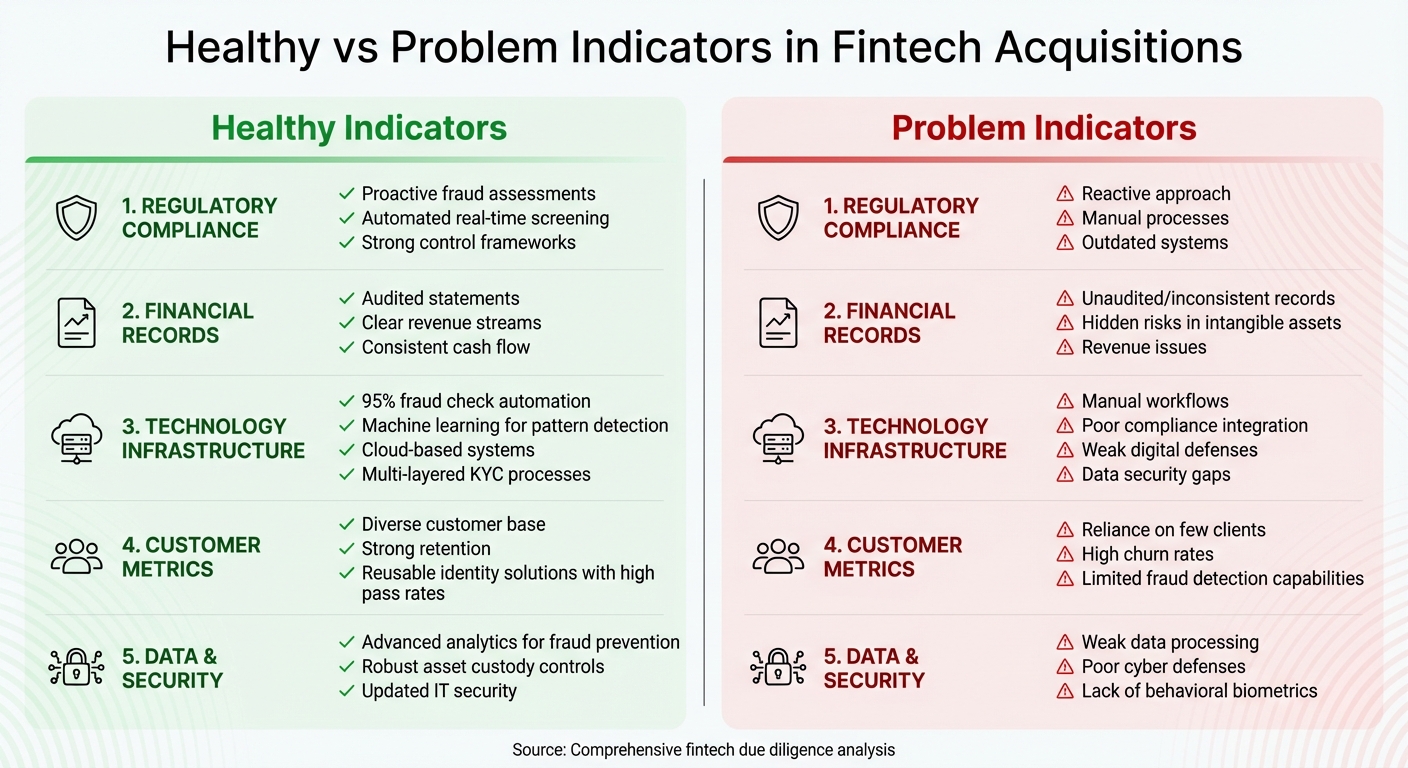
When assessing a fintech business, understanding acquisition risks often comes down to measurable signs. The following table highlights the difference between well-run companies and those showing potential red flags.
Take Regulatory Compliance, for example. Successful fintech firms stay ahead of the curve by using modern fraud risk assessments, implementing strong control systems, and automating real-time monitoring for sanctions and cryptocurrency transactions. On the other hand, companies with compliance issues tend to operate reactively, relying on outdated processes and manual methods, often only addressing issues when regulators step in.
Technology Infrastructure paints a similar picture. Leading fintechs automate up to 95% of fraud checks, reduce fraudulent registrations by 90%, and speed up manual reviews by the same margin. They also use advanced data analytics and machine learning to analyze transaction histories and detect subtle warning signs. In contrast, companies stuck with outdated systems and technical debt struggle to keep up, often failing to integrate modern compliance tools.
| Category | Healthy Indicators | Problem Indicators |
|---|---|---|
| Regulatory Compliance | Proactive fraud assessments; automated real-time screening; strong control frameworks | Reactive approach; manual processes; outdated systems |
| Financial Records | Audited statements; clear revenue streams; consistent cash flow | Unaudited or inconsistent records; hidden risks in intangible assets; revenue issues |
| Technology Infrastructure | High automation (95% fraud checks); machine learning for pattern detection; cloud-based systems; multi-layered KYC processes | Manual workflows; poor compliance integration; weak digital defenses; data security gaps |
| Customer Metrics | Diverse customer base; strong retention; reusable identity solutions with high pass rates and low drop-offs | Reliance on a few clients; high churn rates; limited fraud detection capabilities |
| Data & Security | Advanced analytics for fraud prevention; robust asset custody controls; updated IT security | Weak data processing; poor cyber defenses; lack of behavioral biometrics and device intelligence |
These points underscore the importance of due diligence in evaluating a company's future potential, stability, and hidden risks. For tech businesses, especially those with intangible assets or subscription-based models, spotting these warning signs is critical for making informed investment decisions.
Conclusion
The 10 red flags discussed earlier are essential checkpoints for any fintech acquisition. Overlooking these warning signs can lead to serious financial and legal trouble. As Troy Snyder and Brad Birkholz from Plante Moran caution, "Banks must do their due diligence before striking these deals and monitor the relationships closely afterwards". Missing issues like compliance gaps, outdated technology, or weak cybersecurity could result in hefty fines, enforcement actions, or even business closure.
However, thorough evaluation offers more than just risk avoidance - it delivers long-term advantages. By addressing potential problems early, you can avoid unexpected costs, penalties, and operational hiccups. It also ensures smoother system integration and helps protect your reputation by resolving data protection and customer service issues before they escalate.
FTI Consulting emphasizes, "firms must address regulation and conduct risks head-on if they want to protect value, gain approval and integrate successfully". This underscores the importance of structuring deals to reflect identified risks, ensuring pricing and warranties are aligned with reality. Such a disciplined approach paves the way for a smoother acquisition process.
For those navigating the complexities of fintech acquisitions, MyReadyMade can be a game-changer. With verified business listings, transparent documentation, and expert M&A advisory services, the platform simplifies due diligence. Features like 24/7 deal support, fintech license transfer expertise in over 50 jurisdictions, NDA-protected communications, and fast 30-45 day close times give buyers the tools they need to tackle regulatory hurdles with confidence.
FAQs
What happens if you buy a fintech company without the necessary regulatory licenses?
Acquiring a fintech business without having the necessary regulatory licenses in place can spell trouble. You could face steep fines, legal actions, and operational limitations that disrupt your daily business flow. Beyond the immediate financial and legal risks, your company's reputation could take a hit, potentially drawing more scrutiny from regulators and making future growth or expansion far more challenging.
Lacking the proper licenses can also erode trust with both customers and investors. This loss of confidence can jeopardize the business's stability and hinder long-term success. To steer clear of these risks, it’s crucial to confirm that all required licenses are secured before moving forward with any acquisition.
How can I confirm that a fintech company's user metrics and financial records are accurate?
To ensure a fintech company's user metrics and financial records are accurate, it's crucial to perform thorough due diligence. Begin by examining audited financial statements and digging into key user engagement metrics. Compare revenue claims with actual customer payment records to spot any inconsistencies. It's also wise to get independent verification from third-party auditors or regulatory bodies to confirm the accuracy of the data. This careful approach can help reveal any hidden issues and maintain transparency throughout the acquisition process.
How can you evaluate a fintech company's cybersecurity during an acquisition?
To evaluate a fintech company's cybersecurity readiness during an acquisition, start with a thorough review of its cybersecurity policies and practices. Make sure the company adheres to key data privacy regulations like GDPR or CCPA, and confirm that it has solid incident response plans in place. It's also important to check whether the company conducts regular cybersecurity audits and penetration tests to uncover potential vulnerabilities.
Take a closer look at the company's fraud prevention measures, identity verification systems, and encryption methods to ensure sensitive data is well-protected. Additionally, verify the presence of reliable data backup systems to reduce the risk of data loss. These steps can give you a clear picture of how effectively the company manages and secures its digital assets.
Stay Informed on Fintech Acquisitions
Learn about critical warning signs to assess before investing.
Read the Full GuideRelated Articles

Forex Brokerage Setup Checklist Generator
Create a custom forex brokerage setup checklist with our free tool. Tailor steps to your jurisdiction and business model in minutes!

Crypto Business Valuation Estimator
Estimate your crypto business value with our free tool! Input revenue, profit margin, and growth rate for a quick valuation range. Try it now!

Fintech Regulation Compliance Checker
Check fintech compliance requirements by region and business type with our free tool. Ensure your startup meets key regulations easily!
Looking to Buy or Sell?
Get in touch with our team for personalized assistance